📌 This brief is part of the PetSpecial Pet Bulletin Board. Browse all briefs →
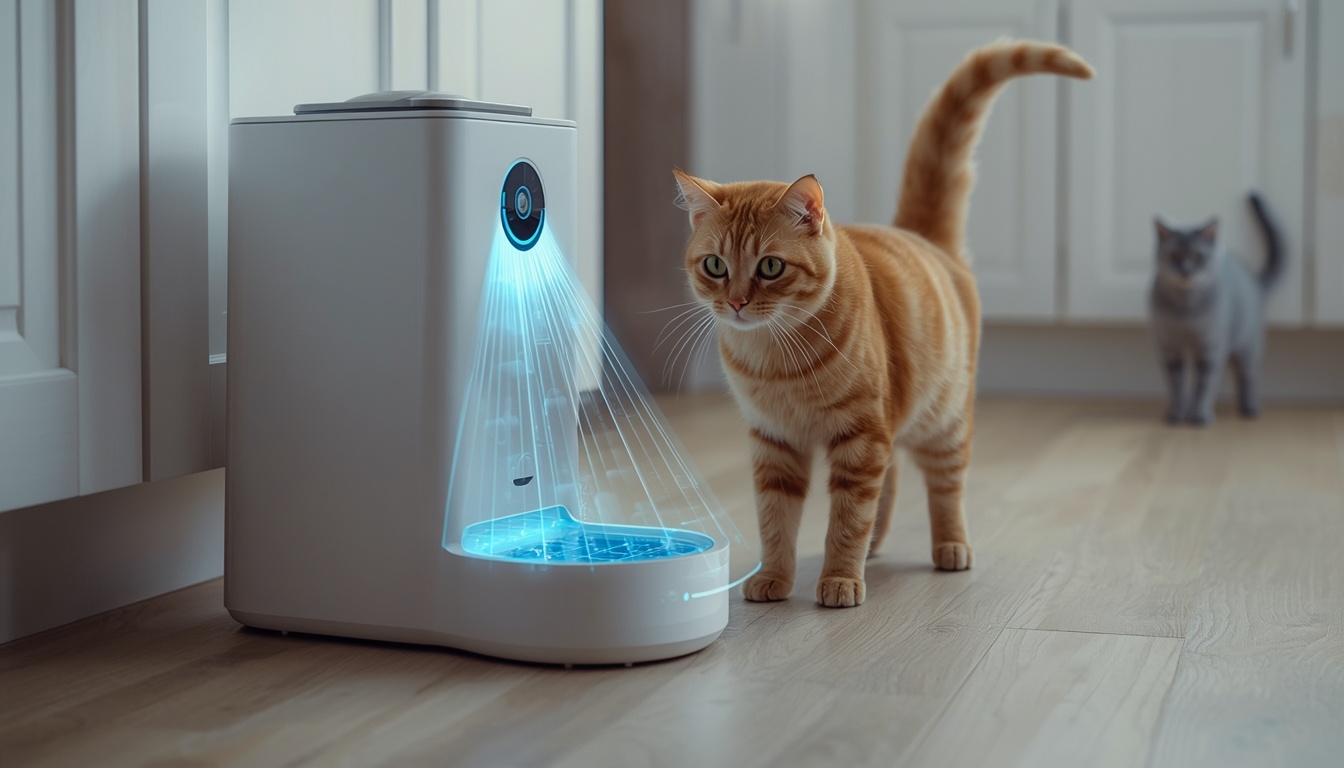
This article explores a November 2024 AI breakthrough from the Universidad de Colima that uses computer vision to end multi-pet mealtime bullying. By tracking the behavioral friction between an assertive food-stealer (Simba) and a timid hiding cat (Billu), the text exposes how basic timed feeders fail vulnerable pets. To solve this clinical crisis, researchers are replacing failure-prone collar tags with an automatic feeder with cat recognition, a smart “Finite State Machine” framework that uses edge-computing video grids to accurately identify individual pets and secure their specific diets in under 60 seconds.
The Home Narrative: The Reality of Feline Food Stealing
In our household, mealtime is a constant tactical battleground that highlights the major flaws in basic pet tech. Before I break down the paper I based my article on and discuss further on automatic feeder with cat recognition, let me tell you about my cats. Simba, our adventurous and highly confident male cat, views every food dish in the apartment as his personal property that he can rightfully devour at any time. The moment an automated feeder dispenser drops kibble, he sprints to the kitchen, gobbling his portion at high speed.
Meanwhile, Billu, our small, timid female Turkish breed, is easily startled by external noises and avoids confrontation at all costs. If Simba so much as walks toward her dish, Billu immediately yields her territory and flees, vanishing beneath the sofa or bed.
When we rely on basic, clock-driven automatic feeders, the outcome is highly predictable: Simba overeats, while Billu skips critical daily calories. Standard smart devices are completely blind to this domestic power dynamic; they understand when to drop food, but have absolutely no situational awareness regarding who is actually eating it.

💡 Struggling with food-stealing or mealtime conflict between your cats? Explore our guide to the 5 Best Automatic Cat Feeders for Two Cats to compare feeding controls, separate food access, and features designed for multi-cat households.
Compare Cat Feeders →Why Multi-Cat Homes Need Automatic Feeder with Cat Recognition Capability
This mealtime stress is not just a personal headache; it is a documented veterinary crisis. Domestic cats naturally evolved to hunt and consume 8 to 16 tiny, isolated meals per day (Delgado & Dantas, 2020). When indoor multi-cat environments force unrelated animals to dine in close physical proximity, it violently violates their ancestral survival instincts.
The research establishes that open, shared food bowls actively reinforce territorial anxiety (Delgado & Dantas, 2020). Less confident cats like Billu engage in defensive eating habits or stop eating entirely, which can lead to severe stress-related illnesses. Over time, dominant cats learn that resource hoarding is rewarded, creating a cycle of food theft that traditional pet appliances are fundamentally unequipped to break.
The IoT Engineering Fix: Deep Learning & Sensor Fusion

To solve this exact structural flaw, a recent engineering study presents a smart appliance built entirely around embedded sensor fusion and real-time deep learning neural networks (Castillo-Arceo et al., 2024). Instead of trusting simple mechanical timers, the researchers built an intelligent device driven by an Arduino Mega 2560 microcontroller that integrates four independent data streams to govern food access.
Arduino Mega 2560
Central Embedded Processor Core
HEJO Camera
Live Video Stream
HC-SR04 Ultrasonic
Proximity Detection
Tecneu HX711
Load Cell Scale
The system coordinates these specific hardware components to manage food access:
The Visual Gatekeeper
An HEJO camera matrix streams live video to a YOLOv5 object detection model trained on the Stanford Dogs Dataset (Khosla et al., 2011). The system is designed to keep the mechanical actuator locked until a verified biological profile is identified.
The Proximity Shield
A Tecneu HC-SR04 ultrasonic sensor measures distance in real time. By checking how close a pet is to the bowl, the system aims to reduce accidental food-release triggers caused by shadows or passing human movement.
The Load Cell Scale
A Tecneu HX711 amplifier circuit monitors a load cell beneath the dish to measure food portions by weight rather than volume. With appropriate calibration, this approach can support gram-level portion control and help reduce overfeeding.
Advanced System Logic: The “Sleep-Detect-Identify” Loop

While early hardware prototypes focused heavily on broad species classification via a single neural network thread (Castillo-Arceo et al., 2024), parallel system frameworks have successfully pushed this computational logic into targeted multi-pet tracking environments using an automatic feeder with cat recognition system governed by a strict Finite State Machine (Zhang & Wang, 2025).
To conserve power and processing bandwidth, the feeder remains in a deep “sleep mode.” The moment the ultrasonic sensor detects an approaching mass within a set threshold, the finite state machine transitions to an active state, powering on the camera module and starting a tight 60-second processing countdown.
Sleep Mode
Sonic OnlyDetect Stage
Camera OnFeed Mechanic
Servo EngagesIf the deep learning algorithm fails to find an exact visual match before the 60-second window closes, the camera shuts down completely and the feeder drops back into sleep mode, successfully locking out unapproved scavengers. Furthermore, recent development data demonstrates that integrating a secondary Passive Infrared (PIR) sensor alongside the camera module adds a layer of remote situational awareness, enabling real-time video streaming directly to an owner’s smartphone over Wi-Fi (Ahmed & Rahman, 2026).
What Remains Uncertain: The “Tailgating” Vulnerability
Imagine a scenario where an engineering framework successfully verifies a timid pet, unlocking the hopper lid. Even if the computer vision module functions perfectly, a major physical vulnerability remains unaddressed in lab settings: the tailgating problem.
While an automatic feeder with cat recognition can successfully identify a timid cat like Billu and open the dish, it cannot physically prevent a larger, dominant cat like Simba from pushing his way into the bowl from behind while the lid is open. If the physical design of the bowl lacks solid, non-removable privacy sidewalls or a protective canopy enclosure shield, an aggressive pet can still easily hijack the meal, regardless of how smart the underlying detection code is.
⚠️ Dealing with serious food-stealing or mealtime aggression? Vision-based feeders may not be enough for every multi-cat household. Explore our guide to microchip vs. two-bowl feeder separation to compare approaches to controlling food access and creating a safer mealtime setup.
Compare Feeding Separation Options →What This Means for Pet Owners
The rapid convergence of machine vision, edge computing, and real-time sensor fusion means we are moving away from traditional pet ownership appliances and toward true personalized biometric ecosystem devices.
For households managing conflicting pet personalities, this tech means you will no longer have to separate your animals into different closed rooms during feeding times. Future smart feeders will dynamically recognize individual facial features, manage distinct therapeutic diets, and actively protect vulnerable pets from food theft to make mealtimes peaceful, predictable, and healthy.
🙋♂️ Frequently Asked Questions: AI & Biometric Pet Feeders
Yes, but it depends heavily on the model’s underlying software training. Advanced computer vision prototypes utilize deep learning architectures like YOLOv5 to identify distinct individual facial shapes, geometric eye spacing, and fine-grained coat patterns (Castillo-Arceo et al., 2024). However, if your pets are identical littermates with zero visual variance, standard machine vision algorithms can experience latency. For identical cats, a hardware setup utilizing a strict Finite State Machine (FSM) combined with a localized RFID microchip scanning system provides a safer backup barrier to confirm identity (Zhang & Wang, 2025).
These systems operate on a tight “Sleep-Detect-Identify” loop. The device remains in a low-power state until an ultrasonic or infrared proximity sensor detects an approaching animal (Ahmed & Rahman, 2026). The internal camera then boots up instantly; if the algorithm verifies a timid cat like Billu, it commands a servo motor to open the food dish. If a dominant scavenger like Simba approaches, the camera checks his visual features against the unapproved database profile and keeps the lid locked, preventing unauthorized access.
The tailgating problem is a physical design vulnerability where a dominant cat stands right behind a timid cat and swoops into the food bowl the moment the automated lid opens. While the computer vision module functions perfectly at the gate, it cannot physically push an intruder away. If your house has severe resource conflicts, you must pair your smart feeder with canopy enclosures or high privacy sidewalls. This forces your pets to enter one at a time, completely blocking side-angle food theft.
Standard timed feeders drop a single volumetric portion into a shared dish based purely on a linear clock. Feline behavioral research demonstrates that cats are solitary hunters meant to eat up to 16 tiny meals a day in complete isolation (Delgado & Dantas, 2020). Forcing competitive animals to share a localized food resource violates their territorial survival wiring. It naturally rewards aggressive behavior in dominant cats while inducing extreme stress-induced avoidance and nutritional deficiencies in less confident pets (Delgado & Dantas, 2020).
Most commercial smart systems need a stable 2.4GHz or 5GHz Wi-Fi infrastructure to send real-time video feeds and log data metrics directly to an owner’s smartphone app (Ahmed & Rahman, 2026). However, the primary biometric verification models execute their object recognition scripts directly on a localized edge-computing microprocessor built into the device frame. If your local internet drops, the feeder’s internal memory will continue executing its scheduled biometric tracking loops offline, ensuring your animals are still fed on time.

About the Author: Shafiqul Islam
Shafiqul Islam is the Founder & Editor of PetSpecial, an educator, and a devoted pet parent to his cats, Billu and Simba. Passionate about pet care, he created PetSpecial to help fellow pet parents find clear, practical, and trustworthy answers to everyday questions about their animals. His articles draw on personal experience where relevant, peer-reviewed scientific studies, and reliable veterinary sources to separate evidence-based guidance from unsupported claims and marketing hype.
Want to know more about Shafiqul and why he created PetSpecial? Visit the About Us page.

Curious About What Science Says About Pets?
From emerging pet technology to animal behavior, health, and everyday care, explore more research-informed stories that help you make better decisions for your companions.
Read More Science-Backed Pet Stories →