The dream of the pet translator
Those of us who have read Philip K. Dick can relate to the title, Do Androids Dream of Electric Sheep? In his novel, Dick follows bounty hunter Rick Deckard as he hunts down escaped Nexus-6 androids while navigating a world where radioactive dust has killed most real animals and artificial pets have become symbols of status.
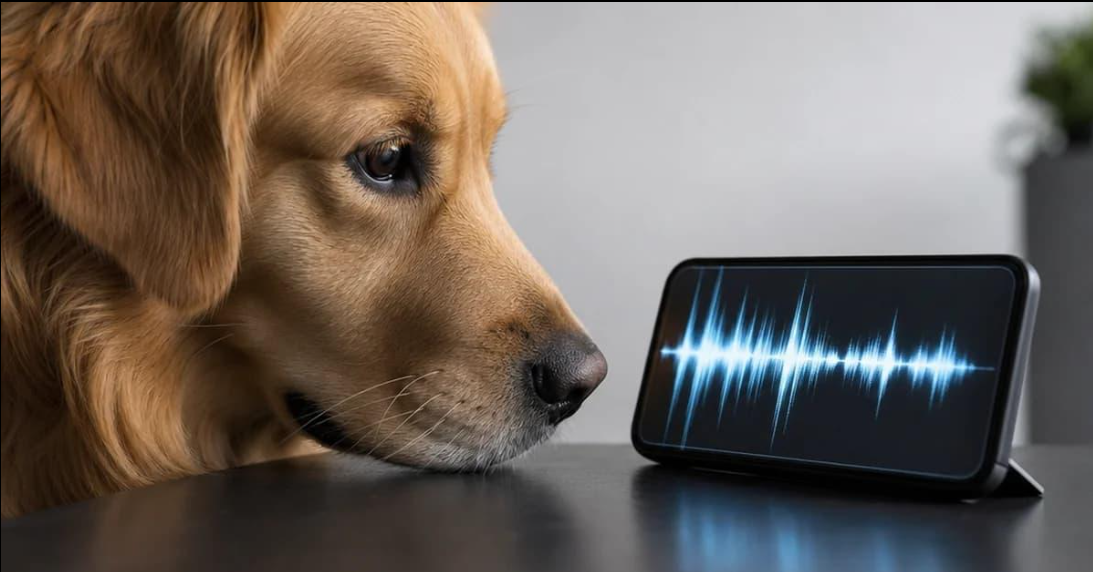
Now imagine a very different possibility. You point your phone at your dog and receive a message:
“I’m hungry.”
Or:
“I’m afraid.”
As we contemplate whether an AI pet translator is actually programmable, another question naturally follows: if machines can already translate human language, what would prevent us from developing an AI agent capable of decoding the communication of the animals that share our lives?

Researchers have taken a serious interest in exploring this possibility, and AI is already helping them uncover patterns in animal communication that were previously difficult to detect. But the results so far suggest that the first useful pet translator may be something much less dramatic (Abzaliev, et. al. 2024).
Instead of humanizing animal communication, the functions of such AI translators might be limited to minimal responses such as:
“Your pet is behaving differently.”
And:
“Here is what has changed.”
A 2025 study by researchers at the University of California, Berkeley, and Project CETI brought us another step closer to understanding animal communication. The researchers identified two distinct patterns resembling an ɑ-vowel and an i-vowel, along with several diphthong-like patterns, in sperm whale communication. Lead researcher Gašper Beguš suggested that sperm whales exchange these vowel-like sounds in what appears to resemble a dialogue (Beguš, et. al., 2025).
The discovery adds a new dimension to our understanding of whale communication. But there is an important distinction: researchers have identified the structure of these sounds, not their meaning. We know that whales produce and differentiate these patterns, but we do not yet know what they are saying.

AI can recognize patterns. That isn’t translation.
In one controlled experiment involving 29 Labrador Retrievers, a deep-learning system distinguished experimentally induced positive anticipation from frustration using facial video. The researchers reported accuracy above 89% (Boneh-Shitrit, et al. 2022).
Although this result is very optimistic, it does not mean an AI camera can reliably look at any dog and announce that it is sad, jealous, or happy. The experiment merely involved one breed, a small group of dogs, and controlled conditions. The truth is, real homes with dogs are way more messy.
And, we must remember that dog’s face is not a sentence.
What about barking?
A group of University of Michigan researchers took a different approach, using a human-speech model to analyze vocalizations from 74 dogs. The system they used achieved about 70% average performance across its tasks (Bremhorst, et al. 2019). But the system was not translating barking into human language. Its tasks included identifying individual dogs, breed, sex, and context.
That is a task of merely classifying patterns; it is not the same as turning a bark into: “I’m hungry. Please open the refrigerator.” That distinction matters because research findings can sound much more advanced when they are reduced to the phrase “AI understands dogs.” The truth is, it does not, at least not yet.

So what would a useful AI dog translator look like?
To answer this question in simple terms, it would look much less dramatic: “Your dog’s vocalization and behavior have changed from its normal pattern.” However, that could still be extremely useful to pet owners.
AI can detect sounds, movements, and trace facial patterns that humans may overlook. With enough reliable data, such systems could help owners notice changes and decide when the dog in question needs a closer observation or veterinary attention.
So, what does the bark mean to the animal? A bark can accompany excitement, fear, frustration, play, or other situations. A particular facial expression may correlate with a behavior without revealing the animal’s complete emotional experience. The research remains far from fully understanding a universal animal language.
Let’s flip the coin for a while and try to see the picture from the opposite end. What if the goal is not to make animals speak human language (maybe through AI), but for humans to become better at listening to what the animals try to communicate?
The first useful pet translator may never speak English. It may simply help us notice what our pets are trying to show us.
Scientific References
Beguš, G., Sprouse, R. L., Leban, A., Silva, M., & Gero, S. (2025). Vowel- and diphthong-like spectral patterns in sperm whale codas . Open Mind, 9, 1849–1874. https://doi.org/10.1162/OPMI.a.252
Abzaliev, A., Pérez Espinosa, H., & Mihalcea, R. (2024). Towards dog bark decoding: Leveraging human speech processing for automated bark classification . Proceedings of the 2024 Joint International Conference on Computational Linguistics, Language Resources and Evaluation (LREC-COLING 2024), 16480–16486.
Boneh-Shitrit, T., Feighelstein, M., Bremhorst, A., Amir, S., Distelfeld, T., Dassa, Y., Yaroshetsky, S., Riemer, S., Shimshoni, I., Mills, D. S., & Zamansky, A. (2022). Explainable automated recognition of emotional states from canine facial expressions: The case of positive anticipation and frustration . Scientific Reports, 12, 22611. https://doi.org/10.1038/s41598-022-27079-w
Bremhorst, A., Sutter, N. A., Würbel, H., Mills, D. S., & Riemer, S. (2019). Differences in facial expressions during positive anticipation and frustration in dogs awaiting a reward . Scientific Reports, 9, 19312. https://doi.org/10.1038/s41598-019-55714-6

One thought on “The First Useful Pet Translator Won’t Speak English”