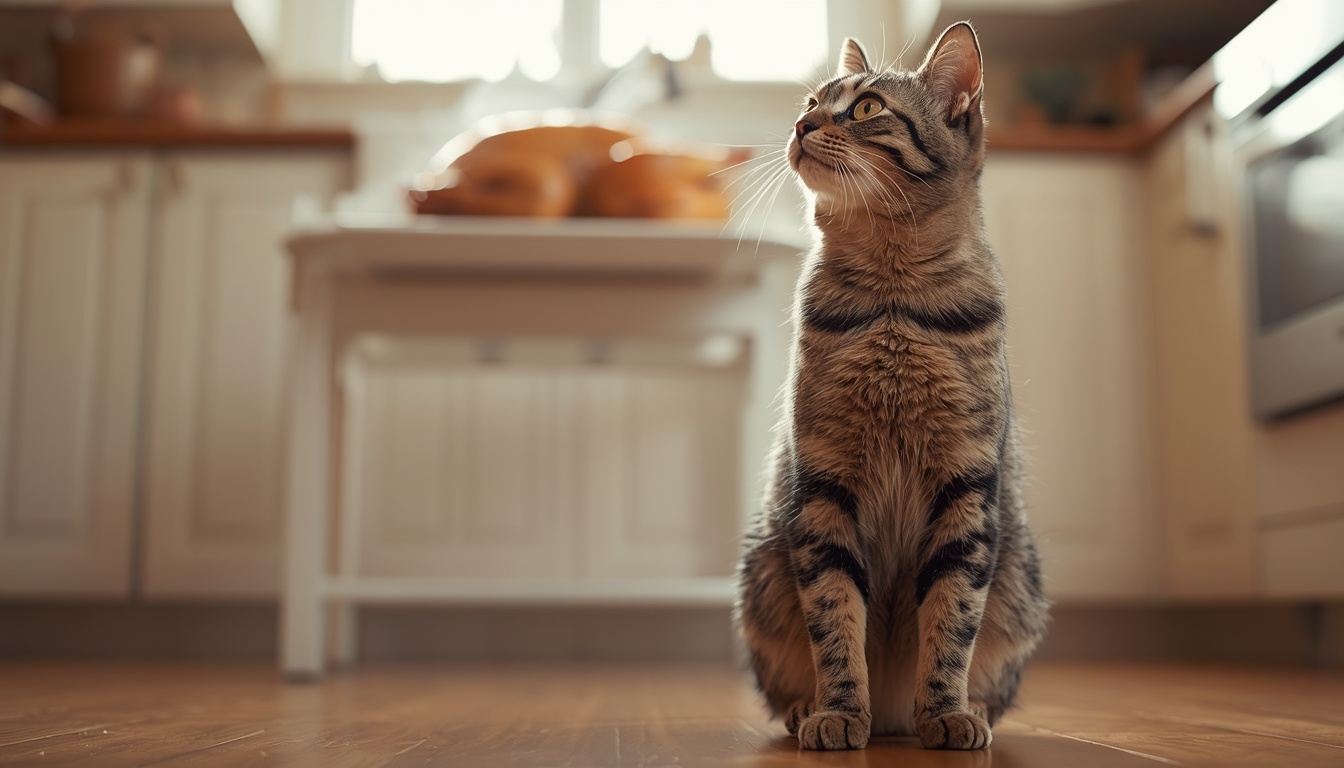
Plain, cooked, boneless, skinless turkey is safe for most healthy cats as an occasional treat. For a 10 pound cat that is roughly 16 to 19 grams, about one 1-inch cube. Keep her away from bones, skin, gravy, stuffing, brined meat, deli turkey, and anything raw. Call a vet if she swallowed bone or anything seasoned with onion or garlic.
A turkey thawing in the kitchen sink is, as far as a cat is concerned, an unattended turkey. You step out for an hour, come back, and there are teeth marks in one end of the bird and a cat sitting nearby with nothing to say for herself.
So can cats eat turkey? Yes, in a small amount, if it is plain. How small is small, and what to do when she has already helped herself to something she shouldn’t have, takes longer to answer.
Cats are very sensitive to smell. When a turkey is in the oven, or a barbecue is going outside, my cats go crazy. Two things they do are adorable: the soft, flirtatious meowing, and the rubbing against my legs every few minutes. That ultimate cattiness melts my heart, and they get the first bite.
Giving them that first bite is also why I wanted to know what a safe amount actually is. The portion numbers here come from USDA nutrition data and veterinary feeding guidance. The hazards come from ASPCA and AVMA material, and the owner stories from threads I link to in full.
How much turkey can a cat eat?
For a 10 pound cat, a day’s worth of turkey is about 16 to 19 grams of cooked breast meat. That is one cube an inch on a side. It looks like almost nothing when you are standing over a whole bird with a carving knife.
The arithmetic runs like this.
Veterinary nutrition guidance from VCA puts treats and table food at no more than 10 percent of a cat’s daily calories, with the other 90 percent coming from complete food. A 10 pound cat is about 4.5 kg. Resting energy needs work out to around 218 calories a day, and most indoor adult cats land somewhere between 220 and 260 calories a day once activity and neutering are accounted for. Ten percent of that is 22 to 26 calories.
USDA FoodData Central lists roasted turkey breast, meat only, at 136 calories per 100 grams.
Turkey portion calculator
This is her whole treat allowance for the day. It stands in place of her other treats, not on top of them.
Treat allowance: 22 to 26 calories a day, which is 10 percent of an estimated 220 to 260 calories.
| Cut, cooked and plain | Her daily limit |
|---|---|
| Breast, meat only | 16 to 19 g |
| Dark meat, meat only | 13 to 16 g |
| Dark meat, skin on | 10 to 13 g |
This runs on an average. It cannot account for her age, how active she is, whether she is spayed or neutered, or a medical diet. The feeding guide on her own food and a word with her vet both beat this estimate.
| Cut (cooked) | Calories per 100 g | Fills a 22 to 26 cal treat budget at |
|---|---|---|
| Breast, meat only | 136 | 16 to 19 g |
| Dark meat, meat only | about 160 to 175 | 13 to 16 g |
| Dark meat with skin on | about 200 to 230 | 10 to 13 g |
Breast meat buys her the biggest piece for those calories. Skin is worth trimming for the same reason: leave it on and the same allowance disappears in two-thirds of the volume.
The 220 to 260 calorie range is an average and not your cat. A large neutered cat who sleeps on a radiator needs less, a young cat who never sits down needs more, and the feeding guide on her own food is a better starting point than my arithmetic. Ten percent is a ceiling rather than a target, and VCA suggests around 5 percent as a habit. If she is on a prescription diet or a weight plan, her treat budget belongs to her vet.
Some links below are affiliate links. As an Amazon Associate, PetSpecial earns from qualifying purchases at no extra cost to you.

Taylor Digital Kitchen Food Scale, 11 lb capacity
$22.994.6 out of 5 (641 ratings)
Sixteen grams of turkey is not something anyone can eyeball. This one reads in 1 gram steps and has a tare button, so you can set the dish on first and zero it out before the meat goes in. Price checked November 12, 2026.
As an Amazon Associate, PetSpecial earns from qualifying purchases.
What safe turkey looks like
ASPCA’s Thanksgiving guidance allows a small bite of turkey as long as it is boneless and cooked all the way through. In practice that rules out most of what comes off a holiday bird.
- Cooked through. No pink, no raw, nothing from the bird while it was still thawing in the sink.
- Boneless. Checked by hand, not by eye. Small bones hide in shredded meat.
- Skinless. The skin carries most of the fat and most of whatever you rubbed on the outside.
- Unseasoned. Not basted, not rubbed, not sitting in drippings. If it came off a seasoned bird, cut from the middle of the breast.
- No gravy, no stuffing. These are the parts most likely to contain onion or garlic.
- Cooled. Straight out of the oven it will burn her mouth.
- Cut small. Pea-sized pieces, not one long strip she can gulp.
If the bird was brined or came labeled self-basting, the salt went into the meat itself and you cannot rinse it back out. On those birds I would skip the turkey entirely and give her something else.
White meat or dark meat?
Breast meat is the better default.
No veterinary body I found ranks light turkey meat against dark for cats. The nutrition data does separate them. Roasted breast runs about 136 calories per 100 grams, dark meat somewhere between 160 and 175, and dark meat with the skin left on over 200. Skin on its own is 414 calories per 100 grams, which is where that jump comes from.
On an allowance of 22 to 26 calories, leaner meat means a bigger piece. Dark meat delivers the same calories in less food.
Fat matters more for a cat with a history of pancreatitis or digestive trouble. For her I would stay with breast meat and ask her vet before offering any of it.
What to keep away from her entirely
Bones are the one I would move furthest out of reach. ASPCA treats poultry bones as a choking hazard and notes that bones can injure or block the digestive tract, sometimes needing surgery to fix. Cooked bones are the problem specifically, because cooking makes them brittle enough to splinter.

Skin, drippings, and anything fried in butter are the fat problem. VCA lists fatty holiday foods including turkey skin and bacon among the things that can trigger pancreatitis. I could not find a controlled study showing that one fatty meal brings it on in a cat. Vets see the association often enough to keep warning about it, and a cat with earlier digestive trouble is the one most likely to pay for a generous helping.
Gravy, stuffing, and anything with a rub on it carry onion and garlic. That has its own section below.
Raw turkey is a household issue as much as a cat issue. AVMA policy discourages raw and undercooked animal protein in cat and dog diets because of salmonella, campylobacter, listeria, and E. coli, and a cat who eats raw turkey can shed those organisms in a house where other people live. That applies to the bird thawing in your sink too, which turns out to be a more popular cat snack than you would hope.
Trussing string and the netting around the roast are a swallowing hazard rather than a food one. String is worse than it looks because of how it behaves in a cat’s intestine, and I have written about that in more detail in what to do if your cat swallows string.
Leftovers left sitting on the counter are their own problem, and I have covered that in how long cat food can safely sit out.
The hazards at a glance
| Hazard | What goes wrong | How serious | What to do |
|---|---|---|---|
| Cooked bones | Splinter, choke, or block or tear the gut. Can need surgery | High | Call a vet. Do not make her vomit |
| Onion or garlic, including powder in gravy and rubs | Damages red blood cells and can cause anemia. Cats are more susceptible than dogs | High | Call a vet or poison control even for a small amount |
| Raw or undercooked turkey | Salmonella, campylobacter, listeria, E. coli. Risk to the household too | High | Call a vet, and wash down anything it touched |
| Trussing string or netting | Behaves badly in the intestine once swallowed | High if swallowed | Call a vet. Never pull on anything you can see |
| Skin, drippings, fried turkey | Fat load. Vomiting, diarrhea, and a pancreatitis risk vets take seriously | Moderate to high, worse with prior digestive trouble | Watch her closely. Call if vomiting repeats |
| Brined or self-basting turkey | Salt is in the meat and cannot be rinsed out | Not quantified for cats. Avoid | Skip it rather than guess |
| Deli turkey, turkey ham, turkey bacon | Salt, fat, and additives that vary by brand | Moderate as a habit | Not an emergency. Just stop giving it |
| A large plain helping | Rich food on a cat who is not used to it | Usually mild | Expect vomiting or loose stool. Call if it does not settle |
Onion and garlic
This is the part of the holiday meal I would worry about more than the bird.

Onions, garlic, leeks, and chives damage red blood cells and can lead to anemia, and ASPCA Poison Control states that cats are more susceptible to this than dogs. ASPCA Pro puts it more sharply: a cat needs roughly half the garlic a dog does before hemolytic anemia becomes a concern.
There is no number I can give you. No veterinary source I found publishes a grams-per-kilogram threshold at which onion or garlic becomes toxic to a cat. The dose depends on which allium it was, what form it came in, how much she actually swallowed, and the cat herself. Powder is more concentrated than the fresh vegetable, which is why gravy and dry rubs cause more trouble than a stray slice of onion.
If you know she ate something with onion or garlic in it, call, even when the amount sounds trivial and even when she seems fine. Allium damage does not announce itself straight away. ASPCA Pro describes monitoring bloodwork for five days after a significant exposure, which gives you the size of the window. A cat who looks well two hours after eating gravy tells you nothing about what happens on day three.
What actually happens, according to owners
I went through Reddit threads from the last several holiday seasons to see what actually happens to these cats.
The thefts are relentless. One r/cats thread from November 2023 is titled “Criminal caught dragging whole turkey across the floor,” which is exactly what it sounds like: a carcass left under paper towels, hauled across the kitchen. The scene at the top of this page is a real one: the bird eaten while it thawed in the sink. A 2025 thread asks whether a chewed turkey can still be served to humans, which is its own kind of holiday problem.
The worried posts cluster around four things: bones, large quantities, deli meat salt, and onion exposure. A January 2026 post on r/CATHELP describes hearing a crunch and then watching the cat closely for a day. An r/AskVet thread from December 2024 involves an onion in the turkey cavity and a piece of meat that hit the floor. A kitten ate raw turkey in a 2022 post and got advice to monitor for stomach upset.
Most of the reported outcomes were mild. Vomiting, loose stool, or nothing at all. Owners who called an emergency vet about a swallowed bone were often told to watch for symptoms rather than come in. The catastrophic outcomes turn up as warnings in these threads more than as follow-up stories.
Plenty of owners read that and conclude the warnings are overblown. The reason vets hold the line on cooked bones is not how often something goes wrong, it is what happens when it does: a blockage or a perforation, surgery, and a bill that arrives on a holiday weekend. Reddit also has a survivorship problem. The owner whose cat was fine comes back and posts an update. The owner whose cat was not often never returns to the thread.
Several owners also described giving deli turkey daily, a few bites at a time, usually to hide a pill. The replies in those threads kept coming back to sodium.
Can cats have deli turkey? Plus turkey bacon and ham
Not as a regular thing. One stolen slice of deli turkey won’t hurt a healthy cat, but it isn’t plain turkey, and none of these three is.
Deli slices, turkey ham, and turkey bacon are cured, salted, and usually seasoned. Sodium is the main issue, additives are the second, and with turkey bacon you also get a processed fatty meat, which is the category VCA flags for pancreatitis risk alongside turkey skin.
I have left the sodium figures out, because they move by brand and I could not verify current per-serving values I trust. The principle holds without them: there is no nutritional reason to put cured meat in a cat, and the owners who give a few slices every night are the ones whose vet raises an eyebrow at a routine check.
Size is what makes it add up. A slice that barely counts as a snack for you is a big share of a 10 pound cat’s day, and the salt and seasoning come with it. If you want to share turkey with her, a plain piece of cooked breast, portioned with the calculator above, does the job without the cure.
A single stolen slice is not an emergency. If she got into the lunch meat drawer once, watch for vomiting or loose stool and leave it there. What matters is whether it turns into a daily arrangement.
If the pill-hiding trick is why deli turkey is in your fridge, ask your vet about a proper pill pocket or a compounded version of the medication. That is a better solution than salted meat every morning.

Whole Life Just One Turkey Freeze-Dried Cat Treats, 2.5 oz
$10.11, list $13.994.1 out of 5 (260 ratings)
One ingredient, turkey breast, with nothing cured or salted about it. The label gives 5,600 calories per kilogram, so a 22 to 26 calorie allowance comes to roughly 4 to 5 grams, which is eight or nine pieces depending on how they break.
Read the pack’s daily guide carefully. Half to three-quarters of an ounce for a medium cat works out to 78 to 118 calories, which is a third or more of her day. That figure is for replacing part of a meal, not for treats on top of dinner. At 4.1 from 260 ratings this also has the thinnest review record of the three picks here. Price checked November 12, 2026.
As an Amazon Associate, PetSpecial earns from qualifying purchases.
Why turkey in her food is fine and turkey from your plate is not
Turkey is a perfectly good protein for cats, which is why half the cans in the pet aisle have a bird on the label. The difference is everything that was added around it.
A food labeled complete and balanced has been formulated to supply what a cat needs in the right amounts and proportions for her life stage. Turkey from your plate is one ingredient. It brings protein and not much else she can count on: no controlled calcium to phosphorus ratio, no vitamin balance, no guaranteed taurine.
Cats cannot make enough taurine on their own and have to take it in from food, and a long-term shortfall affects the heart and the eyes. Commercial diets are formulated with that requirement in mind. A slice of breast meat is not. I have left the minimum taurine figure out, since the number belongs to the current AAFCO nutrient profiles and I have not pulled that document myself.
A holiday bite is still fine. It is a treat and it stays a treat, and a cat who fills up on turkey and then walks away from her dinner has had a worse day nutritionally than a cat who got none.

Purina Fancy Feast Classic Pâté Turkey & Giblets, 24 x 3 oz cans
$20.64 for 244.6 out of 5 (2,486 ratings)
This is the turkey she can actually live on. The can states 100 percent complete and balanced for adult cats, at 93 calories each. A 10 pound cat gets through roughly two and a half to three cans a day, which puts her entire turkey treat allowance at about a quarter of one can. Purina’s own feeding guide says one can per 3.5 pounds of body weight, landing just above the 220 to 260 calorie estimate this page works from. Price checked November 12, 2026.
As an Amazon Associate, PetSpecial earns from qualifying purchases.
She already ate something. Now what?
Three situations, and they want different things from you.
Call a vet or poison control now, before symptoms: she swallowed bone, string, or netting. She ate anything containing onion or garlic, including gravy, stuffing, or a seasoned rub. She ate raw turkey. She ate a large amount of fatty skin or drippings and has a history of pancreatitis or digestive disease. Waiting for symptoms is the mistake here, because with bones and with allium the damage runs ahead of the signs.
Call today, but do not panic: she ate a lot of plain turkey and is vomiting or has diarrhea that is not settling. She ate a quantity of deli meat in one go. She is off her food the next morning.
Watch her at home: she got a small amount of plain cooked turkey and seems herself. Expect nothing. If anything, expect a soft stool.
Go to an emergency vet immediately, without calling first, if she is struggling to breathe, collapsing, having a seizure, straining with a hunched posture, has pale gums, or is unresponsive.
Not unless a vet has told you to, on this specific case. With bone fragments, bringing them back up can do more damage to the esophagus than letting them go down. The same goes for pulling on any string you can see, at either end.
| Service | Phone | Notes |
|---|---|---|
| ASPCA Animal Poison Control | (888) 426-4435 | 24/7, 365 days. A consultation fee applies. Confirm the amount when you call |
| Pet Poison Helpline | (855) 764-7661 | 24/7. One per-incident fee covers follow-up calls, yours and your vet’s |
I have left the fees off. I checked both in November 2026 and the published amounts disagree with each other, including between pages of the same site, so the figure you are quoted on the phone is the only one worth going by. It is still cheaper than an emergency visit you did not need.
Questions people ask
Can cats eat turkey bacon?
I would not give it. Turkey bacon is cured, salty, and fatty, which puts it in the same category VCA flags for pancreatitis risk. A stolen bite is not an emergency, but it should not become a routine.
Can cats have deli turkey?
A stolen slice won’t harm a healthy cat, but don’t make it a habit. Deli turkey is cured and salted, so plain cooked breast is the better choice if you want to share turkey with her.
Can cats eat turkey lunch meat or turkey slices?
Not as a habit. Deli slices are salted and often seasoned, and the sodium adds up fast in an animal that weighs ten pounds. If you are using it to hide a pill, ask your vet for a pill pocket or a compounded form instead.
Can cats eat turkey ham?
Same answer, and ham is usually saltier still. Skip it.
Can cats eat turkey breast?
Yes, and plain roasted breast is the best part of the bird for her. Boneless, skinless, unseasoned, about 16 to 19 grams for a 10 pound cat.
Can cats eat raw turkey?
No. AVMA policy discourages raw and undercooked animal protein for cats and dogs because of salmonella, campylobacter, listeria, and E. coli, and there is a risk to the people in the house as well as to the cat.
Can cats eat turkey bones?
No, and cooked bones are the worst version because they splinter. If she has swallowed one, call a vet rather than waiting to see what happens.
My cat ate turkey with gravy on it. Is that a problem?
Potentially, because gravy is where onion and garlic usually hide. Call a vet or poison control even if she looks fine, since allium damage can take days to show up.
Can kittens eat turkey?
A kitten has a much smaller calorie budget and a greater need for complete nutrition, so there is less room for treats of any kind. I would leave turkey off the menu until she is grown, and ask your vet what fits her weight.
How often can she have turkey?
Occasionally rather than daily. Treats sit at no more than 10 percent of daily calories, and VCA suggests around 5 percent is a better habit, so a small piece now and then rather than a standing arrangement.
Can I replace a meal with turkey?
No. Plain turkey is one ingredient and cannot balance a diet. It is a topper, not dinner.
Sources
All links checked November 12, 2026.
- Thanksgiving Safety Tips. ASPCA. A small bite of boneless, fully cooked turkey; poultry bones as a choking and obstruction hazard.
- People Foods to Avoid Feeding Your Pets. ASPCA. Allium damage to red blood cells, and cats being more susceptible than dogs.
- Raw or Undercooked Animal-Source Protein in Cat and Dog Diets. AVMA policy. Pathogen risk to pets and to the household.
- Cat Treats. VCA Animal Hospitals. Ninety percent of a cat’s daily calories from complete and balanced food, the remaining 10 percent from treats.
- True or False: Treats Should Make Up 10 Percent of Your Pet’s Calories. VCA Animal Hospitals. Treats should not exceed 10 percent of calorie intake, and targeting 5 percent is safer.
- Choosing Non-Toxic Holiday Foods for Pets. VCA Animal Hospitals. Added fat and pancreatitis, naming turkey skin and bacon.
- 4 Harmful Thanksgiving Foods for Pets. ASPCA Pro. A cat needs roughly half the garlic a dog does to develop hemolytic anemia; bloodwork monitored for five days after a large ingestion; cooked bones splinter, so inducing vomiting risks damage to the esophagus.
- Turkey, retail parts, breast, meat only, cooked, roasted. USDA FoodData Central, FDC 174516. 136 calories per 100 g.
- Turkey dark meat and skin, USDA FoodData Central. The records differ by cut and preparation: FDC 171091 gives 150 calories per 85 g for dark meat, cooked and roasted, while other dark meat records run from 158 to 162 per 100 g. Roasted turkey skin on its own is 414 calories per 100 g. This guide gives dark meat as a range for that reason rather than picking one figure.
- ASPCA Animal Poison Control Center. Phone number and fee statement.
- Pet Poison Helpline. Phone number and per-incident fee covering follow-up calls.
- Reddit threads, linked individually where they appear in the text.
If a number here doesn’t match what you see on a label, a feeding guide, or a handout from your own vet, tell me and I will check it.
