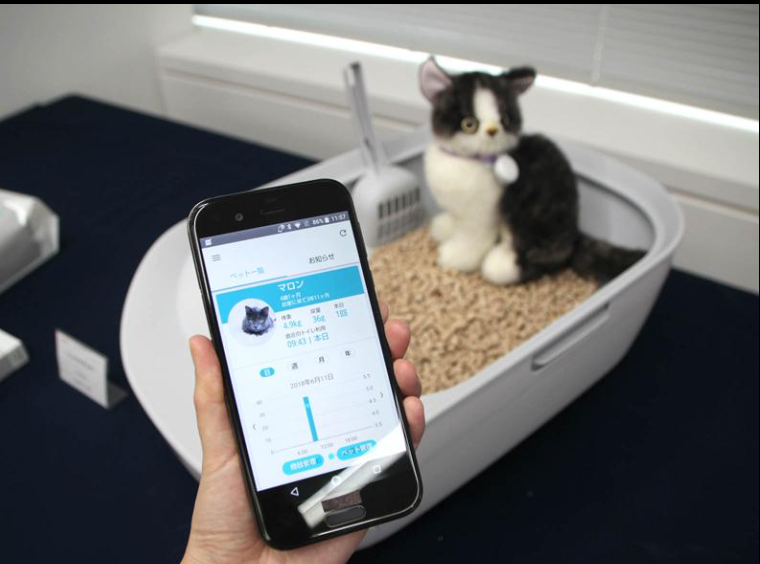
Artificial intelligence (AI) hasn’t left pet care behind. New smart litter-box technology can collect and analyze everyday data about your cat’s bathroom habits, potentially revealing changes that might otherwise go unnoticed. But make no mistake: the goal is not to diagnose your cat. Instead, the AI is designed to detect unusual changes in familiar patterns and alert you that something may be different. In other words, it may notice a change before you do, but it cannot tell you what caused it.
Cats are absolute monsters when it comes to hiding their illnesses. That creates enormous stress for their owners. By the time you notice that something is wrong, the underlying problem may already have been developing for days, and delaying veterinary care can sometimes make a serious condition worse.
Technology may be about to change that scenario. Scientists are exploring how AI can work with data from your cat’s litter box, potentially addressing one of the oldest frustrations of cat ownership: knowing something is wrong before the signs become obvious.
The part of cat care that no cat parent particularly enjoys is cleaning the litter box. Once your cat has done its business, you usually want to get rid of the smelly stuff as quickly as possible. As a result, most cat owners never keep track of how often their cats pee or poop.
A smart litter box, however, can do exactly that. It meticulously records your cat’s bathroom habits, tracking details that would be nearly impossible for most owners to monitor themselves. Over time, those records can reveal patterns in your cat’s toilet behavior that might otherwise go unnoticed. But, make no mistake! Your cat’s Ai-integrated smart litterbox is not a veterinarian, it is more of a witness.
What the research found

A recent study investigated whether data collected by a smart cat litter box could potentially help distinguish cats with chronic kidney disease from healthy cats (Langenfeld-MaCoy, et. al. 2026). The researchers looked at behavioral patterns of the cats including frequency of urination, duration and cat’s litter covering behavior.
The validation data from the study showed that the model achieved a weighted F1 score of 89.9%. The study found that cats associated with chronic kidney disease tended to urinate more frequently and for longer periods, while covering their waste less often. These findings are particularly interesting because these are behaviors an owner might not notice at all.
One extra visit to the litter box may not mean much. But if a pattern develops over many days, it could tell us something important about a cat’s health. And that is where an automated monitoring system can offer an advantage over human memory.
We are not very good at tracking small changes
A 2017 study offers a crucial piece of context. Researchers compared owners’ observations with video recordings and found that cat caregivers underestimated how frequently their cats urinated (Dulaney, et. al. 2017). The study did not simply find that owners “underestimated” urination in a general sense. It specifically compared 14 days of video-recorded observations with daily caregiver observations in 19 cats, and found substantially higher recorded urination frequency than caregivers reported.
This by no means suggests that the owners were careless. Rather, it shows that some of the most useful information about a pet is information that humans are simply not capable of recording continuously.
We notice the dramatic changes: a cat stops eating, vomits repeatedly, becomes lethargic or behaves strangely. We are much less likely to notice that the cat has been visiting the litter box slightly more often every day for two weeks.
But a machine can!
But the machine is not diagnosing your cat
This is where a lot of smart cat litter box owners could get confused. Despite its AI integration, a smart litter box is not a substitute for a veterinarian.
The study showed that behavioral data could help distinguish patterns associated with chronic kidney disease. It did not show that a smart litter box can independently diagnose an individual cat, nor did it establish that automated alerts lead to earlier treatment or better health outcomes.
There are also limitations to the research. The study involved Purina employees, and one of the authors had an advisory role with the company. Because of these connections, the findings are better understood as promising evidence rather than conclusive proof that smart litter boxes can function as veterinary diagnostic tools. The more realistic picture is simpler: a device notices something unusual, the owner pays attention, and the veterinarian receives additional information about the cat’s behavior. That may be a much more useful role for AI in everyday pet care than trying to replace the veterinarian.
Your cat’s baseline may be more useful than a generic warning
The most important aspect here is not that an AI-integrated litter box would tell you how many litter box visits are normal for your cat. That is the veterinarian’s job. Rather, the research points toward using AI to monitor and learn an individual cat’s behavioral patterns.
If your cat typically uses the litter box three times a day and suddenly begins using it twice as often, that significant change may be worth your attention. It does not tell you what is wrong, but it gives you a reason to look more closely and, if necessary, seek veterinary advice.
The technology’s greatest contribution, then, may be its memory and personalized data.
It can observe continuously. It can record patterns. It can notice deviations that are easy for humans to miss.
But it is not designed to tell you, by itself, why the change happened.
The bottom line
A smart litter box cannot replace your veterinarian yet, and an alert should not be treated as a diagnosis.
But it could become something surprisingly valuable: a better witness to your pet’s everyday life.
For animals that cannot tell us when something feels wrong, sometimes noticing the change is the first important step.
Scientific References
- Langenfeld-McCoy, N., Snow, L., Gordon, H., George, Z., Quimby, J., Arndt, O., Thomas, S., Schoeneck, N., & McGowan, R. T. S. (2026). Enhancing detection of feline chronic kidney disease through smart litter box monitoring. Animals, 16(9), 1319. https://doi.org/10.3390/ani16091319
- Dulaney, D. R., Hopfensperger, M., Malinowski, R., Hauptman, J., & Kruger, J. M. (2017). Quantification of urine elimination behaviors in cats with a video recording system. Journal of Veterinary Internal Medicine, 31(2), 486–491. https://doi.org/10.1111/jvim.14680

One thought on “A Smart Litter Box Is Not a Vet. It Might Be a Better Witness.”