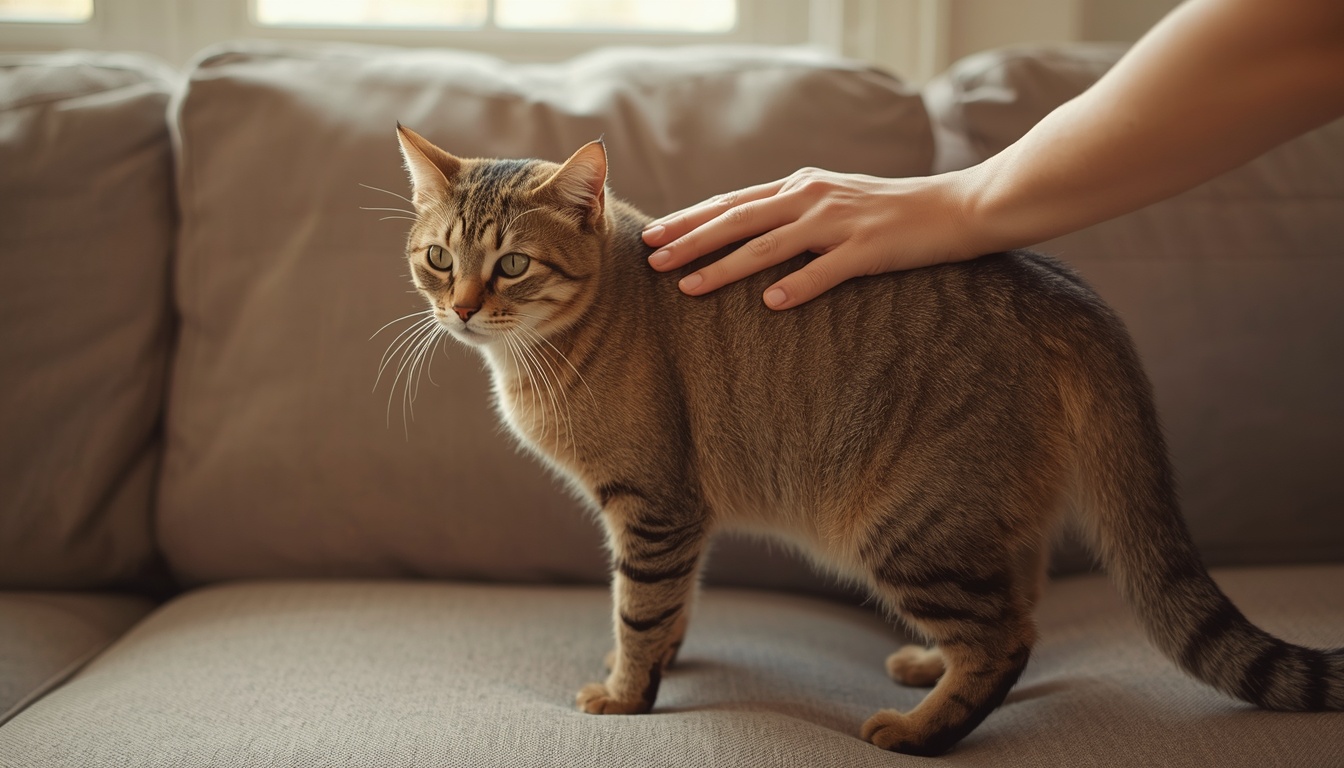
Each time I stand up to move around the apartment, Simba starts meowing in a demanding voice. He stares directly into my eyes and asks, “Did you forget about petting me?” This might sound weird, but this is the reality I have been living with for 5 years now. So, why do cats do this?
The simplest answer is preference. Some cats enjoy gentle strokes along their backs, while others prefer attention around their cheeks or chin. There is no proven ‘magic spot’ along the backbone that makes every cat melt. Your cat’s response matters more than any general rule (Ellis et al., 2013; Ellis et al., 2015).
Why Back Strokes Can Feel Good

Gentle touch can be rewarding. In a study published in Nature, researchers identified sensory neurons in mice that responded to massage-like stroking of hairy skin. Activating those neurons produced behavior suggesting the stimulation was rewarding or anxiety-reducing (Vrontou et al., 2013)..
That offers a possible explanation for why stroking feels pleasant. But there is an important limit: the study involved mice, not cats. It does not prove that your cat’s backbone contains extra ‘pleasure nerves’ (Vrontou et al., 2013). For your cat, enjoying back strokes may simply come down to how they like being touched. Veterinary guidelines explain that cats’ preferences for human contact vary with genetics, early experiences and individual history (Ellis et al., 2013).
Does Petting Remind Cats of Grooming?
You may have heard that petting reminds cats of their mother grooming them. That is a possible interpretation, but it is not an established explanation for enjoying back strokes (Vrontou et al., 2013).
Socially bonded cats may rub against and groom one another to maintain a group scent. Choosing the best cat brush for shedding can mimic this soothing contact, offering a massage-like sensation while keeping your cat’s coat healthy. For a routine, see how often to brush a cat.
What we do know is that friendly physical contact matters in feline relationships. Socially bonded cats may rub against and groom one another (Ellis et al., 2013). Petting can fit into that broader pattern of comfortable social contact, without necessarily recreating a particular kittenhood memory.
The Back and Tail Base Are Different

A cat enjoying strokes down its back does not automatically want scratches just above its tail.
In a study examining cats’ responses to petting, the region near the tail produced the highest negative behavioral scores (Ellis et al., 2015). Veterinary guidelines also note that cats generally prefer touch around the head, cheeks and chin (Ellis et al., 2013).
So, follow your cat’s preferences rather than repeatedly targeting a supposedly irresistible spot. Let them approach, keep the interaction gentle and give them the freedom to leave (Ellis et al., 2013).
When Back Sensitivity Needs Attention
An intense reaction is not always a sign of pleasure. Marked skin rippling, sudden biting, intense scratching or tail-chasing can occur with excessive back sensitivity. Cornell advises veterinary assessment to investigate possible causes, including spinal pain, parasites and allergies. A twitch alone does not establish a diagnosis. A twitch alone does not establish a diagnosis (Cornell Feline Health Center, n.d.).
References
Cornell Feline Health Center. (n.d.). Hyperesthesia syndrome. Cornell University College of Veterinary Medicine. https://www.vet.cornell.edu/departments-centers-and-institutes/cornell-feline-health-center/health-information/feline-health-topics/hyperesthesia-syndrome
Ellis, S. L. H., Rodan, I., Carney, H. C., Heath, S., Rochlitz, I., Shearburn, L. D., Sundahl, E., & Westropp, J. L. (2013). AAFP and ISFM feline environmental needs guidelines. Journal of Feline Medicine and Surgery, 15(3), 219–230. https://doi.org/10.1177/1098612X13477537
Ellis, S. L. H., Thompson, H., Guijarro, C., & Zulch, H. E. (2015). The influence of body region, handler familiarity and order of region handled on the domestic cat’s response to being stroked. Applied Animal Behaviour Science, 173, 60–67. https://doi.org/10.1016/j.applanim.2014.11.002
Vrontou, S., Wong, A. M., Rau, K. K., Koerber, H. R., & Anderson, D. J. (2013). Genetic identification of C fibres that detect massage-like stroking of hairy skin in vivo. Nature, 493(7434), 669–673. https://doi.org/10.1038/nature11810
FAQ
Do all cats enjoy back petting?
No. Every cat has its own preferences. Some enjoy gentle strokes along their backs, while others prefer attention around their head, cheeks or chin. Watch your cat’s response and let them decide when they have had enough.
Does my cat have special pleasure nerves along its spine?
There is no established evidence that cats have a special pleasure zone along their backbone. Research on touch-sensitive neurons in mice helps explain why gentle stroking may feel rewarding, but it does not prove the same mechanism makes cats enjoy back petting.
Should I stop if my cat reacts suddenly?
Yes. Pause and give your cat space rather than continuing to pet the area. If touching their back repeatedly causes distress, biting or pronounced sensitivity, arrange a veterinary check.
