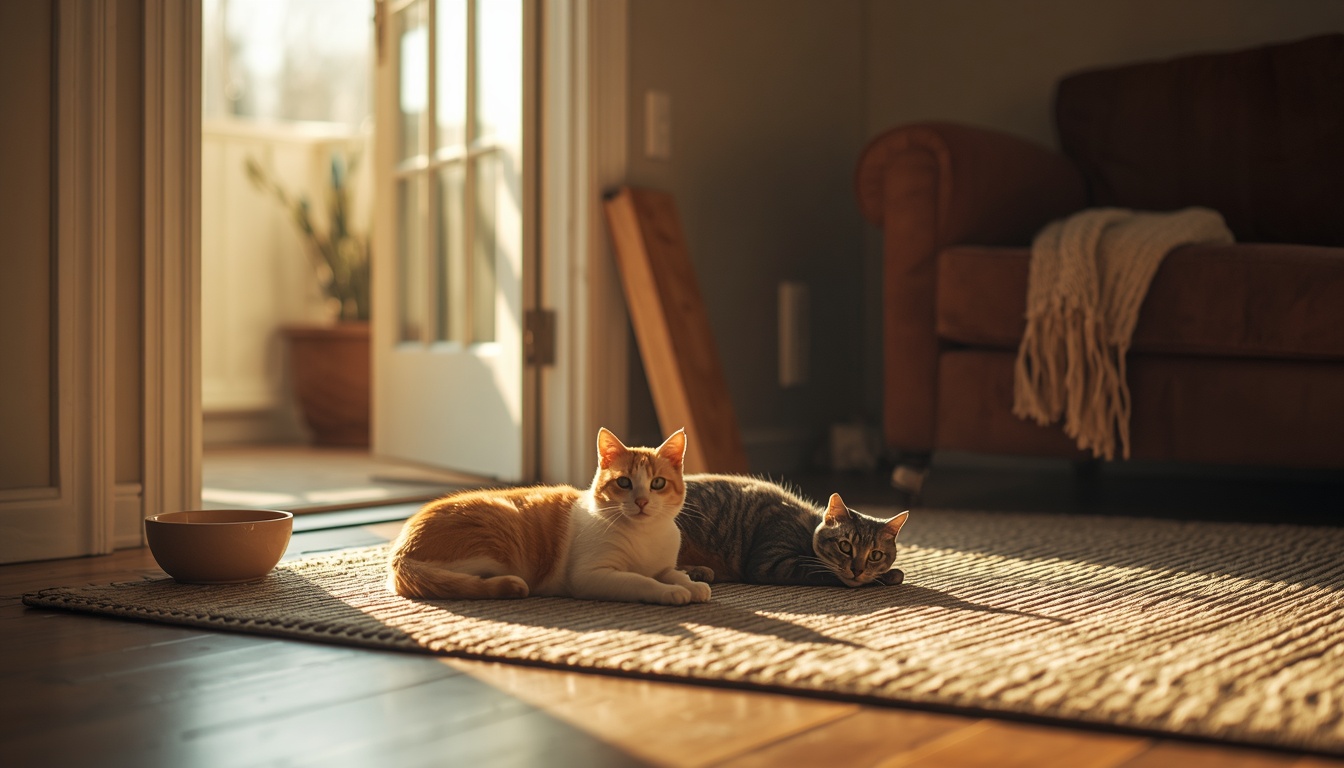
How long can cats be left alone? A healthy adult cat can usually manage a workday or a single night with food, water and a clean litter box. Cats Protection puts the routine maximum at about 12 hours. Past 24 hours, someone should visit every day. Two cats keep each other company, but the time limits stay the same.
Most people ask how long cats can be left alone while they are already packing. A wedding two cities away, a work trip, a phone call at midnight about a parent in hospital. The trip is happening either way, and the real question is what the cats need while you are gone.
The first time we left Billu and Simba alone for more than a night, it wasn’t a choice. A family emergency came up, and taking two cats along wasn’t possible. We had no automatic feeder back then and no self-cleaning box, so I left our house key with a neighbor. Her job was simple: put food down and scoop the litter box.
We were gone for about three days. When we came back, Simba and Billu seemed even closer than before. They were fine. All the worrying had been ours.
It happened more than once after that, and each time the plan was the same: the cats stayed home, and a person came in. That habit lines up with what welfare groups advise. How long a cat can be left alone depends less on the clock and more on whether someone can confirm that food, water and the litter box are still working.

How long can cats be left alone at home?
Cats Protection, the UK’s largest cat welfare charity, gives the clearest figure: most cats are fine for a day or overnight, and about 12 hours is the most you should leave them on a regular basis. US vet sources tend to land on a similar 8 to 12 hour range for healthy adults.
The number is a guide for routine absences. A cat can physically get through a longer stretch, but the risk climbs with every hour nobody checks in. A bowl gets tipped, a door swings shut, a cat stops eating, and none of it gets noticed until you walk in.
Here’s a rough guide for a healthy, settled adult cat:
| Time away | Usually OK? | What it takes |
|---|---|---|
| Workday (8 to 12 hours) | Yes | Normal meals, fresh water, a scooped box |
| One night (up to 24 hours) | Occasionally | Measured food, two water sources, a clean box, a backup contact |
| Weekend (48 hours) | Only with a visit | At least one person checking in each day |
| 3 days to a week | Not unattended | Daily visits, twice a day for kittens, seniors or cats on medication |
“Settled” matters in that table. A cat who just moved house or just came home from a shelter is still learning where everything is, and a long absence in the first few weeks is harder on her than on a cat who has lived with you for years.
How long can you leave two cats alone?
The same limits apply. A second cat makes the hours less lonely, but it doesn’t add hours to the clock.
Company does help
Owners with bonded pairs often say “they have each other,” and there is some evidence behind that. A 2020 survey of 223 cats found that about 13.5 percent showed possible separation-related problems, and those problems were more common in homes with no other animal. It was an owner questionnaire, so it shows a link and can’t prove that a second cat prevents anything. Still, it fits what I see at home: Billu and Simba nap together most of the day whether I am there or not.
Food guarding gets worse when nobody is watching
If one cat guards the food, the other may eat very little all weekend, and a camera won’t always catch it. Simba has a habit of pushing Billu off her bowl even when I am home to see it, which is exactly why I don’t trust one unwatched pile of kibble for two. Separate bowls in separate rooms help. If this sounds familiar, my guide on how to stop a cat eating the other cat’s food covers the fixes.
Twice the waste, twice the spills
Two cats fill a litter box twice as fast, and a full box is the most common reason a cat goes somewhere else. Two cats also double the odds that a water bowl gets knocked over on day one. Everything you set out for one cat needs a little extra margin for two.
When the limits are shorter
Kittens, seniors and cats on medication need a person more often, usually more than once a day. Kittens eat small meals frequently and get into trouble fast. Older cats are more likely to have kidney or thyroid problems that make missed water or meals riskier. A missed dose can matter clinically, so write the medication schedule down for whoever visits.
Urinary blockage in male cats. The AVMA describes a blocked urethra as potentially life-threatening. A male cat straining in the box, crying, or passing only drops needs an emergency vet right away.
Not eating. Cats Protection advises calling a vet if a cat hasn’t eaten for more than 24 hours, and warns that two days without food can cause serious health problems. Cats that stop eating can develop fatty liver (hepatic lipidosis), which can be fatal.
Both of these are reasons a daily visit matters more than any gadget. A feeder can put food down. Only a person notices that it wasn’t eaten.
Before you leave: the two-cat checklist
Owners who report trouble usually had one weak point: a single feeder, a single bowl, or a door that closed. So build in a backup for everything.
- Doors. Wedge every relevant door open, closets included. Tell your visitor to leave them that way.
- Food. Their usual food in measured portions, in separate bowls. Don’t switch diets before a trip. An automatic feeder helps, but test it for a week first and keep a backup bowl. My automatic cat feeders for two cats guide compares setups that keep each cat to their own portion.
- Wet food. It has a short safe window at room temperature, so leave it for the visitor to serve. More in how long wet cat food can sit out.
- Litter. Start with three boxes for two cats in separate spots, and scoop right before you leave. Extra litter won’t make up for a skipped scoop. More on the count in how many litter boxes per cat.
- Water. At least two stations in different rooms (more on this below).
- A note for the visitor. Your vet’s number, the nearest emergency clinic, how much each cat eats, and what “normal” looks like for each of them.
- A backup person. Someone who can step in if your main visitor gets sick or stuck.
Water: two stations, one of them a fountain
Water is the thing a cat can least afford to lose. Cornell’s Feline Health Center puts a 10 pound cat’s needs at about one cup of water a day, and lists lack of access to the water bowl among the common causes of dehydration.
Put out at least two water stations in different rooms, so one spill or one guarding cat can’t cut off both. A fountain works well as the main station because moving water tempts many cats to drink more. Do the math before you trust it, though. Two 10 pound cats drinking about a cup each per day will empty a 74 oz reservoir in roughly four days at best, and less if some of their water comes from wet food the visitor isn’t serving. Keep a plain bowl in another room in case the pump quits.
Some links below are affiliate links. As an Amazon Associate, PetSpecial earns from qualifying purchases at no extra cost to you.

74 oz stainless steel cat water fountain
74 oz capacityWater-level window
The big reservoir makes it a sensible main station for two cats, and the window lets a visitor see in a second whether it needs topping up. Stainless steel is also easier to keep clean than plastic.
As an Amazon Associate, PetSpecial earns from qualifying purchases.
A camera: seeing what you can’t smell from far away
Of the many times we left Billu and Simba with the neighbor, only a handful ended with a mess outside the box. That was when we realized how urgently we needed a camera we could talk through. A visit once a day tells you how things were at that moment. A camera tells you what happened at 3 a.m.
Aim it at whatever worries you most, usually the litter boxes or the food and water. Two-way audio is worth having: a familiar voice can settle a cat who is pacing, and it lets you ask your visitor to check something specific. Meow or motion alerts mean you don’t have to watch the feed all day.

Furbo Mini pet camera
$25 cameraNanny plan from $6.99/mo (yearly)
A 130° view, two-way audio and meow alerts in a small camera. It doesn’t rotate, so point it at the spot that matters most. It does nothing until you activate a Furbo Nanny plan, so count that cost in. Price checked November 15, 2026.
As an Amazon Associate, PetSpecial earns from qualifying purchases.
Why gadgets can’t replace a visit
Pet tech tends to fail when nobody is home. A feeder that jams or loses power on the first night leaves the cats hungry until someone walks in. A fountain pump can stop. A camera can drop off the Wi-Fi exactly when you want to check it.
The 3-day mark is where owners argue most. Some manage it with automatic feeders, fountains and a camera, while others warn that three days is long enough to come home to a disaster.
Several threads describe a door that swung shut, from a draft or a well-meaning friend, cutting cats off from their food and water for days. The guidelines side with the cautious group.
So treat every device as a backup to a person. The feeder covers a late visitor. The camera tells you when to send someone round early. Neither one can scoop a box or take a cat to the vet.
Neighbor, sitter or boarding: what each involves

| Option | Cost | Best for | Watch out for |
|---|---|---|---|
| Neighbor or friend with a key | Free, or a favor returned | Healthy cats, trips up to a week | They may skip a day; leave clear notes |
| Paid drop-in sitter | Per visit, more on holidays | Daily or twice-daily checks | Book early for holiday weeks |
| Overnight in-home sitter | Per night, the priciest at home | Seniors, medication, anxious cats | Fewer sitters offer it |
| Boarding or cattery | Per night, per cat | Long trips, cats who travel well | Travel and a new place stress many cats |
A neighbor with a key is still the best deal, and it’s what worked for us. Paid sitter rates vary a lot by city and by how many cats you have, so get two or three local quotes. Even so, a few days of visits usually costs far less than one emergency vet bill. Most cats are happier staying in their own territory, so I’d choose a sitter over boarding unless your cats need medical care that only a clinic can give.
What to check when you get home

Some cats hide, sulk or cling for a day after you come back, which owners report as normal. Give them a quiet evening and their usual routine. Then look for things that aren’t normal:
- Food or water that was barely touched
- A litter box with no urine clumps
- Vomiting more than once, or unusual lethargy
- One cat hiding and not coming out to eat
- New fighting between cats who usually get along
Any of these is a reason to call your vet. A male cat straining or passing no urine needs an emergency vet right away.
Questions people ask
Can I leave my cats alone for a weekend?
Not without a visit. Healthy adults can manage one night, but for 48 hours someone should check food, water and litter at least once a day.
Can cats be left alone for 3 days with an automatic feeder?
A feeder handles food only. It can’t scoop, refill a spilled bowl, or notice a sick cat. Pair it with daily visits.
Can I leave my cat alone for a week?
Only if someone comes in every day. A week is long enough for a feeder to fail, water to run out, and a health problem to become serious.
How long can kittens be left alone?
Much less than adults. Young kittens need meals and checks several times a day, so plan for someone to come in more than once.
Is it OK to leave a new cat alone overnight?
Try to avoid it in the first few weeks. A new cat is still learning the house and may hide instead of eating or using the box. Build up from short absences first.
Should I leave a light or the TV on for my cats?
It won’t hurt, and a lamp on a timer helps your visitor too. It doesn’t replace food, water, a clean box or a person checking in.
Can two cats be left alone for 3 days?
Not unattended. Two cats empty water and fill litter boxes twice as fast as one, and a guarding cat can keep the other from eating. Have someone visit every day.
Is it OK to leave two cats alone for the weekend?
Only with at least one visit a day. Leave separate food bowls, two water stations and an extra litter box, and ask the visitor to scoop and check that both cats ate.
