📌 This brief is part of the PetSpecial Pet Bulletin Board. Browse all briefs →
Shelter research suggests that hiding opportunities can help cats adapt to unfamiliar surroundings. Veterinary guidelines also support covering carriers, while allowing partial views for cats that prefer them. Neither establishes whether transparent or opaque backpack carriers are better for an individual cat.
The “if it fits, I sit” theory
Every cat owner knows the rule of the cardboard box: if it fits, she sits. Most of us treat it as a joke, except a group of pet researchers who took the joke all too seriously. They have treated it as a research question.
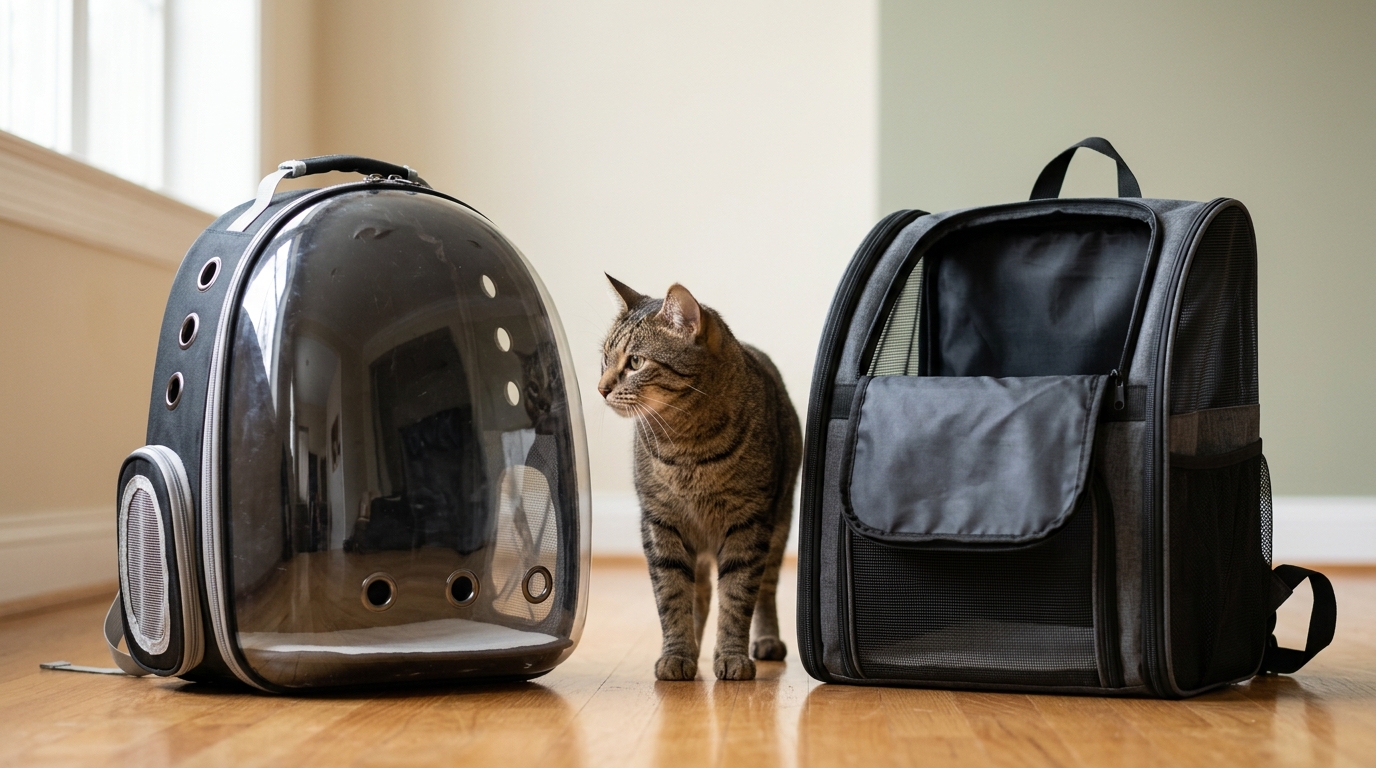
Now imagine two backpack carriers for your cat. One is a clear bubble that shows her the whole world:
“Look at everything.”
The other is mostly covered:
“Nobody can see me.” Which would she choose? Product pages are written for the person buying the backpack, and a panoramic window looks great in a photo. On the contrary, the coin is ever flipped, and hardly anyone tries to look at it from the consumer’s perspective. So, what does your cat actually want in a carrier? Let’s explore.
What a cardboard box did for 23 cats

In 2019, researchers at a Dutch shelter randomly assigned 12 newly arrived cats to cages with a cardboard hiding box and 11 to otherwise furnished cages without one. They scored each cat’s stress from video on a scale from 1 (fully relaxed) to 7 (terrorized) (van der Leij et al., 2019).
The two groups looked similar on day one. Then the cats with a box settled faster. Their stress scores levelled off by day two, while the cats without a box took until day nine. An earlier study from the same team had found that cats with a box recovered at least four days sooner (Vinke et al., 2014).
Although this result is encouraging, the boxes did not stop the weight loss of the cats. Nearly all the cats lost weight, and 15 of the 23 lost at least 5% of their starting body weight. Hiding boxes did not significantly reduce that loss (van der Leij et al., 2019. However, individual food intake was not measured and illness could also contribute, so weight change cannot be treated as a pure measure of stress.

What vets do with the idea
The 2022 AAFP/ISFM guidelines for cat-friendly vet visits treat hiding as a coping strategy. They suggest letting a nervous cat stay in the bottom half of her carrier during an exam, leaving the carrier door open so she can come and go, and using a towel to give her a sense of cover (Rodan et al., 2022). They also recommend teaching cats to enter their carriers voluntarily, using treats.
The companion environment guidelines make the carrier connection explicit: cats that prefer visual access can have the front uncovered or partially covered. How much of the view to block should depend on the individual cat’s needs, previous experiences, and temperament.
My cats are polar opposites when it comes to dealing with external stimuli. When a newcomer arrives at our home, Simba approaches visitors; Billu disappears under the sofa. That makes me suspect they might prefer different amounts of visual cover; but it is a starting hypothesis, not a carrier test. I would still watch how each responds to the carrier itself during gradual practice at home.
Their behavior gives me a starting hypothesis, not a final answer. Before deciding how much of a view either cat needs, I would use gradual backpack-carrier training to observe how each responds to the carrier itself. And, if you are concerned about your cat’s reaction to an under seat environment during your upcoming flight, there is credible reason for you to be worried about.
Should I cover my cat carrier?
Veterinary guidelines support visual covers to reduce stressful sights and sounds, but coverage should suit the individual cat. Some cats may benefit from a partly uncovered front. Always preserve airflow and account for the surrounding temperature.
Does this prove a bubble backpack is bad?
No. Let’s push back on the evidence.
1. It was a shelter, not a carrier. The cats lived in cages for 12 days. A car ride or a flight is a different stressor. The study was small, one observer scored the video, and the authors say a biochemical stress marker would have strengthened it.
2. “Give her a choice” works in a closed room. The guidelines describe quiet, secure, enclosed spaces. At a gas station or an airport, the same choice can end with a lost cat. My TSA cat rules guide covers the checkpoint itself.
3. Not every cat wants to hide. The same guidelines note that confident cats may explore and often prefer perches or high spots. I found no study that tests view versus cover inside a carrier.
4. A cover can cause its own problem. Veterinary guidelines on the clinic environment say a carrier cover must still allow airflow and account for temperature.
5. The training evidence is small. The main carrier-training trial had 22 cats, and a report on it says only three of the 11 trained cats finished all seven stages.
So what would a smart carrier choice look like?

Rather than treating a panoramic window as an automatic benefit, consider whether the carrier allows visual shelter without compromising ventilation. Veterinary guidelines support adjusting coverage to the individual cat, including leaving the front partly or fully uncovered when appropriate.
Let’s flip the coin for a moment. What if the goal isn’t to choose between a view and a hiding place, but to notice which one your cat chooses?
The best carrier feature may be the one your cat tells you she needs. If you’re comparing designs, our cat carrier backpack comparison is a starting point for reviewing the options, not a verdict on which one your cat will prefer.
Scientific References
- van der Leij, W. J. R., Selman, L. D. A. M., Vernooij, J. C. M., & Vinke, C. M. (2019). The effect of a hiding box on stress levels and body weight in Dutch shelter cats; a randomized controlled trial. PLOS ONE, 14(10), e0223492. DOI: 10.1371/journal.pone.0223492
- Vinke, C. M., Godijn, L. M., & van der Leij, W. J. R. (2014). Will a hiding box provide stress reduction for shelter cats? Applied Animal Behaviour Science, 160, 86–93. DOI: 10.1016/j.applanim.2014.09.002
- Rodan, I., Dowgray, N., Carney, H. C., et al. (2022). 2022 AAFP/ISFM Cat Friendly Veterinary Interaction Guidelines: Approach and handling techniques. Journal of Feline Medicine and Surgery, 24, 1093–1132. DOI: 10.1177/1098612X221128760
- Taylor, S., St Denis, K., Collins, S., et al. (2022). 2022 ISFM/AAFP Cat Friendly Veterinary Environment Guidelines. Journal of Feline Medicine and Surgery, 24, 1133–1163. PMCID: PMC10845436
- Pratsch, L., Mohr, N., Palme, R., et al. (2018). Carrier training cats reduces stress on transport to a veterinary practice. Applied Animal Behaviour Science, 206, 64–74. ScienceDirect article identifier: S0168159118302703
Frequently Asked Questions
A cover can help a cat hide and reduce exposure to stressful sights. Veterinary guidelines recommend adjusting coverage to the individual: some cats may benefit from more visual shelter, while others prefer the front partly or fully uncovered. Keep ventilation openings clear and account for the temperature around the carrier.
There is no single answer for every cat. Veterinary guidelines recognize that some cats prefer visual access, while others benefit from hiding. The shelter study discussed here tested access to hiding boxes, not whether cats preferred a clear or covered carrier.
The research discussed here does not establish that bubble backpacks are inherently bad, or that they are suitable for every cat. It did not compare backpack designs. A transparent window alone cannot tell you whether a carrier provides appropriate ventilation, protection from heat, or enough visual shelter for your particular cat.
Not necessarily. Hiding can be a way of coping with an unfamiliar or stressful situation. In the shelter trial, cats given hiding boxes showed a faster reduction in behavioral stress scores than cats without them. Hiding alone therefore does not tell you whether a cat’s distress is getting worse.
No. Cats can respond to fear by freezing or becoming unusually still. Silence alone is not enough to judge comfort; posture, facial expression, and the situation also matter. Veterinary guidance emphasizes interpreting the whole cat rather than relying on one behavior.
A cover and training serve different purposes: a cover offers visual shelter, while training helps the cat become familiar with entering and travelling in the carrier. Veterinary guidance recommends gradual familiarization and short practice journeys, and a small controlled trial found that carrier training reduced behavioral signs of transport stress.

About the Author: Shafiqul Islam
Shafiqul Islam is the Founder & Editor of PetSpecial, an educator, and a devoted pet parent to his cats, Billu and Simba. Passionate about pet care, he created PetSpecial to help fellow pet parents find clear, practical, and trustworthy answers to everyday questions about their animals. His articles draw on personal experience where relevant, peer-reviewed scientific studies, and reliable veterinary sources to separate evidence-based guidance from unsupported claims and marketing hype.
Want to know more about Shafiqul and why he created PetSpecial? Visit the About Us page.

Curious About What Science Says About Pets?
From emerging pet technology to animal behavior, health, and everyday care, explore more research-informed stories that help you make better decisions for your companions.
Read More Science-Backed Pet Stories →