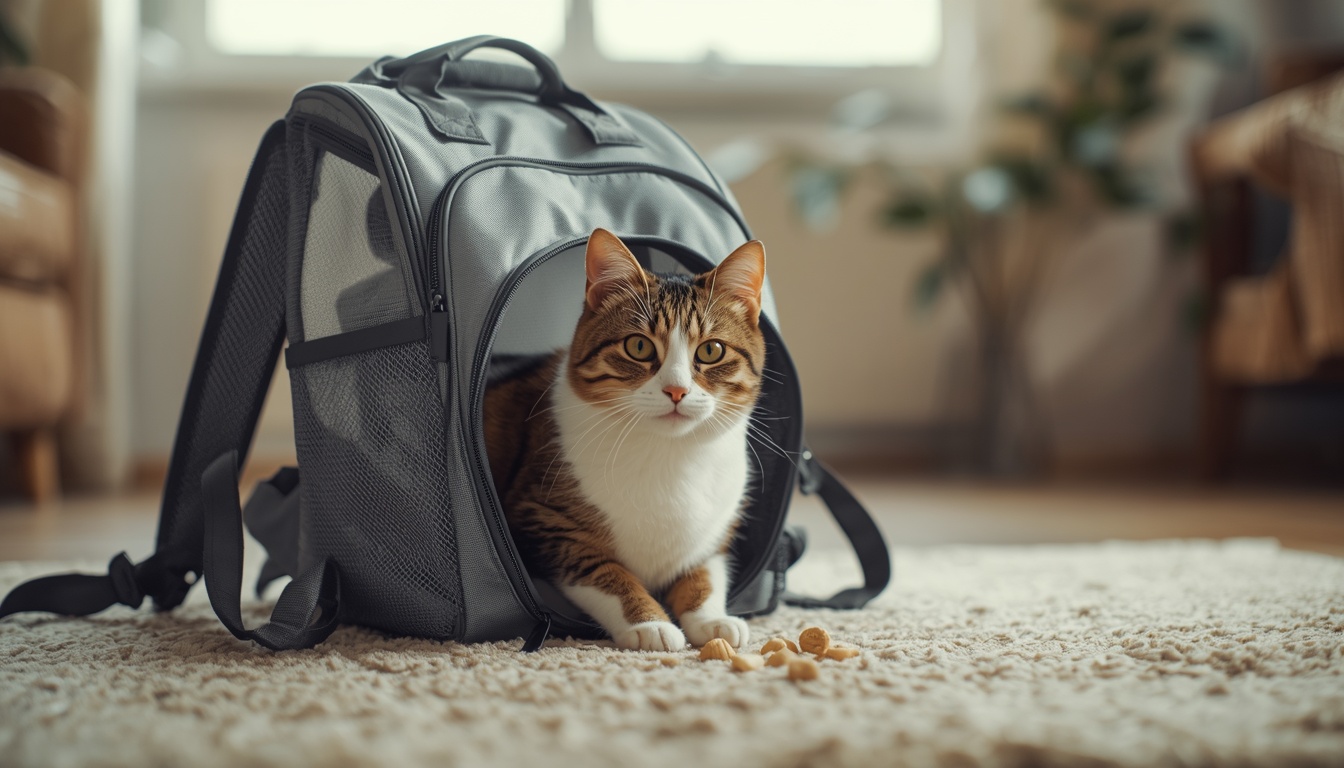
Quick Answer: How Do You Train a Cat to Use a Backpack Carrier?
Train your cat gradually by letting her choose to explore the backpack first. Introduce one step at a time: the zipper, a gentle lift, a few steps while wearing the backpack, and finally a short car session. Move forward only when your cat appears relaxed.
Start at least three weeks before your trip. Treat this as a practical minimum, not a scientifically established timeline.
What does the research suggest? The main trial identified in this article used a six-week training period. Your cat may need more time, so prioritize comfort over the calendar.
Before we go straight to the point and discuss how to train a cat to use a backpack carrier, let me tell you a personal story. Back in 2020, a few months after we rescued Billu, something horrifying happened. Not to our cat, thankfully. One of our next-door neighbors was driving to visit family in another city, about two hours away, with their cat in a hardshell carrier. The cat was presumably uncomfortable in there. At a gas station on the way, they took her out of the carrier, out of sheer affection.
There were people around, and cars were pulling in. The cat panicked, jumped, and ran as fast as she could. They searched for hours and found nothing. In the end, they got extremely lucky. Someone who lived nearby had seen her run, got in touch with them, and she was waiting at his home.
That’s the risk this guide is built around. The neighbors meant well. They were trying to comfort a cat who seemed unhappy in her carrier. But a cat who is comfortable in her bag gives you less reason to open it in the wrong place. Veterinary guidelines recommend keeping an inviting carrier in the home instead of bringing it out only for trips, and that’s what the plan below does, one small step at a time.

How My Cats React to Backpack Carriers
Cats are good at reading a situation. A few weeks after we got our first backpack carrier, we had a vet appointment. Somehow Billu and Simba figured out that I was trying to catch them. Maybe they guessed from the way I was dressed that I was taking them to “the unknown.” Either way, they were nowhere to be found.
On other days, both of them were seen exploring the insides of the backpack carriers.
That’s the double life of a carrier: a place to explore on ordinary days, and a warning sign on vet days. The plan below is about keeping the first one true.
Why Three Weeks, and Why It’s Not a Promise
Let’s cut to the chase. I couldn’t find a study that says how many days a cat needs to learn a backpack. Here is what the evidence does show:
What the Research Says About Cat Carrier Training
- A randomized trial involving 22 cats found that carrier training reduced stress during a short car trip and a simulated veterinary visit. The trained cats received 28 positive-reinforcement sessions over six weeks.
- A write-up of the trial reports that only three of the 11 trained cats completed all seven training stages. Sessions averaged about eight minutes.
- The Transportation Security Administration (TSA) advises familiarizing pets with their carriers in the days leading up to travel. This is practical travel guidance, not a study establishing how long cats need to learn to tolerate a carrier.
Before You Start: The Backpack and the Vet
TSA and the airlines don’t set a backpack standard, so this checklist is my own. Pick a backpack with good mesh ventilation, a stable base, a big opening, and a weight limit that fits your cat. A detailed breakdown of six different types of cat carrier backpacks can help you choose which one fits your needs. Not only that, if you are planning to take a flight with your cat any time soon, knowing which backpack fits under the airplane seat helps you prepare in advance.
Talk to your vet first if your cat is a senior, has a health condition, or seems to be in pain. A veterinary review of cat air travel recommends checking chronic disease, pain, and fitness to fly before a trip.
The 3-Week Plan, Step by Step to Train a Cat to Use a Backpack Carrier

Make It Furniture
Put the open backpack in a room your cat already uses, and leave it there. Veterinary guidelines recommend leaving an inviting carrier at home so it becomes a familiar place rather than something that appears only before a trip.
Put a familiar blanket or something that smells like you inside. If you are unsure whether she wants a view or a hiding spot, see should I cover my cat carrier.
Drop treats near the backpack, then at the entrance, then inside. Let your cat choose. Never push her in.
Move on when: she walks in voluntarily, stays long enough to eat a treat, and shows relaxed body language.
Add the Zipper and the Lift
Zip and unzip the backpack while she eats nearby, so the sound becomes ordinary.
Close one zipper for a second, open it, and give a treat. Build up slowly. Backpack trainers like KittyCatGO recommend this brief-closure method. I’d call it expert advice, not tested science.
Lift the backpack a few inches, support it from underneath, and put it down. Then carry it level across the room. Keep your movement steady.
Keep sessions short. The trial’s average was about eight minutes, which is a guide, not a rule.
Move on when: she stays relaxed through a short closure and a lift.
The first time I zipped Billu inside the carrier, all hell broke loose! She was desperate to get out. So, I unzipped the carrier and let her out. But I didn’t leave the lid closed. I kept it open. And guess what? Just one snack later, Billu had settled back inside the bag! She’s such a drama queen!

Wear It, Then Travel
Wear the empty backpack around the house so she can see and hear it moving with you.
Wear it with her inside for a few steps, then a few more. Ask someone to watch her face, since you can’t see her behind you. I found no evidence that rocking the bag on purpose helps, so just aim for smooth, even steps.
For a road trip, start with a short sit in a parked car, then a short drive. Never wear an occupied backpack while you drive. Secure it in the car following the manufacturer’s instructions. We’ll cover crash safety in a separate article.
For a flight, practice the handling TSA requires at the checkpoint: open the bag, lift her out, hold her, and put her back. Do it on a calm day and end with a treat. Our checkpoint guide walks through TSA’s pet screening steps. The rehearsal itself is my own idea, not a TSA program.
Ready when: she handles each step calmly and recovers quickly afterward.

Is Your Cat Telling You to Slow Down?
A still, quiet cat is not necessarily a calm cat. Veterinary guidelines say freezing can be a protective response. Watch for these signs:
- Freezing, hiding, or trying to escape
- Hissing, growling, or swatting
- Flattened ears, crouching, dilated pupils, lip licking, panting, or drooling, as used in a transport medication study
- Refusing a treat she normally loves
When you see them, go back a step and let her retreat. Don’t force her. Treat-taking alone isn’t proof she’s comfortable, because severe fear can override appetite.
Please read this part:
if she drools or vomits in the car, talk to your vet instead of practicing more. If you suspect pain, call the vet. If she has trouble breathing, collapses, or might be overheating, stop and get urgent veterinary care.
Billu or Simba? Shy Cats and Curious Cats
Veterinary guidelines say timid cats tend to look for concealment, while confident cats tend to explore or perch. In shelter research, a randomized trial found hiding boxes reduced stress in newly arrived cats. That’s a different setting, but it fits the idea that a safe hiding place helps. As I found no study showing how much longer a shy cat needs, These are my plans, not research:
Billu · The Timid Indoor Lover
I’d spend the whole first week letting her use the backpack as a hiding place and not rush week two.
Simba · The Curious Explorer
He’d probably treat the open backpack as a toy. My job would be teaching him that zipped-in time is fine too.
So, here comes the mind-game part! To Billu, the backpack is her safe spot. As someone who rushes under the bed or sofa even when a glass breaks inside the house, Billu sees the backpack very differently from Simba. To him, the backpack carrier is a new toy to explore.
However, whenever we tried to move the carrier while Billu was still inside, she freaked out and tried to open the lid. It was probably a safety trigger activated in her brain. That said, it took a little longer to teach Billu to stay comfortably inside the backpack than it did Simba.
Calming Aids Are a Vet Conversation
A small pheromone trial and two prescription-drug trials (gabapentin and pregabalin) found some benefit for short transport and vet visits. The FDA also approved Bonqat, a pregabalin oral solution, in November 2023 for transport anxiety in cats. None of this replaces training, and none of it tested backpacks or flights.
If your vet suggests medication, the air-travel review recommends a trial dose before the trip. Please don’t dose your cat yourself.
Training a cat to use a backpack carrier may sound easy, but it only works when you go slowly and follow each step carefully.
Want to try a pheromone product during training? Here is one option to consider:
Try the FELIWAY MultiCat Calming Diffuser KitAffiliate link: we may earn a commission at no extra cost to you.What Nobody Has Tested
I found no controlled study on backpack training, zipper desensitization, or training while the carrier is worn on your back. The main trial used ordinary carriers and short car trips. The air-travel review says no studies on cats flying were available when it was published. So the carrier steps are well supported, and the backpack steps are expert advice on top of them.
Before You Travel
Use this checklist to make sure you and your cat are ready for the journey.
Questions We Are Frequently Asked
No study gives a number. The main trial used six weeks. I suggest at least three weeks before a trip, and repeating any week your cat isn’t ready for.
Leave it open in a room she uses, put a familiar blanket inside, and reward her for approaching and entering. Don’t push her in.
Yes. Guidelines recommend keeping an inviting carrier in the home.
Severe fear can override appetite, so refusing food is a sign to go back a step.
The trial showed training helped the adult cats studied. For seniors or cats with health problems, check with your vet first.
I found no evidence it’s required. Some backpack trainers use one.
I wouldn’t. This is a precaution from vehicle-restraint guidance, not a tested finding. Secure it as the manual says.
Guidelines say any cover must allow airflow and watch the temperature. I found no study comparing bubble and mesh backpacks. Never leave a cat in a parked car, as the AVMA advises.

About the Author: Shafiqul Islam
Shafiqul Islam is the Founder & Editor of PetSpecial, an educator, and a devoted pet parent to his cats, Billu and Simba. Passionate about pet care, he created PetSpecial to help fellow pet parents find clear, practical, and trustworthy answers to everyday questions about their animals. His articles draw on personal experience where relevant, peer-reviewed scientific studies, and reliable veterinary sources to separate evidence-based guidance from unsupported claims and marketing hype.
Want to know more about Shafiqul and why he created PetSpecial? Visit the About Us page.