The Official TSA Cat Policy: Do They Have to Come Out?
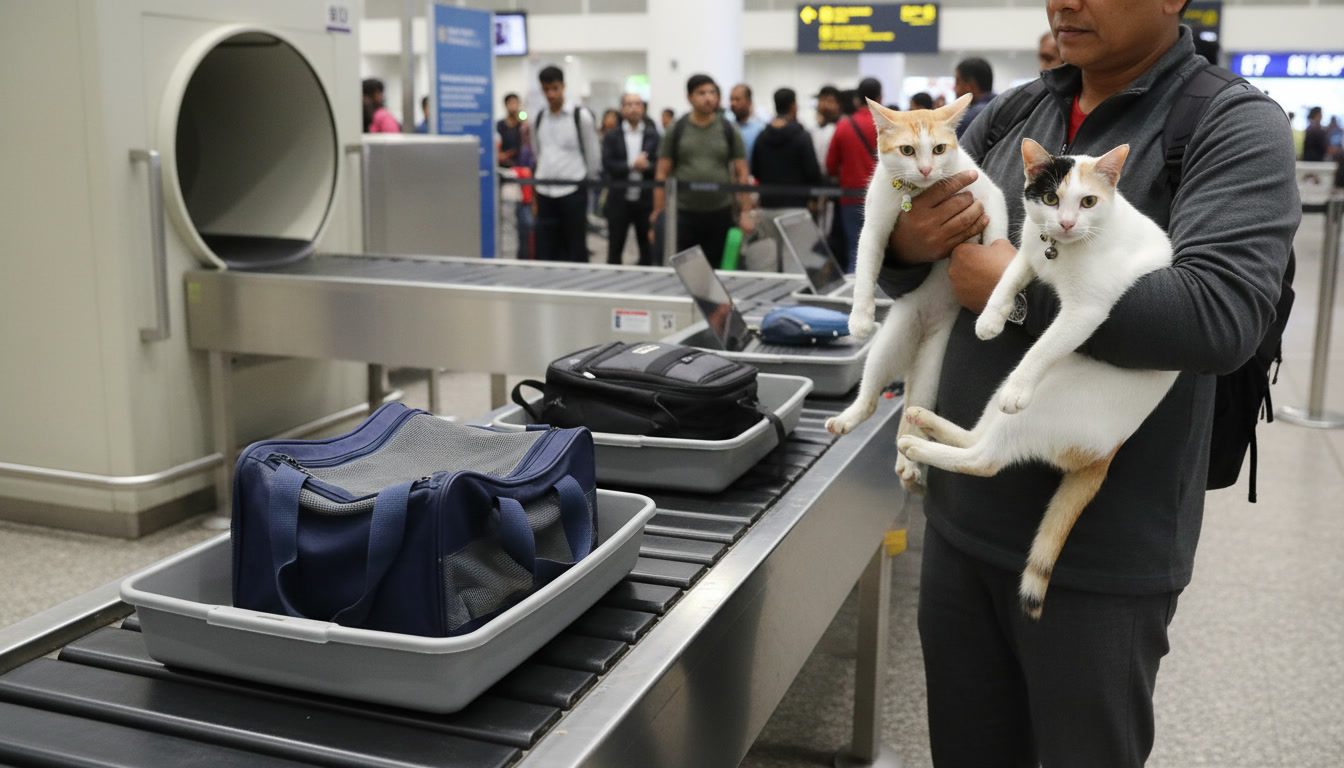
Yes, usually. Under standard U.S. checkpoint rules, a TSA cat screening requires you to remove your pet from its case entirely, sending the empty carrier through the X-ray while you carry your pet through the metal detector. For anxious pets prone to bolting, you can request a private room screening. For further details on travel-compliant bags, you can review the referenced source on Best TSA Approved Cat Carriers.
That is the short version of my answer. If you are shopping for a TSA cat carrier, here is what I wish I’d known earlier: the carrier is the smallest part of this problem. The bigger issue is dealing with your cat’s fear of the airport chaos.
TSA Pet Carrier Requirements: What Actually Happens at the Checkpoint
Here is the sequence, straight from TSA’s pet screening tips and its Small Pets page:
Taking Your Cat Through TSA
Follow the screening process while keeping your cat’s safety in mind.
Bring your cat to the checkpoint in a hand-held carrier.
Wait for the officer’s instructions before taking your cat out. Explain if your cat may panic or bolt.
Place the empty carrier on the conveyor belt for X-ray screening. Never put your cat through the X-ray machine.
Carry your cat through the walk-through metal detector as directed. TSA advises removing the leash while carrying your pet through it, only if there is metal in it.
Complete any additional screening, which may include an officer swabbing your hands for explosive residue.
Once screening is complete, put back your cat into the carrier immediately to avoid any unwanted and rush behavior from your cat. Then move to a quiet place.
Two details are easy to miss. First, TSA says to keep control of your pet with a leash, then remove the leash when you carry your pet through the metal detector. After that, your arms are the leash. Second, TSA says to watch for working dogs and consider using another checkpoint if you see one.
What TSA does not publish is how long the swab takes, how long a private-room wait is, or how to juggle your cat, the carrier, and your bags all at once. And the final call always rests with the officer on duty.
What the Checkpoint Is Really Like With a Cat
Most ‘TSA cat carrier’ guides talk about which bag to buy. I get it, I wrote a whole guide on backpack carriers myself. But a carrier only protects your cat while the zipper is closed. However, that protection breaks down the moment you cross the security gate and the zipper has to open. When planning for flying with a cat, TSA guidelines can look simple on paper, but trust me, the whole episode would make you feel bewildered if you go to the airport unprepared.
I have two cats, and they could not be more different. Billu, who I rescued in March 2020, is a homebody. When a guest arrives, she disappears under the sofa or the bed frame, and she is very hard to catch. Simba is her son. He was born in October 2021, two months after Billu secretly found a boyfriend during a short trip to our rural home. Unlike his mother, he walks straight up to the newcomer and meows for pets.
Now picture each of them in a loud checkpoint with the carrier suddenly out of reach. Same airport, two very different risks. Even if you have one cat, the risks don’t go away.

About a year after Simba was born, I was travelling with my sister on a domestic flight. At the security checkpoint, I had to take the cats out of their carriers and hold them. I was holding Billu, while my sister held Simba. Everything was fine until the metal detector next to us started beeping at a shrieking pitch. As usual, Billu freaked out and tried to jump out of my arms to find somewhere to hide. Instinctively, I tightened my grip, and her sharp nails pierced my skin. I forgot all about the blood running down my hand and focused on one thing: not losing Billu.
What I had forgotten was that she was on a leash. All this was happening while Simba sat on my sister’s lap, curiously observing the weird things his mother was doing. He was probably wondering, “What the hell are you doing, Mom?!”

During another trip in 2024, two things happened that are worth mentioning. I was travelling with Simba this time, without Billu. He was observing people over my shoulder. Suddenly, I felt an unusual reaction from him. Since we were in a restricted area inside the airport and I was waiting in line, his reaction felt strange at first. So I looked back and understood what had happened. He had spotted a service dog actively sniffing the belongings of incoming passengers.
I was already in a different line, so I didn’t worry much. But when I had to take off my shoes and belt and leave everything on the tray while holding Simba in one hand, it was a real nightmare.
Real Risks: When TSA Cat Screening Fails
These incidents show why keeping a cat secure during airport screening matters. A brief moment of confusion can become frightening for both the cat and its owner.
Muji, LaGuardia Airport
NPR reported that Muji bolted during TSA screening on Christmas Eve while traveling from New York to California. She spent 11 days hiding in the airport ceiling before being reunited with her owner.
Xiaohwa, JFK Terminal 4
According to Fox News, Xiaohwa bolted from her crate while an officer was inspecting it and was still missing when the story was published. TSA reminded passengers that they are responsible for their pets during screening.
A Cat at Dulles International Airport
TSA spokesperson Lisa Farbstein told the Anchorage Daily News that a cat had escaped at Dulles but was quickly caught. She recommended requesting a private screening room for cats.
The Norfolk X-ray Incident
On March 3, 2023, Farbstein reported that a traveler had left a cat inside its carrier at the Norfolk checkpoint, resulting in the carrier being X-rayed with the cat inside. The cat was reported to be fine. Yahoo News covered the incident.
The Truth About “TSA Approved Cat Carrier” Claims
TSA does not publish a list of approved cat carriers. TSA’s Small Pets page does not mention any approved carrier, size, or brand. It only says to take your pet out, put the case through the X-ray, and expect the carrier to get a visual and/or physical inspection. So “TSA approved” on a product page is a sales phrase, not a stamp approved by TSA whatsoever.
Size is a different test, and it belongs to your airline. For that part, read my guide on whether a cat backpack fits under an airline seat.
Handling Anxious Pets: Requesting a Private Room TSA Pet Screening

TSA specifically recommends asking for a private room, especially for cats that may struggle or jump away. There is no form to fill out. You just ask an officer, before you open the carrier.
“I’m traveling with a cat that may bolt when removed. I’d like a private screening room for pet screening.”
Then, before the zipper opens, ask how the carrier will be screened and returned, and how the hand swab will work while you keep hold of your cat.
Keep in mind: A private room is not a magic fix. Your cat and carrier still get screened, and a closed door does not make escape impossible. TSA does not promise a wait time either, so plan to arrive earlier than usual.
What If They Say No?
TSA recommends the private room, but travelers don’t always get it. A reader on Cats Going Places wrote that at Orlando in March 2019, with two cats in two carriers, TSA refused a private screening. On the Where Is Jack blog, a volunteer was told no private room existed at that location in 2013. A commenter on the same post said Oakland airport was very helpful and took them into a private room. So, it shows you both sides of the coin.
I can’t promise you a yes. My suggestion, not a TSA rule: ask politely, say the cat may bolt, and ask the officer what they recommend if a room isn’t available. If it still feels unsafe, ask whether a supervisor can help. My advice would be: check first with the airport before you even book your tickets.
Before You Open the Zipper, Agree on the Plan
At the checkpoint you have to hold your cat, place the empty carrier, hold out your hands for the swab, and grab your bags. TSA lists these steps but doesn’t say how to do them all at once. These are my suggestions, not TSA rules:
5 Steps to Follow
Explain your plan first. Say what you intend to do out loud to the officer before you open anything.
Clarify carrier handoff. Ask who will handle the empty carrier and when it will be returned to you.
Wait until the last safe moment. Take your cat out as late as the officer allows. TSA guidance says to remove the cat just before screening begins.
Keep responsibility in mind. Don’t assume an officer will hold your cat while you manage the carrier or your belongings.
Know when to request privacy. If you can’t picture holding your cat safely through the whole sequence, ask for a private screening room before opening the carrier.
Billu or Simba? Know Your Cat’s Type
TSA itself says you should know your pet’s temperament, especially cats, who often get skittish once they are out of the carrier and hear the sounds of a checkpoint.
- Billu · The Timid Indoor Lover. She hates outside noise and gets anxious away from home. I wouldn’t gamble on the open lane with her. I’d ask for the private room straight away.
- Simba · The Curious Explorer. He wouldn’t panic. The second the zipper opened, he’d wander toward the nearest interesting thing, unless a service dog was around. I’d still choose the private room for him.
These are my plans based on knowing my cats. A bold cat can bolt, and a timid cat can sit perfectly still. As you already know how my cats react in airport situations, let me introduce you to my friend Mariam. Her cats, Rosita and Leo, are her travel companions, too.
I asked her which of the two worries her more when they travel together. Her answer was Rosita, for a reason that sounded familiar to me. Just like Billu, Rosita doesn’t like the noisy outside world. That means Mariam has to be especially mindful of her when booking flights. But Mariam shared something I hadn’t thought of before: she tries to book flights during off-peak hours, usually very early in the morning, when the airport is relatively empty.
I found that genuinely interesting. Choosing a quieter time won’t eliminate the stress of air travel, but it may help reduce the noise, crowds, and commotion that make some cats anxious. Sometimes, keeping your cat calmer starts before you even pack the carrier. It starts with choosing when you travel.

Check Your Carrier Before You Leave
TSA does not set a carrier standard, so this checklist is my own, not TSA’s. Check it with the carrier empty:
- The zipper closes fully, and the lock actually holds.
- There are no holes in the mesh or loose stitching where the mesh meets the carrier body.
- You can lift your cat out and put them back without dragging their limbs.
- The frame keeps its shape when lifted and when a door is open.
- The carrier fits your airline’s size rules with your cat inside.
Why bother with seams and plastic? In its 2015 crash tests, the Center for Pet Safety saw stitching fail around one carrier’s front mesh panel and a plastic carrier fracture on impact. Those were car-crash tests, not checkpoint tests, so they don’t tell us how often carriers fail at security. They do show why I check the weak spots before every trip. Also, a tether clipped inside the carrier can’t help once your cat is out of it, so I wouldn’t count on one as part of the plan.
The Security Harness: Your Secondary Line of Defense
When you unzip your carrier at the checkpoint, your arms become your cat’s primary restraint. However, a properly fitted, escape-proof harness serves as a critical secondary insurance policy if your pet slips out of your grip.
Under standard TSA pet screening rules, you are advised to remove your cat’s leash just before walking through the walk-through metal detector, but the harness itself can usually stay on the animal if it does not contain any metal. Any harness with metal must go through the X-ray scanner.
The Harness Workflow at the Checkpoint
-
1
Keep It On From Home
Secure the harness on your cat and place them in the carrier before leaving for the airport. Do not attempt to put a harness on a nervous cat inside a busy terminal.
-
2
Unclip the Leash Last
Keep the leash attached to the harness and wrapped around your wrist until the exact moment the TSA officer instructs you to remove your cat from the carrier.
-
3
Follow the Screening Sequence
Unclip the leash and place it in the gray plastic bin for X-ray screening. Carry your harness-wearing cat securely through the metal detector, following the TSA officer’s instructions.
-
4
Regroup Before Reattaching the Leash
After screening, move to the designated recomposure area if available. Place your cat securely back inside the carrier and reattach the leash only after the carrier door is fully closed and secured.
Safety reminder: Screening procedures can vary. Follow the instructions of the TSA officer, and never risk losing control of your cat to follow a fixed sequence.
Calming Your Cat Before the Airport
Here is what the research says, and it is honest: a veterinary review of cat air travel notes there are currently no studies specifically on air travel in cats, so many tips rest on clinical experience. Treat the ideas below as good habits, not guarantees.
- Get your cat used to the carrier. TSA recommends familiarizing your pet with the carrier in the days before the trip.
- Cut down the noise and sights. Minimize sensory input at the airport and during travel to help make the experience less overwhelming.
- Rehearse at home. Practice opening the carrier, lifting your cat out, and holding them in a quiet room before travel day.
- Consider a feline pheromone spray. Some cat owners use products containing synthetic feline pheromones as part of travel preparation. For example, the manufacturer’s directions for Feliway Classic Spray recommend applying 8–10 sprays inside the carrier or onto bedding 15 minutes before allowing your cat access. Never spray your cat directly or spray the carrier while your cat is inside. Effects can vary between cats.
- Discuss travel medication with your veterinarian. Never give your cat medication or choose a dose without veterinary guidance. If medication may be appropriate, discuss it well before your trip so your vet can determine a suitable plan and advise you about its effects. The U.S. Food and Drug Administration (FDA) approved Bonqat (pregabalin oral solution) in November 2023 to help alleviate anxiety associated with transportation and veterinary visits in cats. It is a prescription medication, so ask your veterinarian whether it is suitable for your cat.
A light cover over the carrier is one way to cut down what your cat sees in the terminal. I go through the evidence in should I cover my cat carrier.
Pet travel · Pre-flight checklist
Before You Fly
Complete these checks before heading to the airport with your cat.
Frequently Asked Questions
These are the questions travelers ask most. I checked the TSA answers against TSA’s own pages. Where TSA is silent, I say so.
At the Checkpoint
Yes, under TSA’s standard procedure. The empty carrier goes through the X-ray and you carry your cat through the metal detector. If your cat may bolt, ask for a private screening room.
Bring your cat in a hand-held carrier, take her out just before screening, and send the empty carrier through the X-ray. Carry her through the metal detector, get your hands swabbed, then put her back in the carrier in the recomposure area. If she may bolt, ask for a private screening room before you open the carrier.
No. TSA says never place a pet in the X-ray tunnel.
TSA says to carry your pet through if possible. It also says a pet can walk through on a leash, and to follow the officer’s guidance. For a nervous cat, I would carry.
TSA doesn’t publish a list of approved harnesses. It says to keep control of your pet with a leash, then remove the leash when you carry your pet through the metal detector. A harness with no metal can stay on your cat. If yours has metal buckles or rings, take it off and send it through the X-ray, and pack a non-metal one for travel days.
An officer swabs your hands for explosive trace detection. TSA doesn’t publish how long it takes. The real question is how you’ll hold your cat while you hold out your hands, so ask the officer before you open the carrier.
TSA says to look out for working dogs and handlers, and consider shifting to another checkpoint so you don’t interfere with the dog’s work.
TSA says to do it in the recomposure area, away from the checkpoint.
The Private Room
Ask for a private screening room before you open the carrier. TSA recommends it for pets that may struggle or jump away, and says you are escorted there with the pet still in the carrier.
No. The pet and the carrier are still screened.
TSA doesn’t publish a wait time. Traveler reports vary, so plan extra time and don’t cut it close to boarding.
There is no guarantee. TSA’s pet guidance doesn’t describe the rooms. My suggestion, not a TSA rule: before you open the carrier, look around the room and ask the officer to close the door. If you see gaps or open spaces you can’t control, say so.
See “What If They Say No?” above. I can’t promise a yes. Ask politely, say the cat may bolt, and ask what the officer recommends.
TSA’s pet guidance doesn’t say what to do. TSA’s statement in the JFK report was that owners are responsible for their pets throughout screening. My suggestion: tell the nearest TSA officer or airline staff right away and ask for help instead of chasing. In the reports I found, cats hid in places people couldn’t reach, like the ceiling, which is a good reason to ask for help early.
Carriers, Rules and Calming
Not because of the label. TSA doesn’t publish a carrier standard. Check the carrier yourself, and check your airline’s size rules.
TSA’s pet pages don’t mention one. Airlines set their own pet rules, fees, and paperwork, so check with yours.
Talk to your vet and don’t dose your cat yourself. A veterinary review says the dose should be worked out a few weeks before travel. Bonqat, the FDA-approved option for transport anxiety in cats, is prescription-only.
Vets say air travel can be stressful for cats, partly because they lose control and predictability. The same review says a cat’s fitness to travel should be assessed as soon as air travel is considered. So talk to your vet early, and think about your cat’s age, health, and temperament before you book.
