💡 Quick Summary
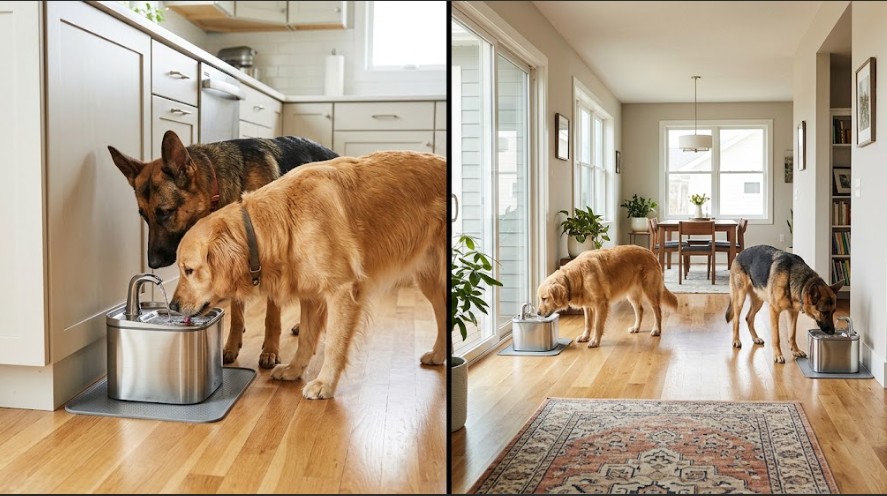
Can two dogs share one water fountain? Yes, but not every two-dog household will have the same experience. The right setup depends on your dogs’ size, drinking habits, behavior, and access to the water, not simply the size of the fountain. One large fountain may work perfectly well for dogs that share comfortably, while two smaller water stations may be the better solution when one dog blocks, guards, or singles out the preferred fountain. And sometimes, the second water station doesn’t need to be another fountain at all.
My friend Hannah’s dogs, Klaus and Bruno, are both large breeds. Both are fond of each other, and they even share toys and play together. But when it comes to sharing food, Bruno seems very possessive. Not only does he guard the dog water fountain, but he doesn’t let Klaus anywhere near it, especially when he is around. So, how did she solve the problem? Hannah bought a new smaller fountain on top her existing 7L one for her two dogs. She effectively applied the “out of sight, out of mind” principle to solve a dog problem that millions of households undergo every day.
You might now be wondering whether the easiest solution to getting your two dogs to access water from one fountain has a single fix like Hannah’s, but that is a much more complex issue than we typically think. How big a fountain you have has less to do with solving the problem than your dogs’ behavior, size, drinking habits, and the way you arrange their water stations. These can all determine whether one fountain works or whether two are the better solution.
The good news is that two dogs sharing a fountain is not a problem in itself. Vets generally say dogs who share a home can share a water bowl, though they recommend having multiple water sources in multi-dog households so every dog has steady access to fresh water. And capacity is rarely the real issue: a healthy dog drinks roughly one ounce of water per pound of body weight per day, so two 70-pound dogs would go through about 140 ounces (around 4 liters) between them. Scientific studies often link a dog’s kidney health with how much water it drinks. An 11-liter reservoir would last them more than two days. If your dogs are still competing for water, access is the likelier culprit.

Signs You May Need Two Water Stations
You may think installing an 11L container can resolve the issue of one dog blocking the other from drinking its share of water. But the problem is much more complex than that. It does not involve the lack of access to water, but your dog’s dominant behavioral patterns. For instance, my friend Hannah’s dogs are playful and fond of each other, but Bruno has unique characteristics when it comes to allowing Klaus to access the water.
Here are a few situations that might resemble yours:
One Dog Blocks or Guards the Fountain
Even if your fountain is large, the persistent issue might be related to one dog’s accessibility to it while the other blocks it. Let me rephrase: there is a difference between your one dog casually blocking the fountain and persistently blocking the other dog from accessing it over and over again throughout the day. Obvious signs of guarding may include growling, stiffening, staring or reacting when the other dog approaches the fountain. In such situations, you have to watch your dogs’ behavior very carefully.
But does it automatically mean your dog has a behavior problem each time it blocks the fountain? Maybe not! If your dog keeps doing this, it may simply mean that one of your dogs prefers one fountain over the other and thinks of it as its own. So, as a dog parent, it should be your primary goal to ensure that both dogs can access water freely.
Remember that having a large reservoir does not mean your dogs can access water at will. If the situation comes down to one dog frequently becoming dehydrated because of this problem, it would be safer to install two separate fountains right away. The dog behavior research we have consulted shows that the habit of guarding fountains exists in two-dog household scenarios, but is less common than food or toy guarding in household contexts.
So, the next time one of your dogs guards its fountain, observe whether that is a repeated behavioral pattern or a one-time act of dominance.
Your Dogs Have Different Sizes, Personalities, or Drinking Habits

Guarding the fountain is one of the many reasons why this behavior may persist. As I often say, each pet has its own distinct personality that guides its behavior. Your two dogs have different personalities, and their differing sizes and drinking habits may contribute to their reluctance to share the same fountain.
Let me bring my friend Sarah’s dogs into our discussion here. Persley is a relatively small breed, while Bogus is the large male who loves to occupy his own space. When he is inside the living space, his behavior makes us believe that Persley is merely a guest, despite the fact that Bogus came much later into the household. So, if one of your dogs is large and the other is small, it is likely that the small one will wait until the large one finishes first. The larger dog may not even realize that it is preventing the other dog from drinking.
One dog may simply be more assertive, while the other may be more willing to wait. In such cases, you may not see growling, snapping, or any obvious signs of resource guarding. But if one dog keeps waiting for the other to finish drinking, it is still something you should pay attention to.
The other issue might involve drinking habits. Hannah’s dog Bruno likes to drink water in smaller sips throughout the day. But Klaus has a different approach when it comes to drinking water: he drinks larger amounts less frequently. Plus, one might take a lot of time to drink, while the other takes only a few seconds. These behavioral patterns can accumulate over time and add to the inconvenience of having one fountain in a two-dog household.
Besides, if one of your two dogs is a senior, you need to give extra attention to the senior dog as it might demonstrate unsual drinking patterns. When it comes down to keeping your elder dog hydrated, the scenario also invloves ensuring it remains healthy.
Now, if you are considering adding another fountain to the existing one at your home, I’d advise you not to assume that two dogs naturally need two separate fountains simply because of their differing characteristics. On the contrary, observe a few behavioral patterns: how they approach the fountain and whether one dog routinely waits. If one of your dogs walks away when the other approaches, pay close attention to this behavior. Also, keep an eye on whether one dog gets enough time to drink without being interrupted by the other.
👀 Watch Your Dogs Before Adding Another Fountain
The next time one of your dogs guards or blocks the fountain, don’t immediately assume that you need a second one. Instead, watch what happens:
- Does the same dog repeatedly block the fountain?
- Does the other dog walk away when it approaches?
- Does one dog consistently wait for the other to finish drinking?
- Does the behavior happen repeatedly throughout the day?
If you see a repeated pattern, the problem may be accessibility rather than fountain capacity. That is when a second water station may make more sense than simply buying a larger fountain.
When Both Dogs Need Water at the Same Time
Maybe the problem is not with how your dogs behave, but with the shape and design of the fountain and the structure of your home. If the fountain becomes a bottleneck when both dogs want to drink simultaneously, it may be time to look at how accessible the water station is rather than simply increasing its capacity.
The Fountain Can Become a Bottleneck
During hot summer days, when my friend Hannah takes her dogs out for a long walk, the problem starts when they return. I am talking about the time before she decided to order a second fountain. The previous fountain did not offer enough space for her two large dogs, Bruno and Klaus, creating a bottleneck that sometimes left Klaus waiting for tens of minutes before Bruno would leave the fountain area. Even though they normally get along well, the single fountain simply did not provide enough space for both dogs to drink comfortably.
This becomes a major issue if your house is relatively cozy and you place the fountain somewhere that cannot comfortably accommodate two big dogs. One may occupy the most convenient spot while the other waits nearby impatiently. Neither dog is necessarily guarding the fountain, but the design of the water station and its surroundings might still make access difficult and uncomfortable.
The same problem can occur if the fountain is placed in a narrow corner, beside furniture, or where one dog naturally stands in front of it. In such cases, the other dog may struggle to reach the water comfortably. If both dogs need to drink at the same time, a fountain with a wider or 360-degree drinking area may provide more accessible space than one with a single narrow drinking point.
So, before you decide that your dogs need a larger reservoir, take a look at the actual setup. Can both dogs comfortably reach the water at the same time? Or does the design and location of the fountain make one dog wait?
That small difference can tell you whether you need more water capacity or simply another accessible water station.

When a Second Station Makes More Sense Than a Bigger Fountain
So, does buying a fountain with a larger reservoir capacity come to your rescue? That should depend on a number of factors. If your dogs keep blocking each other, merely increasing the reservoir size will not fix the problem.
If both dogs can comfortably share the existing fountain, there may be no reason to add another one. But if one dog repeatedly waits, walks away, or gets blocked from drinking, a second water station may be a much simpler solution. It does not necessarily have to be another fountain. A simple water bowl can also work if space is limited, as long as both dogs have easy access to water when they need it.
One Fountain or Two? A Quick Decision Guide
The right setup depends on how your dogs actually use their water station. Use the situations below as a practical guide rather than assuming that every two-dog household needs two fountains.
What Other Dog Owners Notice – Collected from Reddit
Interestingly, this behavior is not limited to one household. In a Reddit discussion among Great Dane owners, several dog parents described having multiple water bowls available, only to find that their dogs preferred drinking from the same one.
One Redditor, parallax__error, said their dogs would continue drinking from the same side even when the bowls were switched around. Another user, StockYogurtcloset868, said that despite having two Great Danes, a Collie, and three large water bowls, all three dogs preferred drinking from the same bowl.
Another interesting observation came from RGB-Free-Zone, who said one of their dogs would politely wait for the other dogs to finish drinking, even though multiple bowls were available. In another discussion, Pupkinsmum said they had always used one large water bowl for their dogs and cats because their animals were perfectly happy sharing it.
These are, of course, individual experiences rather than scientific evidence. But they illustrate an important point for a two-dog household: giving each dog its own bowl or fountain does not necessarily mean each dog will use the one assigned to it. Dogs may develop preferences for a particular water source, location, or even the bowl another dog is currently using.
So, if your two dogs insist on drinking from the same fountain despite having another option available, that alone does not necessarily mean something is wrong. What matters is whether both dogs can actually access water comfortably and without repeatedly preventing each other from drinking.
Once you’ve figured out whether your dogs need one water station or two, read our hands-on guide comparing the top 5 water fountains for multi-dog homes to find a design that matches their habits.
How to Set Up Water for Two Dogs
Now that you know under what conditions you may need a second fountain for your two dogs, let us discuss how to set up water for them.
1. You Don’t Necessarily Need Two Fountains
If your two dogs hardly ever block each other while drinking from a single fountain, I see no reason why you should spend money on another fountain that would also take up additional space inside your home. But if you get a second fountain and place it outside while the existing one remains indoors, that gives us a different equation.
The important thing here is that just because you have two dogs, they do not automatically need two separate fountains. Whether or not an additional fountain would make sense depends on their behavioral patterns. All you need to ensure is that your dogs have access to clean water 24/7.
2. Think About Where You Place the Water Stations
Even if there are two fountains in your home, your dogs might not be able to access them comfortably if they are placed in a corner where two large dogs can barely move around freely. Setting up two fountains right next to each other or putting a bowl next to a fountain may barely solve the problem. Instead, we would advise you to place them in separate locations, preferably near the areas where your dogs spend most of their time indoors.
If your two dogs have different drinking habits, consider having two different water stations.
3. Watch Your Dogs and Adjust the Setup
We have already talked about the necessity of monitoring your dogs’ behavior closely. Based on how they behave, relocate the fountains to maximize the chance of your dogs staying hydrated. Watch for things like how they approach the water, whether one regularly waits while the other drinks, and whether either of them avoids a particular station.
If both of them are comfortable with the setup, there might be no reason to relocate the fountains. But if one dog is repeatedly struggling to access water, changing the location or adding another water station could be more useful than simply buying a new, larger fountain.
4. Keep Every Station Clean
One more thing I’d add: two dogs mean more slobber, and more stations mean more to scrub. That slimy film you sometimes feel on a bowl or fountain is called biofilm, a layer of bacteria protecting itself inside a slime. Vets differ on how often to wash: some say at least once a week, others recommend a daily scrub with hot, soapy water. With two dogs sharing, I’d go with daily. Fountains aren’t exempt, so take them apart, scrub them, and change the filters as the manufacturer recommends.
Need More Water Capacity?
Once you’ve figured out whether your dogs need one water station or two, the next step is finding a fountain that matches their size, drinking habits, and daily water needs.
Explore Large-Capacity OptionsFrequently Asked Questions
Some dogs simply develop a preference for a particular bowl or fountain, even when another water source is available. We have observed that this can happen even when several bowls are placed around the home. A preference by itself does not necessarily mean there is a behavioral problem.
They can, if both dogs still have comfortable access to water. If one dog’s drinking habits consistently prevent the other from drinking when needed, a second water station may be useful.
Not necessarily, but the drinking area should allow both dogs to access the water comfortably if they approach the fountain together. A large reservoir only increases capacity, so a bigger fountain will not necessarily solve a problem caused by limited drinking space.
If you are using two stations because one dog blocks or crowds the other, placing them separately can be more useful than putting them side by side. Ideally, position them in areas where your dogs normally spend time so each has an accessible option.
Yes. The second station does not necessarily have to be another fountain. A clean, accessible water bowl can provide an alternative source if your main goal is to make sure both dogs can reach water without competing for the same station.
If you notice a significant or persistent increase in your dog’s water consumption, it is worth discussing it with your veterinarian rather than assuming it is simply a drinking-habit difference. Excessive thirst can sometimes be associated with an underlying health issue, so measuring how much your dog actually drinks can give your veterinarian useful information.
Before we conclude
Two dogs can share one fountain when both get easy, unpressured access to water. Spend a few days watching how yours use it. If one waits, gets blocked, or avoids the fountain, add a second station in a different spot, whether that is another fountain or a simple bowl. And if your dog’s drinking changes suddenly, check in with your vet.
This article is for general information and is not a substitute for advice from your veterinarian or a qualified dog trainer.

Shafiqul Islam
Shafiqul Islam is a university educator, writer, and longtime pet owner. At PetSpecial, he combines personal experience with research to write about pet care, animal behavior, and practical decisions that help pet owners care for their animals.
3 thoughts on “Can Two Dogs Share One Water Fountain? One Fountain vs Two”