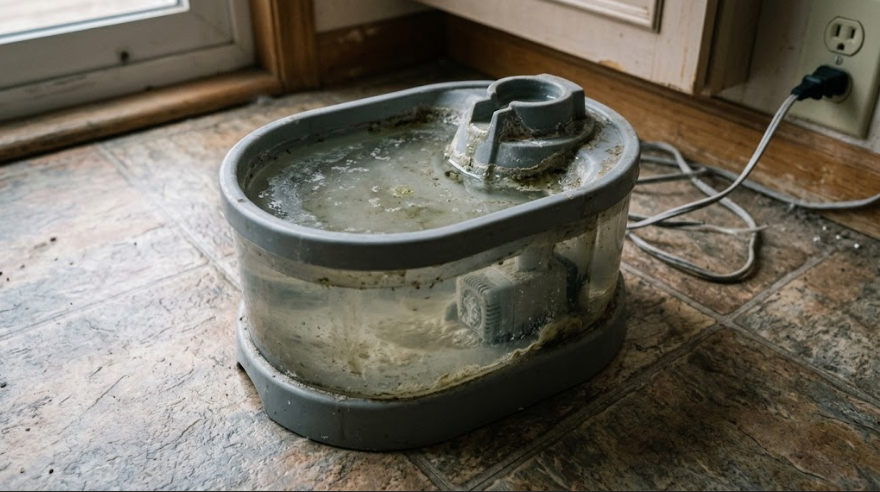
Quick answer: A fountain shared by two dogs doesn’t need exactly double the cleaning, but it usually needs more frequent cleaning, because two dogs mean more saliva, hair, and food debris going in. Rinse and refill daily, do a full wash every 3-7 days, and clean the pump and filter on a weekly or manufacturer-recommended schedule. Circulating water does not clean itself.
If two dogs share your fountain, you probably know this routine. You scrub it until it looks spotless, and a few days later the water feels slick, there’s a film on the basin, and hair and bits of kibble have lodged around the pump.
Does that mean you bought a bad fountain? Usually not. A shared fountain simply gives saliva, food debris and hair more ways into the same wet system. Research on dog water bowls shows that bacterial counts climb over time, and at least one manufacturer, PetSafe, tells owners that multi-pet homes should clean more often than single-pet homes.
One caveat before we go further. We couldn’t find good evidence that two dogs produce a specific 2× or 3× increase in fountain biofilm, so we won’t claim one. The more defensible explanation is plainer: two dogs are more likely to put organic material and microbes into the water.
You’re not alone. Two friends of mine, each with two dogs, told me the same thing: a few days after a thorough clean, the film is back.
If the slime keeps coming back even though you’re cleaning, it’s worth looking at what the fountain is made of and how easily it comes apart.
What is that slippery film?
That film is usually biofilm: a community of microorganisms that sticks to a surface and surrounds itself with a slimy matrix. It isn’t just dirt floating in the water. Once microbes have settled on a wet surface, they’re harder to remove than free-floating ones, and gentle rinsing often won’t do it (see Donlan, 2002).
The best dog-specific evidence comes from bowls rather than fountains. In a small Hartpury University study, researchers swabbed plastic, ceramic and stainless-steel water bowls at the start, then again at day 7 and day 14. Bacterial counts rose significantly between the start and both later checks, in every material. They did not find a statistically significant difference between the three materials.
A 2022 study in PLOS ONE looked at dog food dishes rather than water bowls. The researchers surveyed 417 owners, swabbed the dishes of 68 dogs, then asked some owners to follow FDA hygiene guidelines for about a week. Those dishes ended up significantly less contaminated than dishes in the comparison group, and washing in hot water or a dishwasher worked better than cold or lukewarm water.
Neither study tested an electric fountain. A fountain has parts a bowl doesn’t: a pump, an impeller, a filter housing, tubing, seams. It’s reasonable to apply what we know about biofilm and dog bowls to those parts, but nobody has measured biofilm inside a two-dog fountain, and we shouldn’t pretend otherwise.
Moving water isn’t clean water
A running fountain can look fresher than a bowl of still water, but circulation doesn’t scrub anything. Saliva, hair, food particles, dust and whatever your dogs carry in on their muzzles and paws all end up in the reservoir, and the slimy layer builds on the surfaces underneath.
Makers say as much. PetSafe’s support page for its Seaside Stainless fountain tells owners that, even with filters, they should dump out old water and refill with fresh often to limit the saliva, food debris and fur that make a fountain dirty sooner. What matters isn’t whether the water moves. It’s where grime can stick and how easily you can get to it.
The pump is often the dirtiest part

The reservoir is the part you see. Underneath it, the pump, impeller, filter housing, tubing and small channels give hair and debris plenty of places to collect.
That’s why design counts almost as much as material. PetSafe’s own instructions for removing slime say to take the pump apart and scrub inside it, down where the impeller sits, not just wash the outside. A fountain you can strip down and scrub in five minutes will usually stay cleaner in practice than a “more hygienic” one full of parts you can’t reach.
So when you’re choosing or maintaining a fountain for two dogs, the useful question isn’t how well it filters. It’s how completely you can take it apart.
Why two dogs change the cleaning equation
Two dogs don’t automatically mean twice the cleaning. What changes is how much goes into the water. Two dogs may drink more often, shed more hair near the reservoir, track in more debris and leave more saliva behind. How fast your fountain gets grubby depends on the dogs, the design, your water and where the fountain sits.
That makes a schedule built around what you can see more useful than a fixed number of days. (Whether two dogs should share a fountain in the first place is a separate question, and we cover it in Can Two Dogs Share One Water Fountain?)
What it looks like in two households
Numbers only go so far, so here are two real two-dog homes. I asked two friends how their fountains hold up. Sarah and her dogs, Bogus and Persley. Bogus is a large breed and Persley is smaller. They share one fountain. Sarah told me that a few days after she cleans it, biofilm is back.
Hannah and her dogs, Bruno and Klaus. Hannah looks after both dogs, and both are big. She runs two fountains, a larger one and a shorter one, and she reports the same pattern: biofilm builds up on both a few days after she cleans them. If you have an elder dogs at your household like Klaus, our practical guide on how to keep a senior dog hydrated might offer you some help.
The households differ: one fountain versus two, a mixed-size pair versus two big dogs. The timeline is the same in both. Within a few days of a thorough clean, the film returns. That doesn’t prove anything about dogs in general, and neither friend tested the film in a lab, so “biofilm” here is how they describe the slimy layer. But it fits what the research suggests: let what you see building up set your interval, not the number of dogs. It’s also why this article suggests a deeper clean every few days rather than every few weeks.
A cleaning routine for a two-dog fountain
Treat the following as a practical starting point, not a research-backed protocol. For reference, PetSafe’s guidance for its stainless multi-pet fountain is to clean at least every two weeks in a multi-pet home. With two dogs and a visible film, most people will want to go well beyond that minimum.
| Task | How Often | Why It Matters |
|---|---|---|
| Empty, rinse, refill water | Daily | Removes loose hair and food debris before it has time to settle on wet surfaces |
| Wash reservoir, bowl, and lid with warm soapy water | Every 3-7 days | Rinsing alone doesn’t remove biofilm once it has attached; scrubbing does |
| Disassemble and clean pump, impeller, and intake tube | Weekly, or per manufacturer instructions | These parts stay wet constantly and are the easiest spots for buildup to hide |
| Replace or rinse filter | Per manufacturer schedule | Not all filters can be washed with soap; follow the model’s specific guidance |
| Fully dry all components before reassembly | Every cleaning | Reduces the conditions that let biofilm re-establish quickly after cleaning |
| Clean immediately, off-schedule | Whenever water looks cloudy, smells off, feels slippery, or flow slows down | These are signs buildup has already started, regardless of your usual schedule |

Every day
- Dump the water and refill with fresh water.
- Rinse the basin.
- Wipe out any hair, kibble or residue you can see.
Every few days
Take apart whatever comes off easily and scrub the surfaces rather than just rinsing them. Do it sooner if the water turns cloudy, the basin feels slippery, debris is floating, or the flow drops.
Sarah and Hannah’s experience points the same way: with two big dogs in the house, a few days is about how long a clean fountain stays clean.
About once a week
Clean the pump following your manufacturer’s instructions. Hair and debris can wind around the impeller and slow the flow, and because it’s out of sight, it’s the part most people forget.
Filters
Stick to the replacement schedule, then check more often with two dogs. PetSafe’s support page says that homes with multiple pets can expect to change filters more often.
The rule underneath all of this is simple. The dirtier the fountain gets between cleanings, the shorter your interval should be. You don’t need to prove two dogs make twice the bacteria. You only need to respond to what’s building up.
Stainless steel helps, but it isn’t a cleaning plan
Stainless steel is often sold as the obvious choice for a cleaner fountain. The evidence doesn’t support treating the material as a guarantee. In the Hartpury study, counts rose over 14 days in every bowl type and the differences between stainless steel, ceramic and plastic weren’t statistically significant. The study used ordinary bowls, not fountains, so it can’t tell us which fountain material is best.
For a two-dog home, cleanability matters more than what’s printed on the box. Look for smooth surfaces, few crevices, dishwasher-safe parts where the maker allows it, and a pump you can actually open and scrub.
For products, go with the manufacturer’s instructions. Scrubbing does the real work on stuck-on residue. Some makers do recommend a diluted vinegar solution for slime and mineral buildup: PetSafe, for instance, suggests a 50/50 white vinegar and water mix for the bowl and center cone on its stainless multi-pet model, and says not to use soap on the charcoal filter. Other brands say different things, so check your own manual rather than assuming one method fits every part.
When to replace the fountain
Cleaning solves buildup, but not every fountain deserves endless cleaning. It may be time to replace yours if:
- The pump stays dirty after a thorough clean. Buildup you can’t reach is a design problem, not a you problem.
- Cracks, deep scratches or worn seals appear. They create more places for residue to hide and can affect how the fountain runs.
- Flow stays weak after you’ve cleaned the pump and changed the filter. The issue may be mechanical.
- You dread cleaning it. If a teardown takes 30 minutes every few days, the fountain is a poor fit for a two-dog household.
The goal isn’t a fountain that never needs cleaning, because that doesn’t exist. It’s one whose upkeep fits the way your two dogs actually use it.

Conclusion
A two-dog fountain doesn’t need an elaborate maintenance system, just a realistic one. Keep the water fresh, rinse the basin regularly, pull out visible debris before it piles up, and clean the pump and other hidden parts properly. Shorten the interval whenever you notice slime, cloudiness, odor, hair buildup or reduced flow.
Above all, pick a fountain you can clean thoroughly. An easy-to-remove pump and few awkward corners will do more for you than a premium material attached to a design you can’t take apart.
Still shopping? Our guide to the best water fountains for two dogs covers large-capacity options, and if you’re not sure one fountain is enough, one fountain vs. two walks through that decision. Keep in mind that a second fountain also means a second pump to clean. And if you want the bigger picture on why fresh, available water matters, see our look at hydration and kidney health in dogs, which covers what the science does and doesn’t say. The best fountain isn’t the one that promises to stay clean. It’s the one you’ll keep cleaning.
Frequently Asked Questions
How often should I clean a fountain two dogs share?
Rinse and refill daily, and do a full teardown clean on a regular basis. How regular depends on how fast hair, debris, slime, or odor shows up. If it looks or feels dirty before your usual cleaning day, clean it then.
Why does my dog’s fountain get slimy so fast?
Saliva, hair, food bits, and dust settle on wet surfaces, and microbes can build a film on top of them. A circulating fountain doesn’t clean itself, so the pump and filter housing can collect buildup too.
Do two dogs mean twice the cleaning?
Not necessarily. Nothing we found shows two dogs create exactly double the buildup. They do add more chances for saliva, hair, and debris to get in, so you may need to clean more often depending on how your dogs use it.
Is stainless steel better at preventing slime?
Not by itself. In the Hartpury bowl study, bacterial counts rose over time with no statistically significant difference between stainless steel, ceramic, and plastic. Ease of cleaning matters more.
Do I need to clean the pump separately?
Yes. Treat the pump as part of the drinking system. Hair and debris can collect around the impeller and inside the housing, so follow the manufacturer’s instructions for taking it apart.
Is rinsing enough?
Rinsing clears loose debris, but it won’t remove a film that has stuck to the surface. That takes scrubbing.
When should I replace the fountain?
Think about replacing it when buildup won’t come off, surfaces are cracked or deeply scratched, seals are failing, or flow stays weak after you’ve cleaned the pump and changed the filter. If it’s a chore to disassemble every time, that’s a reason too. When you do shop, start with our picks for two dogs.
Is one fountain enough for two dogs?
Often, yes, if it holds enough water and both dogs can reach it comfortably. If one dog guards the fountain, a second water station can help. We go through the trade-offs in Can Two Dogs Share One Water Fountain?
References
- Hartpury University. Microbiological Assessment of Canine Drinking Water and the Impact of Bowl Construction Material. Hartpury University Research Portal. pure.hartpury.ac.uk
- Luisana E, et al. Survey Evaluation of Dog Owners’ Feeding Practices and Dog Bowls’ Hygiene Assessment in Domestic Settings. PLOS ONE. 2022;17(4):e0259478. journals.plos.org
- Donlan RM. Biofilms: Microbial Life on Surfaces. Emerging Infectious Diseases. 2002;8(9):881–890. wwwnc.cdc.gov
- PetSafe. How to Clean My PetSafe Drinkwell Stainless Multi-Pet Fountain. PetSafe Support. support.petsafe.net
- PetSafe. My PetSafe Seaside Stainless Fountain Is Slimy. PetSafe Support. support.petsafe.net

Shafiqul Islam is an educator and researcher interested in animals, environmental humanities, science, and technology. He is the Founder & Editor of PetSpecial, where he explores pet research, animal behavior, pet health information, emerging pet technology, and the changing relationship between people and their companion animals. His articles draw on scientific studies, veterinary references, and other authoritative sources where appropriate, with research sources provided for readers who want to explore the evidence further.