Quick Summary
To keep a senior dog hydrated in a two-dog home, start with the one thing a shared bowl can’t tell you: whether the older dog is the one drinking. A shared bowl or fountain only shows what the household drank. It can’t show a senior drinking too little because the younger dog gets there first, or too much because of early kidney disease, diabetes or Cushing’s.
Two healthy 30 kg dogs drink roughly 3,000–3,600 mL a day between them, and that same total can hide either problem. The fix is not a bigger fountain. It is:
- a few days of measuring each dog’s intake separately,
- water placed where the senior can reach it without competition, and
- a vet visit when the numbers change, not a water bowl taken away at night.
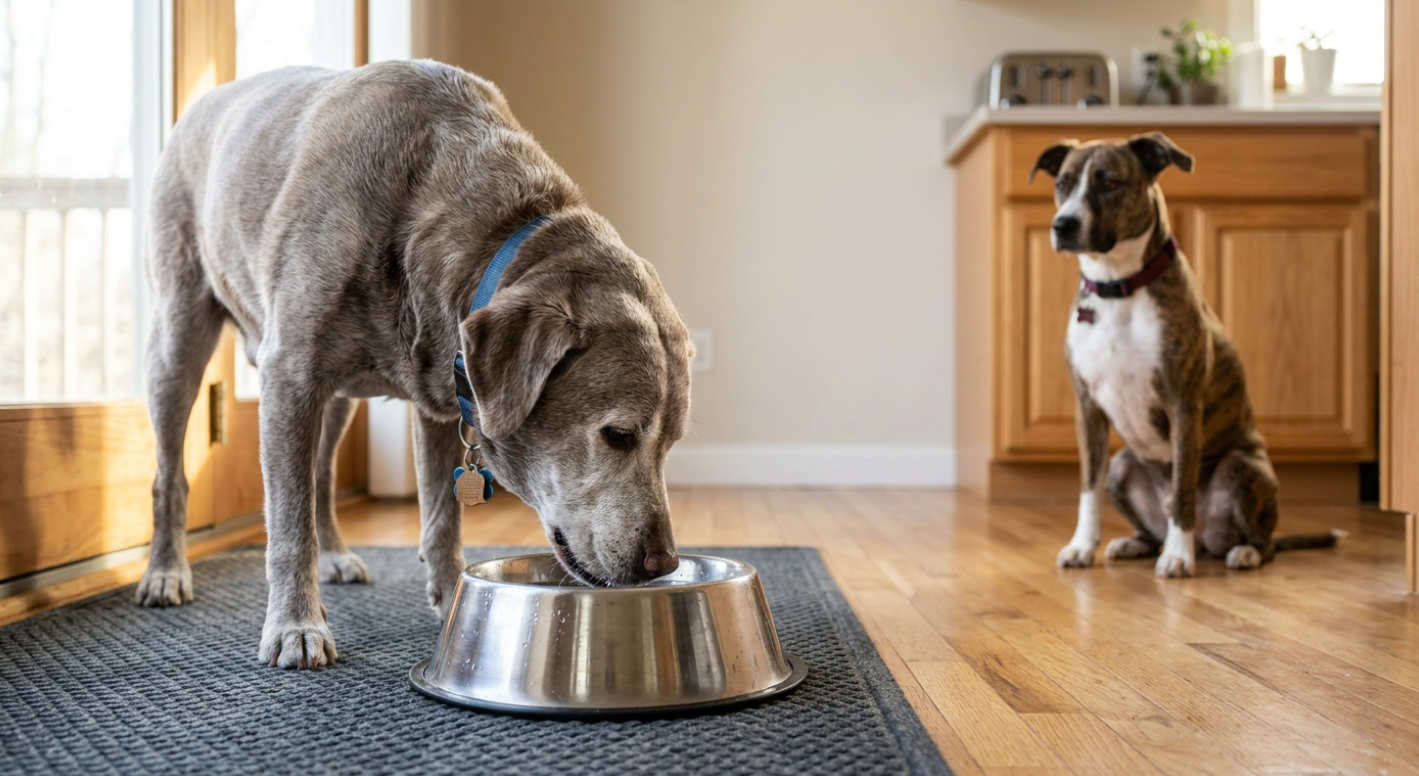
My friend Hannah’s older dog, Klaus, has always been the slower drinker of her two. Nobody thought much of it until a routine blood test showed early signs of kidney dysfunctionality. Her vet asked how much Klaus drank each day, and Hannah realized she had no idea. The 7-liter fountain emptied at about the same rate it always had. Whatever was happening with Klaus, the fountain wasn’t showing it.
Senior dogs are more vulnerable to dehydration, and they are also the dogs most likely to start drinking too much. In a two-dog home, both changes are easy to miss. This guide covers how to tell, and what to do about it.
Why Senior Dogs Dehydrate Quietly
Aging changes how a dog handles water. Total body water falls, thirst becomes less sensitive, and the kidneys gradually lose their ability to concentrate urine (Guelfi et al., 2025). An older dog can therefore lose more water and feel less urge to replace it. We covered the kidney side of this in detail in our guide to dog hydration and kidney health.
The senior years are also when the three leading causes of excessive drinking appear: chronic kidney disease, diabetes mellitus and Cushing’s disease (Today’s Veterinary Practice, 2023). Cushing’s alone causes increased drinking and urination in 80–90% of cases (Cornell Riney Canine Health Center, n.d.-a). So a senior can drift in either direction. The job is to notice which.
The basics still apply: fresh water in more than one place, wet food or water added to kibble as a source of moisture, and, for a dog that struggles to get up, bringing the bowl to the dog several times a day (Covetrus, 2019). What follows is what those basics miss when a second dog is in the house.
Step 1: Check Hydration the Right Way (and Why the Skin-Pinch Test Misleads)
The skin-tent test is the home check everyone knows. Lift the skin over the shoulders and see how fast it falls back. In an older dog, it can mislead. The Merck Veterinary Manual notes that geriatric animals may have lost collagen in the skin, “resulting in poor skin turgor and sunken eyes, despite normal hydration” (Merck Veterinary Manual, n.d.-a). A slow skin tent in a 12-year-old may mean nothing. A normal one is weak reassurance too, because dehydration cannot be detected on examination until roughly 5% of body water has been lost (Today’s Veterinary Practice, 2024).
Gum moisture is more useful. Hydrated gums feel slick; dehydrated gums feel tacky. Capillary refill, where you press the gum and count until the color returns, should take under two seconds (Merck Veterinary Manual, n.d.-a). Use these together with energy level and urination. None of them replaces a urine test.
Step 2: Make Sure Your Older Dog Can Actually Reach the Water

This is where the second dog matters, and it is a common reason an older dog ends up drinking less than it should.
Dogs that live with other dogs are more likely to guard resources. In a survey of 3,589 dogs, those in multi-dog households showed more guarding aggression, more avoidance and more rapid eating than dogs living alone (Jacobs et al., 2018). Food is the best-studied resource. No study has looked specifically at dogs guarding water, so we won’t claim it is common. But the behavior pattern is documented, and water is a resource.
The more important finding is about owners. When shown videos of guarding, owners recognized growling and snapping well but consistently missed the quiet forms: avoidance and hurried eating (Jacobs et al., 2017). A senior that waits, turns away when the younger dog approaches, or gulps and leaves is showing exactly the signs owners overlook. Veterinary guidance on older pets adds that they “may be less tolerant of children and other household pets” and should have protected resting areas with resources easily accessible (Landsberg et al., 2017).
If you have seen any of this, our guide on whether two dogs can share one water fountain walks through when a second station makes more sense than a bigger reservoir. For a senior, the second station belongs near their resting spot, out of the younger dog’s traffic.
Step 3: Stop Reading the Shared Bowl as a Health Signal
Here is why the fountain’s refill rate told Hannah nothing. Healthy dogs generally drink about 50–60 mL per kilogram a day, and intake above 100 mL/kg/day is the veterinary definition of excessive drinking (Schoeman, 2011). For two 30 kg dogs, the normal combined total is 3,000–3,600 mL.
Now picture a senior drinking an abnormal 3,000 mL (100 mL/kg) and a companion drinking 600 mL. The total is 3,600 mL. Normal. Reverse it, with a senior drinking only 600 mL and a companion drinking 3,000 mL, and the total is still 3,600 mL. Still normal. These are illustrations, not data, but the arithmetic is the point. A shared bowl is blind to the individual.
Two cautions on the numbers. The 100 mL/kg cut-off was established in laboratory dogs and “may not reflect normal water consumption in pets” (Nelson, n.d.). And a dog that normally drinks little can be drinking abnormally well below that line (Bihannic et al., 2025). What matters most is change from your own dog’s baseline, which you cannot know without measuring.
One more thing to check before you worry: medication. Seniors are the dogs most likely to be on something, and corticosteroids such as prednisone and prednisolone list increased drinking and urination as their most common side effects (VCA Animal Hospitals, n.d.-b; Veterinary Partner, n.d.). If the change in drinking started after a new prescription, tell your vet; don’t restrict water, and don’t stop the medication on your own.
Senior Dog Hydration Calculator (Two-Dog Home)
Estimates each dog’s expected daily water intake, shows why the household total can hide a problem, and checks a measured 24-hour intake for your senior against veterinary guidelines. Estimates, not prescriptions.
| Dog | Guideline range 50–60 mL/kg/day [1] |
1 oz/lb rule ≈65 mL/kg/day [2] |
Excessive-drinking line >100 mL/kg/day [1] |
|---|
Where these numbers come from
- Schoeman, J. P. (2011). Approach to the dog with polyuria and polydipsia. WSAVA Congress Proceedings, via VIN. Healthy dogs generally consume 50–60 mL/kg/day; polydipsia is defined as more than 100 mL/kg/day.
- The “1 oz per lb” rule is a common North American rule of thumb, not a veterinary standard. 1 oz/lb converts to about 65 mL/kg/day. See our guide to water needs for two dogs.
- Nelson, R. W. Approach to the patient with polyuria and polydipsia. VIN. The 100 mL/kg figure was established in laboratory-reared dogs and may not reflect normal intake in pets; measure over several consecutive days.
- Bihannic, R., et al. (2025). Psychogenic polydipsia in dogs: a review. Dogs that normally drink little can be drinking abnormally below the 100 mL/kg line.
- Merck Veterinary Manual. The fluid resuscitation plan in animals. Signs of dehydration and why skin turgor misleads in geriatric animals.
- Covetrus (2019). Changes in a senior dog’s behavior. Reducing or removing water is not the way to control incontinence.
This tool does not diagnose anything. A change from your own dog’s baseline matters more than any single number. Talk to your vet about any change in drinking.
Step 4: Measure How Much Your Senior Dog Really Drinks
Veterinary sources recommend that owners measure water intake at home over several consecutive days, because intake varies from day to day (Nelson, n.d.; Schoeman, 2008). There is no fixed number of days in general guidance, so treat this as a method, not a protocol.

Give each dog its own bowl in a different room, or supervise drinking. Shared measurements cannot be assigned to one dog.
Measure at the same time each day using a measuring jug or kitchen scale. One gram of water is about one milliliter.
Keep one bowl where the dogs cannot reach it and subtract its water loss. A control helps account for evaporation, which can otherwise make fountain or bowl measurements look higher than actual drinking.
Record wet food, broths, hot days, and long walks, since all of these can affect how much water your dog drinks.
Look for a pattern rather than relying on a single day’s measurement. If anything looks unusual, bring your log and a urine sample to your veterinarian.
If exact measurement isn’t practical, counting bowl refills is an accepted semi-quantitative method (Fujifilm, 2025). Something is better than nothing.
Step 5: Use a Fountain for Convenience, Not as a Hydration Fix

Fountains have a hydration reputation that the evidence doesn’t support. In cats, the species actually studied, three controlled trials found no meaningful difference in intake between fountains and bowls (Grant, 2010; Pachel & Neilson, 2010; Robbins et al., 2019). A review of studies from 1975 to 2025 concluded that intake was not affected by whether water was still or flowing (Rodrigues et al., 2026). No comparable dog trial exists, and a veterinary behaviorist quoted by the AKC said she was unaware of evidence that dogs prefer running water (Johnstone, 2026).
A fountain still has practical value in a two-dog home: a large reservoir means fewer empty-bowl moments, and 360-degree designs let two dogs drink without jostling. Our roundup of the best water fountains for two dogs compares capacity and access. For a senior, look at the drinking surface rather than the liter count: a wide, open basin on a stable base, low enough that a stiff dog isn’t straining, on a non-slip mat. None of that has been studied, so it is reasoning, not proof.
Owners also report that some seniors are put off by the pump hum or the trickle, and that a fountain becomes an ordinary bowl of standing water the moment the power goes out. Neither has been studied, but both are worth knowing before you buy.
Two more things fountains don’t do. They don’t measure individual intake. Tag-based “smart” fountains exist, but we found no independent validation for dogs or multi-dog homes. And they don’t clean themselves. Pet bowls were the fourth-germiest item in a household germ study (NSF International, 2011), and bacterial counts in dog water bowls rose significantly within a week in every material tested (Wright & Carroll, 2018). Our guide to cleaning a dog water fountain for two dogs covers the pump, filter and schedule.
Step 6: Think Twice Before Raising the Bowl
Raised bowls are widely recommended for stiff seniors, and some dogs clearly find them easier. But there is no outcome study showing they help, and the one large study on raised bowls found a different association: about 20% of bloat (GDV) cases in large breeds and 52% in giant breeds were attributed to a raised feed bowl (Glickman et al., 2000). That study looked at food bowls, and a later review found the evidence conflicting (Buckley, 2017). Our position: don’t raise a bowl for a large or giant deep-chested senior without asking your vet, and if you do, keep it modest and stable.
Step 7: Keep Water Available at Night

Night accidents push many owners to remove water at bedtime. Veterinary guidance says this “is not the way to control incontinence” (Covetrus, 2019). A senior drinking more at night may be replacing water lost through dilute urine; restriction risks dehydration and hides a medical sign. Cornell recommends ruling out a bladder infection first, then using nightlights and, if needed, dog diapers changed often (Cornell Riney Canine Health Center, n.d.-b). A late potty trip, a non-slip route to the door and a second water bowl near the bed are safer than an empty one.
Step 8: Keep Water Where a Forgetful Dog Can Find It
One of the screening criteria for canine cognitive dysfunction is failing to easily find the food or water dish (VCA Animal Hospitals, n.d.-a). A senior with early cognitive change may wander away from the bowl mid-drink or simply not go. Owners of dogs with failing eyesight describe something similar: a dog that stands over a full bowl as if it were empty, or misjudges where the water surface is. Keep water in the same, well-lit spot, introduce any change gradually, and keep the daily routine predictable (Landsberg et al., 2017). We found no evidence that running water or fountain noise helps these dogs drink.

Collected from Reddit
While researching this article, I spent some time in the senior-dog communities on Reddit, and the same patterns kept appearing in owners’ own words.
The clearest example of the shared-bowl problem came from a r/DogAdvice thread, where jjuturna described a 9-year-old who had stopped drinking from the bowl she shared with the household’s 6-year-old and started waiting for the toilet instead. The owner’s update: raising the bowl about 12 inches “worked wonders,” which she took as a sign of discomfort bending down and planned to raise with her vet. In a r/dogs thread, ilovemypuptoomuch tried the same fix for a 14-year-old who had “trouble leaning down to his bowl,” and it didn’t help; the dog ended up taking water from a pipette. Same symptom, opposite results, which is roughly where the evidence on raised bowls sits.
Access came up repeatedly in a r/olddogs thread. starkmafia said their vet “recommended placing multiple water bowls around the house,” because seniors with joint pain won’t travel for water but will drink if they pass a bowl. r_teuf’s elderly dog had stopped using her bowls entirely until the owner realized “she was uncomfortable with the slippery floor in that spot” and put down a rug. SGalla310’s dog refuses the bowl next to her food but drinks from three others around the house. And ihavenoideawhatwho noticed their older girl “jumps when her metal tag clinks against the Pyrex bowl,” and ordered tag silencers.
On drinking more, the r/seniordogs thread by Delicious-Match985 is a good model of what to watch for. Her 12-year-old “never finishes her bowl in a day” but had started emptying it daily over two to three weeks; she noticed only because she knew the dog’s normal. SnoopyFan6’s advice was to monitor consumption “so the vet has concrete data.” In a r/DogAdvice thread about a newly adopted senior with unquenchable thirst, potato_nurse urged the owner “not to restrict his water intake until a veterinarian has had a chance to evaluate him,” and Cinamngrl mentioned a 70-pound dog with kidney problems drinking about a gallon and a half a day. That is roughly 180 mL/kg, well past the 100 mL/kg line.
One r/olddogs thread shows how mixed the advice owners receive can be. teahsea3’s 13-year-old boxer had started draining his bowl and having accidents; bloodwork and urinalysis were normal, and the vet suggested removing the water bowl when the owner left the house. Several commenters who had been through the same thing (MiyoMush, WWPWHD, BerlyH208, BeachMountainArt) reported eventual Cushing’s diagnoses, two of them noting their dogs never developed the pot-belly the vet had used to rule it out. BeachMountainArt now keeps “two water bowls filled.”
These are individual experiences, not evidence. But they line up with the research in one respect: the owners who caught problems early were the ones who knew their dog’s normal and noticed the change.
Senior Dog Drinking Less vs Drinking More: Decision Guide

Senior Dog Drinking Less vs Drinking More: Decision Guide
Match what you’re seeing to the row that fits best. The tag shows how quickly to act. If two rows apply, follow the more urgent one.
| What You Notice | What It May Mean | What to Do |
|---|---|---|
| Senior waits, turns away, or hurries when the other dog is near | Quiet avoidance, often missed by owners |
Watch & adjust Add a water station near the senior’s resting area; measure each dog separately |
| Household total looks normal, but the senior is rarely seen drinking | Shared total masking the individual |
Watch & adjust Measure each dog’s intake for several days |
| Measured intake above 100 mL/kg/day, or a clear rise from baseline | Possible kidney disease, diabetes, or Cushing’s |
Book a vet visit Bring the intake log and a fresh urine sample |
| Drinking more started after a new medication (steroids especially) | Expected side effect, but it can mask disease |
Tell your vet Don’t restrict water or stop the drug yourself |
| New nighttime accidents | Medical until proven otherwise |
Book a vet visit Get checked before changing water access |
| Drinking more plus weight loss or more urination | Same causes, more urgent |
Prompt vet visit Within a day or two; bring the log |
| Drinking less plus tacky gums, sunken eyes, or lethargy | Clinical dehydration (5% or more) | Same-day vet visit |
| Any change in drinking plus vomiting or diarrhea | Fluid loss a senior can’t afford | Same-day vet visit |
| Refusing water, collapse, pale gums, or straining with little or no urine | Emergency | Emergency vet now |
Thresholds: healthy dogs generally drink 50–60 mL/kg/day, and more than 100 mL/kg/day is commonly used as a veterinary threshold for excessive drinking. These figures are reference points, not a diagnosis. Individual water needs can vary with diet, activity, temperature, medication, and health.
Contact your veterinarian promptly if you notice any of the following:
- A sustained rise or fall in drinking, especially with more urination or weight loss
- Tacky gums, sunken eyes, or marked lethargy
- Vomiting or diarrhea alongside reduced drinking
- Refusal to drink for more than a day
- New house-soiling in a previously reliable senior
Frequently Asked Questions
Treat it as medical until proven otherwise. Chronic kidney disease, diabetes and Cushing’s disease are the three most common causes of a sustained increase in thirst in older dogs, and a senior blood panel and urinalysis will usually point to the cause. If the first tests come back normal and the drinking continues, ask about further testing rather than accepting “just aging.”
Aging does blunt thirst, but a senior that drinks very little should still be checked for a reason: dental pain, arthritis that makes the trip to the bowl hard, nausea, cognitive or vision changes, or a second dog quietly keeping it away. Moisture from wet food counts toward total water, so a dog on wet food will drink less from the bowl than one on kibble.
Not from a shared bowl. Separate the dogs for a few days of measurement, use a control bowl for evaporation, and compare each dog with its own normal. Counting refills is a rough but acceptable fallback.
Yes. Corticosteroids such as prednisone commonly cause increased thirst and urination, and other drugs can too. Mention any new prescription to your vet when you report a change in drinking, keep water available, and never stop a steroid without veterinary guidance.
No, not without veterinary instruction. Increased night drinking can be a medical sign, and restriction risks dehydration. Rule out infection and illness first, then manage accidents with a late potty trip, nightlights, washable pads or diapers.
Plain, unsalted broth with no onion, garlic, chives or leek can encourage some dogs to drink. Most store-bought broths and stock cubes contain onion or garlic, which damage dogs’ red blood cells even when cooked or powdered (Merck Veterinary Manual, n.d.-b; VCA Animal Hospitals, n.d.-c), so read the label or make your own. Keep plain water available as well.
Put bowls near where the dog rests, on the same floor level, on a non-slip mat, and bring water to the dog if it struggles to get up. Raising the bowl helps some dogs and not others; for a large, deep-chested dog, ask your vet first.
There is no evidence for this in dogs, and controlled studies in cats found no meaningful difference. A fountain can make fresh water easier to keep available, which is a different benefit, and it needs regular cleaning.
Not on its own. Older dogs can have loose skin while well hydrated. Check gum moisture and capillary refill as well, and let your vet confirm with a urine test.
Roughly 50–60 mL per kilogram a day is the common veterinary guideline, with more than 100 mL/kg considered excessive. Both are guides, not targets. A change from your dog’s own baseline matters more than any single number.
Scientific References
Sources are listed in APA style. Peer-reviewed studies link to the publisher’s DOI where one exists; veterinary school, hospital, and manual pages link directly. All links were checked on October 8, 2026.
- Buckley, L. A. (2017). Are dogs that are fed from a raised bowl at an increased risk of gastric dilation volvulus compared with floor-fed dogs? Veterinary Evidence, 2(1). https://www.research.ed.ac.uk/files/59772063/57_599_1_PB.pdf
- Cornell Riney Canine Health Center. (n.d.-a). Cushing’s syndrome. https://www.vet.cornell.edu/departments-centers-and-institutes/riney-canine-health-center/canine-health-information/cushings-syndrome
- Cornell Riney Canine Health Center. (n.d.-b). Senior dog dementia. https://www.vet.cornell.edu/departments-centers-and-institutes/riney-canine-health-center/canine-health-topics/senior-dog-dementia
- Covetrus. (2019). Changes in a senior dog’s behavior: Is it age or health related? https://northamerica.covetrus.com/resource-center/blogs/animal-health/animal-health/2019/06/20/changes-in-a-senior-dog-s-behavior-is-it-age-or-health-related-
- Fujifilm. (2025). Diagnostic approach to polyuria and polydipsia [Handbook]. https://asset.fujifilm.com/www/th/files/2025-07/5ffcb005956bfa24e13d4339180f6184/handbook_diagnostic_approach-to-polyuria-and-polydipsia05152025.pdf
- Glickman, L. T., Glickman, N. W., Schellenberg, D. B., Raghavan, M., & Lee, T. L. (2000). Non-dietary risk factors for gastric dilatation-volvulus in large and giant breed dogs. Journal of the American Veterinary Medical Association, 217(10), 1492–1499. https://doi.org/10.2460/javma.2000.217.1492
- Grant, D. C. (2010). Effect of water source on intake and urine concentration in healthy cats. Journal of Feline Medicine and Surgery, 12(6), 431–434. https://doi.org/10.1016/j.jfms.2009.10.008
- Guelfi, G., Capaccia, C., Ratto, V. F., Bufalari, A., Leonardi, L., Mechelli, L., Cenci, S., & Maranesi, M. (2025). The emerging role of water loss in dog aging. Cells, 14(7), 545. https://doi.org/10.3390/cells14070545
- Jacobs, J. A., Coe, J. B., Pearl, D. L., Widowski, T. M., & Niel, L. (2018). Factors associated with canine resource guarding behaviour in the presence of people: A cross-sectional survey of dog owners. Preventive Veterinary Medicine, 161, 143–153. https://www.sciencedirect.com/science/article/abs/pii/S0167587717301253
- Jacobs, J. A., Pearl, D. L., Coe, J. B., Widowski, T. M., & Niel, L. (2017). Ability of owners to identify resource guarding behaviour in the domestic dog. Applied Animal Behaviour Science, 188, 77–83. https://bpb-us-e2.wpmucdn.com/about.illinoisstate.edu/dist/6/45/files/2019/10/Jacobs-2017-ability-of-owners-to-identify-resource-guarding-behaivor-in-the-domestic-dog.pdf
- Johnstone, G. (2026). Could your dog benefit from using a pet water fountain? American Kennel Club. https://www.akc.org/expert-advice/lifestyle/dog-water-fountain/
- Kosmal, P. A. L., Shoveller, A. K., Gillies, G., & Armstrong, L. E. (2025). Diet format, protein, amino acids, salt, and osmolytes, as well as water viscosity, affect water consumption in domestic cats: A scoping review of 32 publications (published from 1975 to 2025) on water intake, hydration status, and related health outcomes. Journal of Animal Science, 104, skaf434. https://doi.org/10.1093/jas/skaf434
- Landsberg, G. M., Madari, A., & Žilka, N. (2017). Management of dogs and cats with cognitive dysfunction. Today’s Veterinary Practice. https://todaysveterinarypractice.com/neurology/management-of-dogs-and-cats-with-cognitive-dysfunction/
- Merck Veterinary Manual. (n.d.-a). The fluid resuscitation plan in animals. https://www.merckvetmanual.com/therapeutics/fluid-therapy/the-fluid-resuscitation-plan-in-animals
- Merck Veterinary Manual. (n.d.-b). Garlic and onion (Allium spp) toxicosis in animals. https://www.merckvetmanual.com/toxicology/food-hazards/garlic-and-onion-allium-spp-toxicosis-in-animals
- Nelson, R. W. (n.d.). Approach to the patient with polyuria and polydipsia. Veterinary Information Network. https://www.vin.com/apputil/content/defaultadv1.aspx?id=7259430&pid=14365&print=1
- NSF International. (2011). 2011 NSF household germ study: Executive summary. https://d2evkimvhatqav.cloudfront.net/documents/2011_NSF_Household_Germ_Study_exec-summary.pdf
- Pachel, C., & Neilson, J. (2010). Comparison of feline water consumption between still and flowing water sources: A pilot study. Journal of Veterinary Behavior, 5(3), 130–133. https://www.sciencedirect.com/science/article/abs/pii/S155878781000002X
- Pavlovsky, G. (2026). Psychogenic polydipsia in dogs – a review of pathogenesis, diagnosis and treatment. Journal of Small Animal Practice, 67(7), 580–589. https://doi.org/10.1111/jsap.70105
- Robbins, M. T., Cline, M. G., Bartges, J. W., Felty, E., Saker, K. E., Bastian, R., & Witzel, A. L. (2019). Quantified water intake in laboratory cats from still, free-falling and circulating water bowls, and its effects on selected urinary parameters. Journal of Feline Medicine and Surgery, 21(8), 682–690. https://doi.org/10.1177/1098612X18803753
- Schoeman, J. P. (2008). Approach to polyuria and polydipsia in the dog. WSAVA Congress Proceedings, via VIN. https://www.vin.com/apputil/content/defaultadv1.aspx?pId=11268&meta=generic&catId=32729&id=3866513
- Schoeman, J. P. (2011). Approach to the dog with polyuria and polydipsia. WSAVA Congress Proceedings, via VIN. https://www.vin.com/apputil/content/defaultadv1.aspx?meta=Generic&pId=11343&catId=34571&id=5124416
- Today’s Veterinary Practice. (2023). A stepwise diagnostic approach to polyuria and polydipsia. https://todaysveterinarypractice.com/wp-content/uploads/sites/4/2023/10/TVP-2023-1112_Polyuria-Polydipsia_2.pdf
- Today’s Veterinary Practice. (2024). Fluid therapy in hospitalized patients, part 1: Patient assessment and fluid choices. https://todaysveterinarypractice.com/internal-medicine/fluid-therapy-patient-assessment-and-fluid-choices/
- VCA Animal Hospitals. (n.d.-a). Behavior counseling: Senior pet cognitive dysfunction. https://vcahospitals.com/know-your-pet/behavior-counseling-senior-pet-cognitive-dysfunction
- VCA Animal Hospitals. (n.d.-b). Prednisone/prednisolone. https://vcahospitals.com/know-your-pet/prednisoloneprednisone
- VCA Animal Hospitals. (n.d.-c). Onion, garlic, chive, and leek toxicity in dogs. https://vcahospitals.com/know-your-pet/onion-garlic-chive-and-leek-toxicity-in-dogs
- Veterinary Partner. (n.d.). Prednisolone/prednisone. Veterinary Information Network. https://veterinarypartner.vin.com/doc/?id=4951498&pid=19239
- Wright, C., & Carroll, A. (2018). Microbiological assessment of canine drinking water and the impact of bowl construction material. Hartpury University. https://pure.hartpury.ac.uk/en/publications/microbiological-assessment-of-canine-drinking-water-and-the-impac/
Veterinary Disclaimer: This article is for general education and isn’t a substitute for veterinary advice. If your senior dog’s drinking has changed, please talk to your vet.

Shafiqul Islam
Shafiqul Islam is a university educator, writer, and Fulbright scholar with an academic background in Environmental Humanities. During his Fulbright studies at the University of Montana in Missoula, he developed a deeper interest in the relationships between humans, animals, and the environments they share.
A longtime pet owner, Shafiqul brings firsthand experience with companion animals to his work at PetSpecial. He writes practical pet-care guides and Pet Bulletin articles covering animal behavior, emerging pet technology, and the changing relationship between people and their pets. His approach combines personal experience, research, and careful product evaluation to create useful, evidence-informed content for pet owners.
3 thoughts on “How to Keep a Senior Dog Hydrated in a Two-Dog Home”