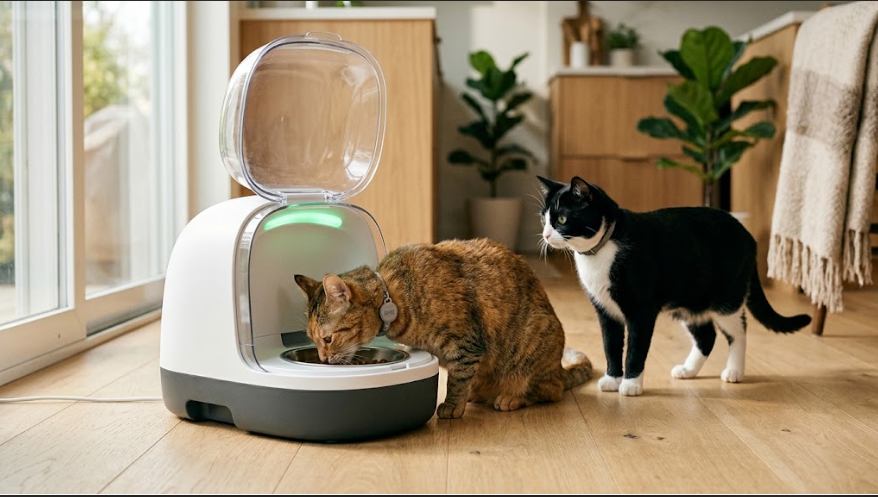

Strange as it might sound, cats have strong personalities. As territorial animals, one cat may not tolerate the presence of another unless the two are particularly comfortable with each other. I have two cats at home, Billu and Simba. Despite being mother and son, they often fight and can hardly tolerate each other’s presence. So I have to be extra careful and vigilant about making sure Billu gets to eat her full meal. Simba often finishes his food first and then helps himself to whatever is left in Billu’s bowl.
So, how do you solve a problem like this? Buying an automatic feeder for two cats sounds simple until you realize that having two cats doesn’t necessarily mean they need the same feeding setup. The right solution depends on what you’re actually trying to control: when your cats eat, how much they eat, or which cat has access to which food.
Quick answer: Two cats don’t automatically need a two-bowl feeder. If they share food peacefully, a two-bowl timed feeder is fine. If one cat steals food, needs a different diet, or needs a different schedule, you likely need separate feeders or a microchip/RFID feeder.
The real problem: what are you trying to solve with your feeder?
You may think an automatic cat feeder for two cats can solve all your feeding problems at once. But trust me, the problem can be deeper than it seems. If your cats are nothing like Billu and Simba, you may be perfectly fine with a simple two-bowl, automatically timed feeder. If they happily eat from their own bowls and don’t interfere with each other’s meals, your main goal is probably convenience: making sure both cats get fed while you’re at work, traveling, or away from home for a day.
My situation is completely different. If I chose a feeder like that, I could come home from work or return from a trip to find Billu’s food gone and Billu having had little or nothing to eat. Depending on the design, both bowls may simply receive food from the same hopper at the same time. If one cat finishes first, nothing about the second bowl necessarily prevents that cat from walking over and eating the other cat’s portion.
If you have two cats that need completely different types of food, for instance, one is chubby and needs to lose weight whilst the other is skinny and you want to feed her extra, this dispenser might not be the most suitable option for you. So before buying a two-bowl automatic cat feeder, ask yourself: Do I need to control when my cats eat, how much they eat, or which cat can access the food? Those are three different requirements, and the feeder you need depends on which problem you’re actually trying to solve.
Two-Bowl Automatic Feeders: What Do They Actually Do?

Let me first explain how a typical two-bowl automatic feeder works. A two-bowl automatic feeder usually uses a single central food hopper and a dispensing mechanism to distribute food into two side-by-side bowls at the same time. In other words, one programmed feeding cycle supplies both bowls from the same food reservoir.
The important point is that two bowls do not necessarily mean two independently controlled meals. In a typical setup, both cats receive the same type of food at the same scheduled time, with the portions generally intended to be equal.
If your cats are comfortable with the same meal plan and the same type of food, a two-bowl feeder can be a perfectly practical solution. It gives both cats access to their meals without requiring you to dispense the food manually every time.
However, it does not allow you to control the cats’ meals completely independently. If one cat needs a different portion, a different food, a different feeding schedule, or protection from the other cat stealing its meal, a basic two-bowl system may not be enough.
For households that simply need feeding convenience while they’re at work, traveling, or otherwise away from home, this type of feeder can provide a straightforward solution without the complexity of individual access-control systems.
When Is a Two-Bowl Feeder Enough?
A two-bowl automatic feeder can be a good fit when your cats have relatively simple and compatible feeding habits. If both are good to go with the same kind of food, eat roughly the same amount, don’t fight over their servings, and don’t try to steal from each other, this can be the perfect option for you.
A two-bowl feeder can make sense if:
- Both cats eat the same food.
- Their portion requirements are similar.
- They eat at roughly the same times.
- Neither cat regularly steals the other’s food.
- You mainly want to automate feeding while you’re away.
For example, if both of your cats normally finish their own meals without going after each other’s food, a scheduled two-bowl feeder can take care of feeding while you’re at work or away for a day. You don’t necessarily need individual access control when there is no access-control problem to solve.
PetSpecial tip: If your cats already eat peacefully from separate bowls, don’t overcomplicate the solution. The purpose of an automatic feeder in this situation is mainly to automate when they eat, not to control who gets to eat.
When Are Two Bowls Not Enough?
A two-bowl solution might not work for you if your cats don’t comfortably share similar feeding habits. The basic function of a two-bowl dispenser is to dispense food into the bowls, but it doesn’t control what happens after the food has been served. For example, Billu is a slow eater, like me, while Simba finishes his portion within minutes. If you’re in a similar situation, a two-bowl system can pose significant challenges.
A two-bowl feeder may therefore not be enough when:
- One cat regularly steals the other’s food.
- One cat needs a larger or smaller portion.
- The cats need different types of food.
- The cats need different feeding schedules.
- One cat needs restricted access to food.
This is where you need to look beyond the number of bowls. The important question becomes whether each cat can actually be fed independently.
What About Two Separate Automatic Feeders?
The food itself might not always be the problem. If your cats need to eat different amounts or at different times, using two separate automatic feeders can be a practical solution. Instead of depending on one hopper to supply food for both cats, each feeder can be programmed independently, allowing you to adjust the portion and feeding times for each cat according to its needs.
However, separate feeders still don’t provide true access control. If Simba can finish his meal and simply walk over to Billu’s feeder, he may still help himself to her food. In that situation, having two feeders solves the problem of separate dispensing, but not necessarily the problem of who is allowed to eat what.
Two separate feeders control the meals independently. Microchip or RFID feeders can control access independently.
When Do You Need a Microchip or RFID Feeder?

Microchip or RFID feeders work fundamentally differently. This type of feeder does not function only as a food dispenser. It is designed to determine which cat is allowed to access the food and, depending on the model, when that access is permitted. The feeder uses your cat’s microchip or an RFID tag to identify the individual cat and then allows access to its designated food compartment. This makes it possible to keep one cat from accessing another cat’s food.
This type of feeder can be particularly useful if one cat regularly steals the other’s food, if your cats need different types of food, or if one of them needs stricter portion control. For example, if Billu needs one type of food while Simba eats another, simply placing two bowls next to each other may not be enough. A microchip or RFID system can give each cat access to its designated food.
However, there are some caveats to consider when opting for this kind of feeder. They normally cost more than traditional two-bowl feeders. Some cats may also need time to adjust to how the microchip or RFID feeder works. Additionally, depending on how well your cats adapt to the system, you may need a separate feeder or access-controlled station for each of your pet kiddos. Microchip feeders are a premium investment, but they offer unmatched safety benefits if you are trying to strictly limit a sensitive cat’s intake of certain commercial proteins, especially in light of recent findings regarding environmental contaminants and lead in cat food.
So, if your main problem is “When should my cats eat?”, a timed feeder may be enough. If the problem is “Who should be allowed to eat this food?”, that’s when a microchip or RFID feeder becomes worth considering.
Which Automatic Feeder Setup Is Right for Two Cats?
At this point, choosing between the two becomes quite simple. How many cats you have is not the only factor you need to consider. What matters more is how independently you need to manage their meals.
| Feeding setup | Best suited for | What it controls |
| Two-bowl feeder | Cats with similar diets and peaceful eating habits | Feeding time and basic convenience |
| Two separate feeders | Cats needing different portions or schedules | Each cat’s meals independently |
| Microchip/RFID feeder | Cats that steal food or need restricted access | Which cat can access the food |
If your target is to simply feed your cats without taking any additional hassle, especially while you’re away, a two-bowl feeder may be all you need. If they require different portions or schedules, two separate feeders give you more control. And if the real problem is that one cat keeps stealing the other’s food, microchip or RFID access control addresses a different problem altogether.
For my situation with Billu and Simba, the deciding factor isn’t really the number of bowls they can access; it’s the fact that Simba finishes his food before Billu and then goes after hers. That makes access control much more important than simply having two feeding positions.
The Bottom Line
Choosing an automatic feeder for two cats is really about identifying the problem you are trying to solve. Two bowls solve a convenience problem. Separate feeders solve an independent feeding problem. Microchip or RFID feeders solve an access-control problem.
If you’re still unsure which type fits your household, check out our guide to the best automatic cat feeders for two cats, where we compare different feeder setups and the situations they are designed for.
See Our Best Automatic Cat Feeders for Two Cats
Frequently Asked Questions
Can two cats share one automatic feeder?
Yes, if both cats eat the same food, need similar portions, eat at similar times, and do not compete for each other’s food. A two-bowl feeder can provide convenient scheduled feeding in this situation.
Do two-bowl automatic feeders prevent cats from stealing food?
No. A two-bowl feeder controls where food is dispensed, but it generally does not control which cat can access each bowl. If one cat regularly eats the other’s food, you may need separate feeders or a microchip/RFID feeder.
Should two cats have separate automatic feeders?
Not necessarily. Separate feeders become more useful when the cats need different portions, different feeding schedules, or different types of food. They give you more control over each cat’s meals than a shared two-bowl system.
When do I need a microchip or RFID feeder?
Consider one when the main problem is access rather than timing. If one cat repeatedly steals another cat’s food, or the cats need different diets, a microchip or RFID feeder can restrict access to the designated cat.

Shafiqul Islam is the founder of PetSpecial, a pet-focused website dedicated to practical, research-informed guides for pet owners. He writes about pet care, feeding, grooming, and useful pet products, combining hands-on experience with careful product research to help readers make informed decisions. You can learn more about him at shafiqul-islam.com.
2 thoughts on “Automatic Feeder for Two Cats: Two-Bowl, Separate, or Microchip?”