
Quick Summary
Feeding two cats different diets doesn’t have to become a daily struggle. Whether your cats have different tastes, portions, feeding schedules, or specific dietary needs, the key is making sure each cat gets the right food without eating the other’s meal. From separate feeding areas to automatic and access-controlled feeders, there are several ways to make it work. In my case, Billu and Simba have different preferences and feeding habits, so I’ve learned that a little planning and a consistent routine can make a big difference.
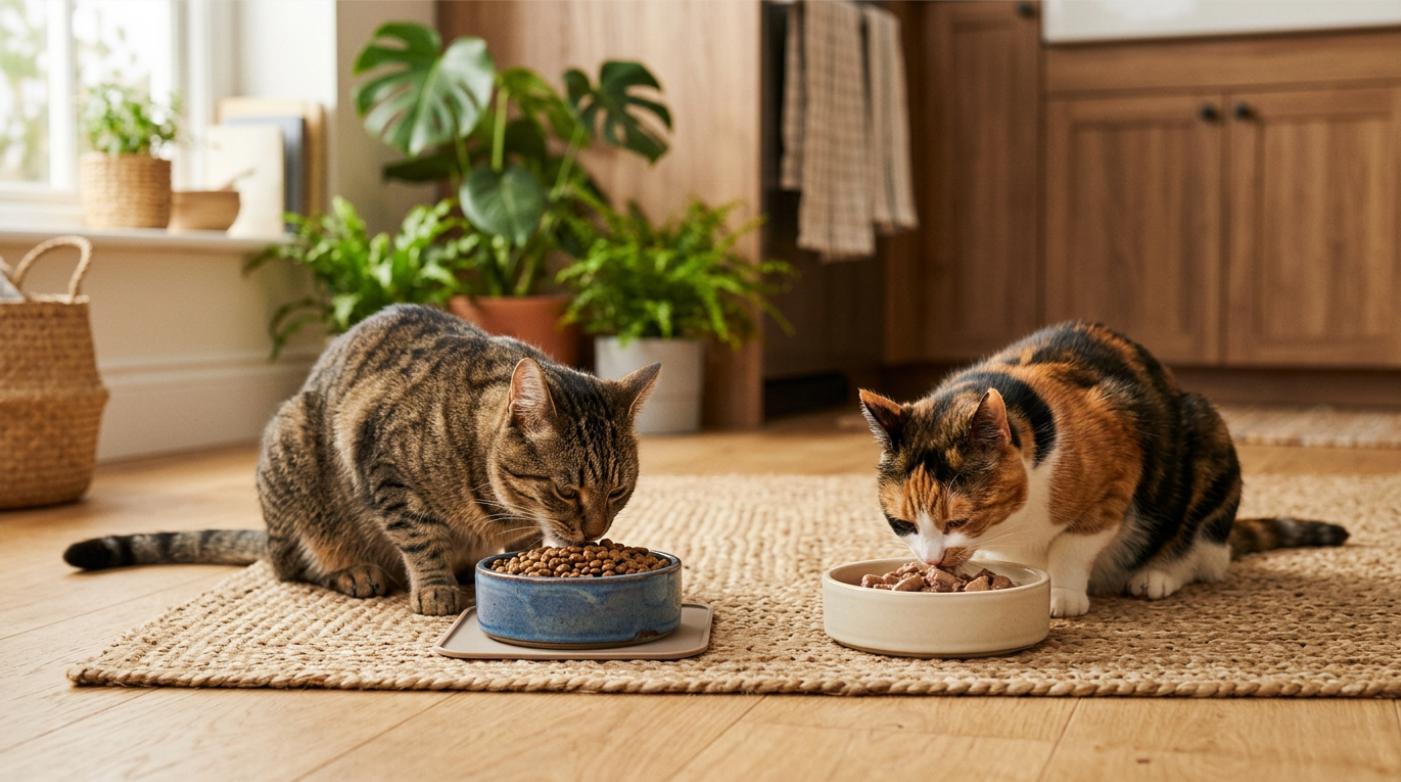
If your two cats are on different vet-recommended diets, or simply have different tastes, such as one preferring dry food while the other loves wet food, you are not alone. Meet me, the proud parent of Billu and Simba. Both of them like dry food, but Billu is a fish fan, while Simba’s comfort word is “chicken.” Learning to feed two cats different food means finding a routine, and sometimes the right feeding setup, that works for both cats without turning mealtime into a chore.
The challenge becomes much greater when the difference isn’t simply about preference. One cat may need fewer calories, a different type of food, or a diet prescribed by a veterinarian. In those situations, feeding two cats different diets isn’t just about putting different food in different bowls. You also need to think about how much each cat eats, when they eat, and whether they can access each other’s meals. While medical conditions are a common trigger, recent heavy metal safety alerts, such as the widespread detection of lead in cat food, have prompted many owners to separate their cats’ diets to minimize heavy metal bioaccumulation.
Why Do Two Cats Need Different Diets?

My two cats, although mother and son, are only 2 years apart in age, they are 4.5 and roughly 6.5. But let me tell you about my friend Mariam’s cats. She has two, Rosita and Leo. Rosita is quite old, 9 now, while Leo is 3. When I visited Mariam’s house the last time, we talked a lot about their different habits. While Leo always waits for every opportunity he gets to sneak out of the apartment, Rosita loves staying inside, enjoying the mountain view through the window in the university district of Missoula.
The point is that, apart from their age difference, Rosita and Leo have several reasons why they may need to be fed different meals. Age is only one part of the equation. Activity level, body condition, food preferences, and health requirements can all affect what a cat should eat.
- Age and life stage: A well-cared-for indoor cat can live well into its teens, with some reaching 18–20 years or beyond. In Leo and Rosita’s case, there is a six-year age gap, which can matter when considering their nutritional needs and feeding habits. To put that difference into perspective, Leo, at 3, is roughly comparable to a human young adult, while Rosita, at 9, is roughly comparable to someone in their mature adulthood. For both of my cats, they are young adults.
- Weight and calorie requirements: Mariam’s cats and mine have one thing in common: the male cat is chubbier than the female. Both Billu and Rosita are skinny, laid-back ladies, while Leo and Simba have more of an “I’m always hungry” personality. Their body condition, appetite, and activity levels can therefore make their calorie requirements quite different.
- Activity level: How active your cats are can affect how many calories they need to maintain a healthy weight.
- Food preferences: In Mariam’s case, Leo prefers dry food, while Rosita prefers wet food. In my case, I have to manage fish-flavored food for Billu, while Simba wants chicken. Their food preferences can therefore vary significantly, making mealtimes a little more complicated when two cats share the same household.
- Food sensitivities: Some cats may be sensitive or intolerant to certain ingredients or types of food. If one cat needs to avoid a particular ingredient while the other can eat it normally, keeping their meals separate becomes more important.
- Medical needs: If one of your cats develops a health condition, your veterinarian may recommend a specific diet or, in some cases, medication mixed with food. When only one cat needs that treatment, you may need to keep its meals separate from the other cat’s food. This is where knowing how to feed two cats different diets becomes especially important.
How to Serve Different Tastes Without Doubling Your Workload

What if one cat wants wet food and the other eats dry?
This is Mariam’s situation with Rosita and Leo, and it’s probably the trickiest version of the problem. Most automatic feeders are designed for dry kibble. Wet food is a different story because it doesn’t stay fresh indefinitely, and you can’t simply rely on a hopper to dispense it the way you would with kibble. Some models have lidded compartments with ice packs, but they are not the same as having freshly served wet food.
So if you are thinking about buying one of these feeders, read the specifications carefully before trusting it with your cats’ meals. The easiest solution is to split the responsibility. Let the feeder handle the dry food and serve the wet food yourself at set times. Then remove whatever is left rather than letting it sit around all afternoon. [Weight readiness handbook]
Can two cats eat the same brand in different flavors?
Yes, and this is probably the simplest solution I know. Stick to one brand and, if possible, the same product line, and simply change the flavor: fish for Billu, chicken for Simba. One shopping trip, no arguments.
There is one thing you need to watch, though. A can or packet of fish and one of chicken may not contain exactly the same number of calories, even when they come from the same brand. Check the label before giving both cats the same amount. And if either cat has a health condition or a sensitive stomach, talk to your veterinarian before changing proteins.
How do you know a food is ‘complete and balanced’?
A cat who chooses food by taste will happily eat something delicious without knowing whether it actually provides everything it needs. You know, cats are cats. When it comes to balanced nutrition, the responsibility is ultimately ours as cat parents.
So flip the bag or can over. Somewhere on the label, there should be a statement saying that the food is ‘complete and balanced‘ for a particular life stage, such as adult maintenance. If it doesn’t have that kind of nutritional statement, it may be a treat or topper rather than a complete meal. And treats, however much your cat loves them, shouldn’t become dinner.
Different Diets Mean Different Feeding Plans
The important question isn’t simply whether your cats eat different food. You also need to consider whether they need different portions, different feeding schedules, or protection from each other’s meals.
One cat might need a smaller portion, like Billu and Rosita, while the other may need a larger portion, like Simba and Leo. One might need wet food, while the other needs dry food. One cat might be accustomed to a particular food, while the other has a different taste. And if one of your cats has to be fed a veterinarian-recommended diet for whatever reason, you need to make absolutely sure that the other cat doesn’t take a bite out of that cat’s bowl.
How to Feed Two Cats Different Diets
If your cats have to be fed different meals, the simplest option is often to feed them in separate rooms. Once they are finished, clean the bowls so that neither cat can return to eat throughout the day. Over time, this can help them get used to a consistent feeding routine that works for your household.
This model works particularly well if you are at home during their feeding times. But if you are out for work or have to stay away from home for a day or two, the equation changes completely. In that case, automatic feeders and access-controlled feeders can become useful.
When Different Diets Require Different Feeders
If you are often stuck outside or have to travel a lot, where you cannot physically take your cats with you, the type of feeding and litter-box arrangements you have at home can mean a lot. Your ability to supervise them and control their meals, portions, and other basic needs can make the difference between returning home to find your cats comfortable and finding that something has gone wrong while you were away.
Two Separate Automatic Feeders

If it comes down to how much your cats eat versus when they eat, buying separate automatic feeders can be a practical solution. This can untangle the problem by allowing you to program each feeder according to your cats’ individual feeding routines. You can also adjust the portion size or feeding time differently for each cat, giving you much more control than a single feeder can provide.
In my case, Simba needs a significantly larger portion than Billu. Mariam told me the same about Leo. On the other hand, Billu needs several smaller meals, while Simba follows a simpler feeding schedule. In a situation like this, separate feeders give both cats much more flexibility than a dual-tray system because you can adjust each feeder according to the individual cat’s needs. But there is still one thing separate feeders cannot necessarily control: access. If Simba finishes his own meal and walks over to Billu’s feeder, he can still eat her food.
If you’re trying to decide between different feeding systems, our guide to two-bowl vs. microchip feeders explains how each approach handles portions, feeding schedules, and access control
So, if the issue is only different feeding schedules or portion sizes, having two separate automatic feeders can resolve the problem. But if one of the cats is a fast eater and a habitual thief like Simba, who scares the other cat away so he can finish her leftover meal, the solution needs to go a step further. You need a feeding system that can stop one cat from accessing the other cat’s food.
Microchip vs. RFID Feeders for Multiple Cats
If your cats need different diets and separate automatic feeders still don’t solve the problem, you may need to control which cat can access which food. That’s where microchip and RFID feeders become useful.
A microchip feeder recognizes a cat by detecting the microchip implanted in its body, while an RFID feeder typically uses a separate tag that you attach to your cat’s collar. The basic idea is the same: the feeder recognizes the designated cat and allows that cat to access its food while keeping the other cat out. This can be particularly useful when one cat is on a restricted or veterinarian-recommended diet, or when one cat regularly finishes its own meal and then chases the other to steal from her bowl.
For a household like mine, where Simba can finish his food and then go after Billu’s bowl, this kind of access control can solve a problem that simply giving them two separate feeders may not. If you want to learn more about stopping one cat from eating another cat’s food, read our guide on How to Stop One Cat from Eating the Other Cat’s Food. However, you have to keep in mind that cats prefer eating apart in separate feeding areas. Keep this in mind when considering microchip feeders.

Which Feeding Setup Fits Two Cats With Different Diets?
| Your cats’ situation | Feeding setup to consider |
|---|---|
| Different portions | Two separate automatic feeders |
| Different feeding schedules | Two separate automatic feeders |
| Different food, but you can supervise meals | Separate feeding areas |
| Different food and you cannot supervise | Access-controlled feeder |
| One cat regularly eats the other’s food | Microchip or RFID feeder |
| One cat is on a restricted or veterinary diet | Separate feeding with controlled access |
The key is to match the feeding setup to the problem. If your cats simply need different portions or schedules, separate automatic feeders may be enough. If one cat must be prevented from accessing the other’s food, you’ll need stronger access control.
Looking for the Right Automatic Feeder?
If your cats need different portions, feeding schedules, or more controlled access to their meals, choosing the right feeder can make a big difference. See how different automatic feeders compare and find a setup that fits your household.
See the Best Automatic Cat Feeders for Two Cats
What I Do for Billu and Simba
Here’s what a normal day looks like at my place. Billu is 4, while Simba is 6. Billu eats dry food in tuna and other fish flavors, while Simba is loyal to chicken-flavored dry food. We found this out the honest way: trial and error, over a lot of time.
Mornings and nights are dry food. At lunch, I boil chicken or fish for them. I keep it plain, with no seasoning, and I check the fish for bones.
| Billu | Simba | |
|---|---|---|
| Dry food | Tuna or other fish flavors | Chicken flavor |
| Morning | Dry food | Dry food |
| Lunch | Boiled fish or chicken | Boiled chicken or fish |
| Night | Dry food | Dry food |
Most of the time, I feed them in separate rooms. When we’re out, an RFID-enabled feeder takes over. It wasn’t smooth at first. Simba kept trying to sneak over to Billu’s bowl. What fixed it was routine: separate rooms and taking away whatever was left once the meal was over. It took a little while, but he got the message. If that’s your problem too, see [How to Stop One Cat From Eating the Other Cat’s Food].
We visit the vet from time to time, and he keeps an eye on their body condition. That helps me make sure the portions are appropriate rather than simply guessing based on how much they seem to want to eat.
Conclusion
If you are prepared enough, feeding two cats different diets doesn’t have to become a daily struggle. All you need to focus on is controlling how much your cats eat, when they eat, and whether the right cat has access to the right meal.
If you are at home when it’s the scheduled feeding time for your cats, feeding them in separate rooms and preparing measured portions will do the job. However, if your cats need different schedules or portion sizes and you are frequently away and cannot be there to feed them, separate automatic feeders can make your job much easier and your life more comfortable. And more importantly, if one of the cats keeps stealing from the other’s bowl, a microchip or RFID feeder can provide the access control you need to help keep both of them healthy.
The goal isn’t to make your cats eat the same way. It’s to create a feeding routine that works for both of them.
Frequently Asked Questions
Can I feed two cats different food?
Yes. There is nothing inherently wrong with feeding two cats different food, especially when their nutritional needs, preferences, portions, or health requirements are different. The important thing is to make sure each cat gets a complete and balanced diet appropriate for its needs and that one cat doesn’t regularly eat the other’s food.
Can I feed one cat wet food and the other dry food?
Yes. Your cats don’t necessarily have to eat the same type of food. You can give one cat wet food and the other dry food as long as each diet meets that cat’s nutritional needs. The bigger challenge is making sure they don’t switch bowls. If you are away from home, remember that many automatic feeders are designed primarily for dry food, so check the feeder’s food compatibility before buying one.
Will a dual-bowl automatic feeder work if my cats eat different food?
Usually, that’s not what a basic dual-bowl feeder is designed for. In most cases, both bowls are supplied from the same food reservoir or feeding system, so you cannot put one type of food in one bowl and another type in the other and expect the feeder to manage them independently. If your cats genuinely need different food, separate feeders or separate feeding areas will usually make more sense.
Is it okay to feed my cats different brands or flavors?
Generally, yes, as long as the foods are appropriate for each cat and provide complete and balanced nutrition for its life stage. In my case, Billu prefers fish while Simba is more interested in chicken, so feeding them different flavors isn’t really a problem. However, if either cat has a health condition or a veterinarian-recommended diet, check with your veterinarian before making changes.
Can I feed both cats the same prescription or special diet?
Not necessarily. If one of your cats has been prescribed a particular diet by a veterinarian, don’t assume that the other cat should eat the same food simply because they live together. Some diets are designed for specific health conditions, while others may be intended for weight management or another particular need. If you’re considering feeding both cats the same therapeutic or prescription food, ask your veterinarian whether it is appropriate for both of them.
About the Author

Shafiqul Islam is a university educator, researcher, and lifelong pet owner who writes about practical pet-care problems from both research and firsthand experience. He is the founder of PetSpecial, where he combines careful research with real-life experience caring for his cats, Billu and Simba, to examine how pet products and feeding solutions work in everyday households.
Rather than simply recommending popular products, Shafiqul focuses on the specific problem a pet owner is trying to solve, comparing different approaches, explaining their limitations, and identifying situations where professional veterinary advice is important. His goal is to make PetSpecial a practical, trustworthy resource for pet owners making everyday care and product decisions.
PetSpecial Disclosure: PetSpecial combines firsthand experience, product research, and publicly available information. Personal experiences described in articles are clearly presented as individual experiences and should not replace advice from a qualified veterinarian.