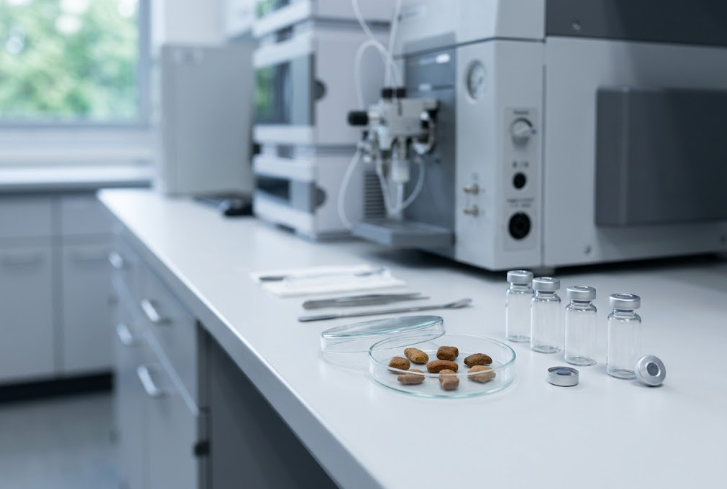
A nonprofit tested 100 cat foods and detected lead in 99%, cadmium in 96%, and arsenic in 94%. Detection is not the same as danger: the study ranks products against one another and does not show that any food harms a cat. The practical patterns are clearer than the headline. Fish-based foods carried far more mercury, dry food carried more lead, and canned and pouched foods carried more of a plastic chemical called DEHP.

In early October 2026, Clean Label Project (CLP) released a report on lead in cat food and other contaminants. It covers 100 products from 62 brands (31 dry, 40 wet, 29 air- or freeze-dried), tested by an ISO 17025-accredited laboratory for more than 122 contaminants, and CNN reported it the same week. Heavy metals are not unique to pet food: the FDA notes that crops take up toxic elements from the environment as they grow. So the useful question is not whether anything was found, but how much, in which foods, and whether it matters for a cat.
What the Report Found
| Contaminant | Detected In | Strongest Pattern |
|---|---|---|
| Lead | 99% | About 3× higher in dry food than in wet or air-dried food |
| Cadmium | 96% | About 2.5× higher in fish-based products |
| Arsenic | 94% | Reported as total arsenic, so the more toxic inorganic form is not separated out |
|
Glyphosate (herbicide) |
37% | About 40% higher per added plant ingredient among the top ten ingredients |
|
DEHP (plasticizer) |
48% | About 5× higher in canned and pouched foods, where detected |
Mercury showed the sharpest split. Products with fish or seafood in the name carried about 18 times the mercury of other products, even after accounting for wet versus dry. Nearly half (48.6%) of fish-based products ranked among the highest for mercury; no poultry-based product did. By CLP’s own standard, which ranks products against each other, 84.8% of poultry products passed against 25.7% of fish and seafood products. An earlier analysis of 101 dog and cat foods found the same direction: every food above its mercury reference level listed fish first, though its authors judged the risk minor for wet cat foods.
How to Read the Numbers
Established. The WHO says no safe level of lead is known for people. For cats, a 1970s feeding trial found that adult cats given methylmercury-contaminated fish developed ataxia and loss of balance at high daily doses. Those doses were not designed to mimic cat food, so the trial shows mercury can harm cats, not that today’s foods do.
Reasonable inference. Most cats eat the same food for years, so small exposures could accumulate, which is CLP’s central concern. A study of 47 cats (22 male; 25 female; aged between 2 months and 18 years) found higher cadmium in the liver and kidney cortex of cats with chronic kidney disease. That is an association: it cannot show whether cadmium contributes to kidney disease or whether diseased kidneys simply retain more.
Not established. That any tested product harms a cat. CLP itself says the study compares products and does not determine harm, no applicable regulatory thresholds exist to measure levels against, and each product was tested from a single batch.
Two Findings with Fine Print

Glyphosate. The scientific debate is real. The WHO’s cancer agency (IARC) classed glyphosate as probably carcinogenic to humans in 2019, while the US EPA and the European Food Safety Authority reached the opposite conclusion, as a review of the dispute lays out. The CLP report does not link the residues it found to harm in cats.
DEHP. The US National Toxicology Program lists DEHP as reasonably anticipated to be a human carcinogen, and the CDC’s ATSDR names food as the main route of human exposure. CLP says food contact with packaging may explain the higher canned and pouched levels. BPA turned up in only two products.
Who Is Behind the Report
CLP also runs a Purity Award and brand-certification program, so it has a stake in how the category is judged, and as far as I can tell the report is published by CLP itself rather than in a peer-reviewed journal. Ryan Babadi of Toxic Free Future, who was not involved, told CNN it appears reasonably conducted. The Pet Food Institute, which represents manufacturers, told CNN that members run safety programs that include supplier verification and testing.
What Cat Owners Can Do
Cat parents should take the following measures immediately.
- Rotate proteins if your cat eats only fish.
CLP suggests this rather than dropping fish, since some fish-based foods met its standard. The Cornell Feline Health Center likewise says feeding two or three different foods can keep a cat from fixating on one.
- Read past the first ingredient.
In 35 of 100 products, the first-listed ingredient was outnumbered by another ingredient category in the top ten, and products outnumbered by plants tended to carry more lead.
- Ask brands whether they test finished products and every batch.
One test result cannot speak for a brand.
- Keep nutrition first.
Look for the AAFCO “complete and balanced” statement. Cornell does not recommend raw or gently cooked diets, citing infectious risks and no clear benefit, so do not switch to raw because of contaminant headlines.
- Do not let a cat go hungry over this.
Cornell warns that a cat that refuses to eat can develop serious medical problems, so see a vet if yours stops eating and loses weight.
I am not planning to stop feeding my cats packaged food because of this report, but it has made me pay closer attention to labels and testing. If you rotate proteins in a two-cat home, food stealing can quietly undo the plan. In my house, Simba finishes first and heads for Billu’s bowl, so I can never be sure what each cat actually ate. Our guide to stopping one cat from eating the other’s food covers the behavior side, and our automatic feeder comparison for two cats covers what feeders can and cannot control.
Conclusion
The report shows that contaminants are nearly universal in cat food and that protein source and food format change which ones appear. It does not show that 99% of cat food is unsafe or that any product has harmed a cat. Treat it as a reason to ask brands harder questions and watch for independent, peer-reviewed follow-up.
Questions Cat Parents Frequently Ask
CLP detected lead in 99% of 100 products, at widely varying levels. Detection alone does not establish that a food is unsafe.
CLP does not say so. It suggests rotating in other proteins if fish is your cat’s only protein.
Neither is cleaner on every measure: dry had about 3x more lead, while canned and pouched had about 5x more DEHP. By CLP’s standard, wet and dry performed within one percentage point of each other; protein source mattered more.
No. The report measured chemical contaminants, not the bacteria and parasites that are Cornell’s main concern with raw diets.
This bulletin summarizes a published report for general information and is not veterinary advice. If you are worried about your cat’s diet or health, talk to your veterinarian.
References
- Clean Label Project. (2026). CLP Insights: Cat Food Category Report. https://www.cleanlabelproject.org
- LaMotte, S. (2026, October 2). Cat food investigation finds heavy metals, pesticides and plastic chemicals. CNN. https://www.10news.com/science-and-tech/cat-food-investigation-finds-heavy-metals-pesticides-and-plastic-chemicals
- Cornell Feline Health Center. (2026). Feeding your cat. https://www.vet.cornell.edu/departments-centers-and-institutes/cornell-feline-health-center/health-information/feline-health-topics/feeding-your-cat
- World Health Organization. Lead poisoning (fact sheet). https://www.who.int/news-room/fact-sheets/detail/lead-poisoning-and-health
- U.S. FDA. (2021). FDA releases action plan for reducing exposure to toxic elements in foods for babies and young children. https://www.fda.gov/news-events/press-announcements/fda-releases-action-plan-reducing-exposure-toxic-elements-foods-babies-and-young-children
- Charbonneau, S. M., et al. (1974). Chronic toxicity of methylmercury in adult cat. Toxicology and Applied Pharmacology, 29(1), 138. https://hero.epa.gov/hero/index.cfm/reference/details/reference_id/2304743
- Paßlack, N., et al. (2014). Liver and kidney concentrations of strontium, barium, cadmium, copper, zinc, manganese, chromium, antimony, selenium and lead in cats. BMC Veterinary Research, 10, 163. https://pmc.ncbi.nlm.nih.gov/articles/PMC4108249
- dvm360. Mercury in dog and cat foods: Cause for concern? https://www.dvm360.com/view/mercury-in-dog-and-cat-foods-cause-for-concern
- Review of the IARC and regulatory glyphosate assessments. (2019). Brazilian Journal of Pharmaceutical Sciences. https://scielo.br/j/bjps/a/xqCsfgKpk3jX5ZsYytG8hgh/?lang=en
- National Toxicology Program. Report on Carcinogens: Di(2-ethylhexyl) phthalate. https://ntp.niehs.nih.gov/ntp/roc/content/profiles/diethylhexylphthalate.pdf
- ATSDR. ToxFAQs/ToxGuide: Di(2-ethylhexyl)phthalate (DEHP). https://www.atsdr.cdc.gov/toxguides/toxguide-9.pdf

Shafiqul Islam
Shafiqul Islam is a university educator, writer, and Fulbright scholar with an academic background in Environmental Humanities. During his Fulbright studies at the University of Montana in Missoula, he developed a deeper interest in the relationships between humans, animals, and the environments they share.
A longtime pet owner, Shafiqul brings firsthand experience with companion animals to his work at PetSpecial. He writes both practical pet-care guides and Pet Bulletin articles covering animal behavior, emerging pet technology, and the changing relationship between people and their pets. His approach combines personal experience, research, and careful product evaluation to create useful, evidence-informed content for pet owners.
2 thoughts on “Lead Found in 99% of Tested Cat Foods: Should You Be Worried as a Cat Parent?”