Updated: 16 November 2026
Quick Answer
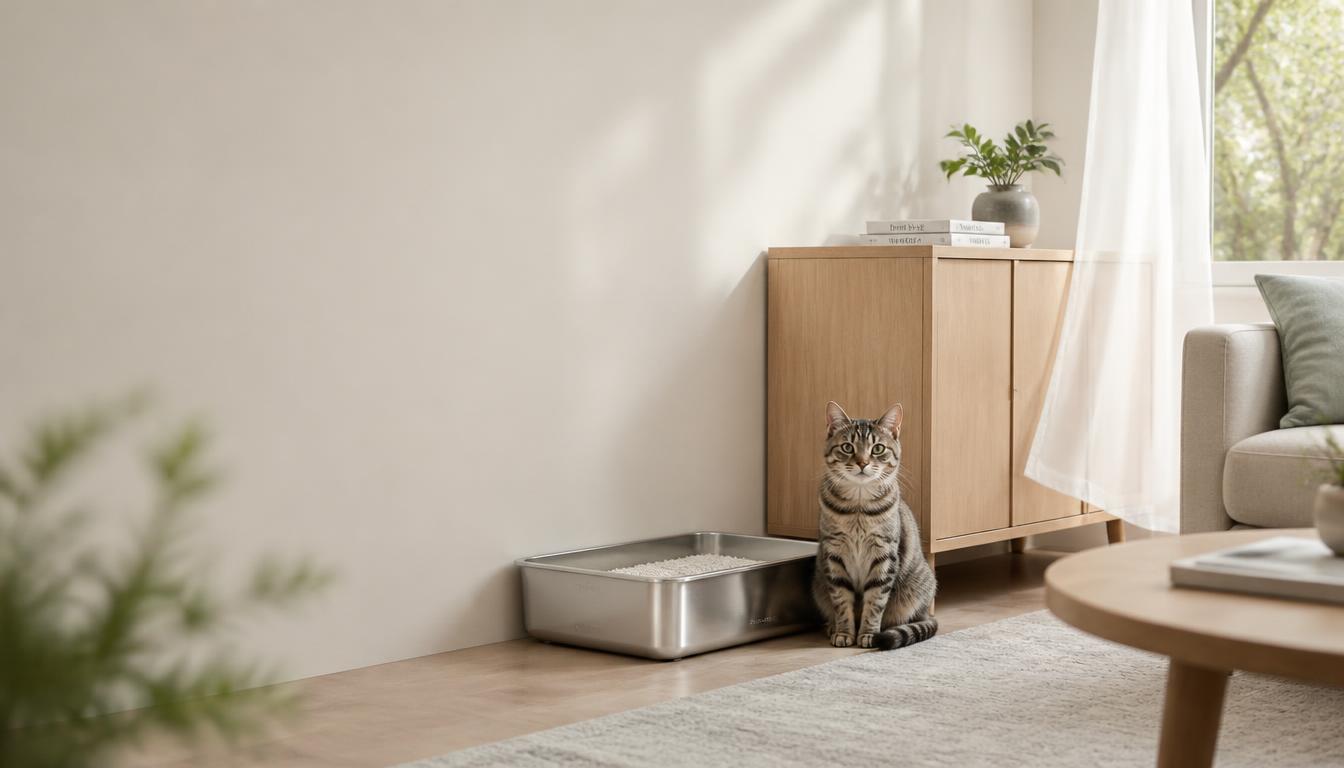
The best cat litter box for odor control is the one that suits your space, your cats, and how often you can realistically scoop your lifestyle. For one cat, the best litter box for odor control is usually a large stainless steel pan with unscented clumping litter, especially if you can scoop daily. For many homes, it’s the most practical fix for smell that hangs around after cleaning.
If the box has to sit in your living room, a covered pellet system can hold urine odor in, though a hood concentrates smell inside the box. With two or more cats, an automatic box with a sealed drawer takes over the daily work, though it doesn’t replace the extra boxes that vets usually recommend. The litter matters as well, and my guide to the best cat litter for multiple cats covers which ones hold up. Big cats and high-peers need tall walls before they need any odor feature.
Vet first: If the smell changes suddenly while your cat strains, cries, or pees outside the box, call your vet before you buy anything.
Litter box smell is the one common pet problem your guests notice before they meet your cat. Whenever a new guest arrives at my place, this is what I hear from them – do you guys not smell the odor? Cat parents across the board talk about the same issues. A cat parent describes this on a Reddit post and recommends the same loop over and over: scoop, wash, refill, and the room still smells an hour later. One thread is titled, simply, “Brand new litter box, scooped daily, still stinks.” Others admit they are afraid they have gone nose-blind to their own home.
My home is fairly spacious, so Billu and Simba have plenty of room around their litter box. Things are different at my friend Kate’s place. She shares a one-bedroom apartment with Oli, a 3-year-old female Domestic Shorthair. With no spare room, the litter box sits in the living room, and first-time guests usually mention the smell within minutes of walking in. Kate is also a bookworm who spends most of her day at the library, so the box doesn’t get scooped as often as it should. That probably explains some of the odor. When she finally switched, which box made the difference?
This is a researched buying guide, not a lab test. I pulled dimensions and features from manufacturer and retailer listings, care advice from the AAFP/ISFM guidelines, Cornell, and International Cat Care, and long-term experience from owner discussions on Reddit. When a listing doesn’t disclose a number, I say so rather than guess. I sorted the picks by the situation you are in, because a box that works in a three-bedroom house with one cat can fail badly in a studio/one bed with two.
Odor Fix Finder: Which Box Fits Your Home?
Answer six quick questions and the tool will point you to the product that fits your household and cats’ needs, plus the minimum box length based on vet sizing guidance.
Odor Fix Finder
Six questions, about 30 seconds.
Educational guide, not veterinary advice. If your cat strains, cries, or pees outside the box, see your vet first. As an Amazon Associate, PetSpecial earns from qualifying purchases; we also earn from PETLIBRO purchases made through our links.
PetSpecial is reader-supported. Some links on this page are Amazon and PETLIBRO affiliate links, so if you buy through them, we may earn a commission at no extra cost to you.
Best Cat Litter Boxes for Odor Control at a Glance
Sizes are mostly exterior dimensions from the listing unless we have indicated otherwise. One thing to keep in mind is that the usable litter space is always smaller, especially in boxes with sloped walls or a curved drum.
| Situation | Pick | Type | Size (L × W × H) | Entry | Ongoing refills | |
|---|---|---|---|---|---|---|
| Smell lingers after scooping | iPrimio Stainless Steel XL StainlessNo refills | Open stainless pan | 23.5 × 15.5 × 6 in | About 6 in | Litter only | Check Price → |
| Smell lingers after scooping | Full-size stainless hotel pan (DIY) StainlessNo refills | Open stainless pan | About 20 × 12 in at the rim, 6 in deep | About 6 in | Litter only | Check Price → |
| Small apartments | Tidy Cats Breeze Hooded Covered | Covered pellet and pad system | 21.75 × 16.5 × 16.75 in | 5.5 inches high from the ground | Pads weekly, pellets monthly | Check Price → |
| Small apartments | Catit Airsift Jumbo Covered | Covered pan with carbon and ammonia filter pad | 22.4 × 19.7 × 18.3 in | 10.4 × 9.6 in front door | Filter pad about every 30 days | Check Price → |
| Two or more cats | PETLIBRO Luma Self-cleaning | Open-top automatic | 23.3 × 22.5 × 28.1 in | 17.4 in wide | Carbon deodorizer, bags | Check Price → |
| Two or more cats | Litter-Robot 4 Self-cleaningCovered | Enclosed globe automatic | 22 × 27 × 29.5 in (litter bed about 14 × 14 in) | 15.75 × 15.75 in opening | Carbon filter or OdorTrap pack every 2 to 4 weeks | Check Price → |
| Busy owners, one cat | PetSafe ScoopFree Crystal Pro Legacy, Front-Entry Self-cleaningCovered | Hooded automatic, crystal litter tray | 27.6 × 19.1 × 16.0 in | Front entry | Disposable tray up to every 30 days, or a reusable tray refilled with crystal litter | Check Price → |
| Busy owners, one cat | PETKIT PuraMax 2 Self-cleaningCovered | Enclosed automatic | 24.41 × 21.18 × 21.73 in | About 7.9 in threshold | N50 deodorizer, bags | Check Price → |
| Big cats and high-peers | iPrimio Enclosed Sides XL StainlessNo refills | Stainless pan, detachable plastic wall extension, open top | 23.5 × 15.5 in pan; walls 6 in, or 12 in with extension | Low front opening | Litter only | Check Price → |
| Big cats and high-peers | PawHut XL Enclosed StainlessCoveredNo refills | Stainless tray, fully enclosed plastic top, flap door | 15.9 × 23.8 × 16.3 in (floor about 14.4 × 22.2 in); cats up to 13 lb | 9.1 × 7.5 in door | Litter only (2 filter bags included) | Check Price → |
Some links are affiliate links.

Why Your Litter Box Still Smells After Scooping
Most “best litter box” lists treat odor control as a feature checklist: a carbon filter here, a sealed drawer there. Owners who have lived with the problem for years tell a different story. In their experience, the smell usually comes from four places: i) the urine itself, ii) the surface of the box, iii) the shape of the box, and iv) the routine around it.
Cat urine is more than ammonia
The sharp smell most people blame on ammonia is only part of it. A 2025 study on cat urine odor looked at felinine and the sulfur compounds that give cat urine its distinctly “catty” smell. That’s one reason litter box odor can be stubborn even when you scoop. The study measured urine chemistry, though, not litter or box materials, so it doesn’t tell us which box controls smell best.

Old plastic holds on to odor
This is the complaint I saw most often in owner discussions while scanning through different Reddit posts. Plastic boxes pick up fine scratches from claws and scoops. So, owners say urine smell settles into them so that washing no longer gets it out. A vet-reviewed guide on cats.com makes the same point: scratches and grooves can hold bacteria and odor, so a worn box is worth inspecting and replacing.
Search Reddit for the best cat litter box for odor control and one answer keeps coming back: switch to stainless steel.
Has anyone tried stainless steel litter trays?
People who made the switch describe the difference as night and day.
Why does my litter box still smell even when I…
The same advice comes up again: plastic holds on to urine smell over time, and steel doesn’t.
I want to be fair here, though.
I could not find a controlled study comparing stainless and plastic litter boxes, and stainless doesn’t make waste smell any less. It just gives the smell fewer places to stay once you scoop.
Some owners even say a stainless box shows a missed scoop faster, because nothing is soaking up the smell.
Thread summaries reflect owner experience, not scientific testing.
We rescued Billu in March 2020, right as Covid shut everything down, and her first litter box was a small plastic bowl. She outgrew it fast, so we moved up to a large plastic box. It didn’t do its job for long. We were in a smaller apartment then, still learning how often litter needs changing, and the box paid for every mistake we made. Once we got our routine right, the smell still hung around, and that’s when we switched to stainless steel. We never looked back. By the time Simba was born, we already knew which box to get.
Hoods can trap the smell inside
A covered box hides the view and can keep smell from drifting across the room. It can also concentrate odor inside the hood, right where your cat’s nose is. Owners argue about this in threads like “Why covered litter boxes make your home smell,” and the common report is a wave of odor every time the lid opens. A hood also makes it easier to miss a day of scooping, because you can’t see what’s waiting inside.
Routine matters more than any box
The AAFP/ISFM caregiver guidance is plain about this: remove waste at least once a day, wash the box every one to four weeks with soap and hot water, and skip harsh chemicals and ammonia-based cleaners. It also recommends unscented clumping litter. No box on this list gets around that routine. The right box just makes it easier to stick with it.
Best Cat Litter Boxes for Odor Control by Situation
I built this section around your situation, not a blanket list of products. Each part opens with a problem you might face at home, followed by two picks that address it. For each pick, I note what it does for odor, who it suits, and where it falls short, using owner feedback where it exists.
Best Litter Box for Smell That Lingers After Scooping
Say you scoop every day and change the litter on schedule, yet the corner still smells. If your box is plastic and more than a year or so old, the box itself is the first suspect. Owners in this spot often say they replace plastic boxes every six to twelve months just to reset the smell (that’s owner experience, not a rule). A stainless pan can break that cycle, as long as the scooping keeps up.
 Prototype
Functional Layout Illustration
iPrimio Stainless Steel Litter Box XL
A large open stainless pan with a nonstick coating, according to the listing. There is no filter, fan, or drawer. The odor control comes from a surface that doesn’t scratch the way plastic does and rinses clean when you wash it.
One or two average-size cats, owners who scoop daily, and anyone done buying plastic replacements.
A cats.com review calls it heavy and one of the priciest traditional boxes around. The 6-inch sides won’t stop a cat who pees high. And because of the coating, this isn’t bare stainless, so skip abrasive scrubbers.
 Prototype
Functional Layout Illustration
Full-Size Stainless Hotel Pan (DIY Option)
Restaurant hotel pans, the steel trays used on buffet lines, are a long-running Reddit fix for litter box smell. Honestly, I hadn’t considered one until I came across a thread on r/cats last year. It works on the same principle as the iPrimio: a hard steel surface that doesn’t hold on to urine. It isn’t sold as a cat product, so you are buying kitchen equipment and using it as a litter box.
Budget setups, and multi-cat homes that need several boxes. A multi-pack makes it cheap to follow the one-box-per-cat-plus-one rule.
A full-size pan is about 20 × 12 inches at the rim, and the sides taper, so the floor is smaller than the rim. That is narrow for a large cat. Get the 6-inch depth, check that the rim is rolled and smooth, and put a mat under it, since the pan can slide on hard floors.
From our home
As I mentioned earlier, Billu started on plastic. When she was fully grown, we moved her to a larger plastic box, but the odor stayed. On our vet’s recommendation, we switched to stainless steel, and that solved most of the problem. To be fair to the box, we also change the litter fairly often, so steel alone isn’t doing all the work.
Our takeaway: If the smell survives a good wash, replace the box before you spend money on filters, sprays, or fancy litter. For many homes, steel is the most practical fix. The iPrimio is the tidier buy. The hotel pan is the cheaper way to get several steel boxes into a multi-cat home.
As an Amazon Associate, PetSpecial earns from qualifying purchases. Buying through these links costs you nothing extra and helps support the site. Product images in this section are Functional Layout Illustrations, not photos of the actual products.
Best Litter Box for Odor Control in Small Apartments
In a studio or a one-bedroom, the litter box often lives a few feet from where you eat, sleep, or cook. There is no spare room to shut it away in, and roommates and guests notice. Speaking from my time in Missoula, it gets worse in the harsh winter months, when opening a window stops being an option.A covered design is a trade-off here: it can keep smell from drifting across the room, but it concentrates odor inside the box, so it only works if you keep cleaning inside the hood.
 Prototype
Functional Layout Illustration, Not an actual product photo.
Purina Tidy Cats Breeze Hooded System
Breeze works differently from a normal box. Urine runs through a layer of large non-clumping pellets onto an absorbent pad in a slide-out tray underneath, while solid waste stays on top for scooping. In a cats.com hands-on review, urine odor was well contained, and the smell mostly showed up when the pad tray came out. The hood hinges open for scooping.
One cat in a small space, especially if urine smell is your main complaint.
Poop odor is controlled less well, according to the same review and many buyer comments. Some cats refuse the big pellets, and refills add up: Tidy Cats calls for a new pad every seven days and fresh pellets monthly for one cat. It’s a poor fit for several cats sharing one unit. The AAFP/ISFM guidelines list fine, unscented clumping litter as most cats’ preference and advise against liners and grates for cats with box problems, so switch slowly and watch your cat. Assembled size: 21.75 × 16.5 × 16.75 inches.
 Prototype
Functional Layout Illustration. Not an actual product photo.
Catit Airsift Jumbo Hooded Litter Pan
A hooded pan with Catit’s Airsift Dual Action pad in the roof, which combines activated carbon with an ammonia-absorbing layer. It works with ordinary clumping litter, and Wirecutter picked it as its covered litter box. Catit lists it at 22.4 × 19.7 × 18.3 inches (L × W × H), with a 10.4 × 9.6-inch front door that folds back for scooping.
Cats who already accept a covered box, and owners who want to keep normal clumping litter instead of switching to pellets.
Catit says one filter pad lasts about 30 days, and owners report that a pad left longer stops doing much. Many cats dislike the flap door, and some buyers say it sticks. It pops off easily, so you can run the box without it. A filter can’t make up for a skipped scoop.
Kate and Oli’s winter
I asked my friend Kate how she handles odor with Oli, especially in winter. Her one-bedroom is small, and with the living room furniture, the litter box has nowhere else to go. The smell got bad enough that she switched to a hooded box like the ones above. That only partly fixed it, so she has also started changing the litter more often. Between the two, she says, her apartment finally feels livable.
As an Amazon Associate, PetSpecial earns from qualifying purchases. Buying through these links costs you nothing extra and helps support the site. Product images in this section are Functional Layout prototypes created for illustration, not photos of the actual products.
Best Litter Box for Multiple Cats
More cats means more waste, more trips, and a box that never fully airs out, which is why the best multi-cat litter box for odor control looks different from a single-cat setup. It’s also where owners lean hardest toward automatic boxes. One thing first: the AAFP/ISFM guidance recommends one box per cat plus one, in separate locations. That’s about giving each cat a choice and avoiding standoffs over shared resources, not about cleaning. An automatic box keeps one spot clean around the clock. It doesn’t replace the second and third boxes.
 Prototype
Functional Layout Illustration
PETLIBRO Luma Smart Litter Box
Luma has an open-top design, so there’s no globe or hood holding smell in. A built-in fan pulls air through a carbon deodorizer, and waste goes to a sealed 11-liter drawer. Petlibro says the drawer holds about seven days of waste for two cats, and that the fan system traps 97% of odor in a six-hour third-party lab test. That figure is the manufacturer’s, not mine. A camera recognizes up to 10 cats and logs each visit.
Two or three cats, owners who want the box open and airy, and anyone who’d like per-cat visit tracking. (Here’s what smart litter box data can and can’t tell you about your cat’s health.)
It lists at $599.99, and the AI waste analysis and video history need a paid plan starting at $95.99 a year, though basic use doesn’t require one. Luma works with clumping, tofu, and mixed litters, but not crystal, pine, or very fine litters. It’s rated for cats from 2.2 to 22 pounds, and Petlibro says to switch off auto-cleaning for kittens under six months. In a cats.com review, users reported minor leaking with lighter litters, a sensor that sometimes thinks a cat is inside, and louder cleaning than expected. A three-month test at Tom’s Guide with two cats found the drawer shallower than expected.
 Prototype
Functional Layout Illustration
Litter-Robot 4
The globe rotates after each visit, sifts out clumps, and drops them into a sealed drawer with a carbon filter, plus a slot for optional OdorTrap packs. Whisker recommends replacing the filter or pack every two to four weeks, and is honest that odor is “significantly reduced,” not eliminated. The company says one unit serves up to four cats and that the drawer may need emptying as rarely as every eight days.
Multi-cat homes that use standard clumping clay litter and want the most established automatic box on the market.
At $699 it’s the priciest pick here. The usable litter bed is about 14 × 14 inches inside the globe, smaller than the outside suggests, and the entry sits about 12 inches off the floor unless you add the step. Whisker advises against plant-based, pellet, and non-clumping litters. The bigger warning comes from owners. The r/litterrobot community has long threads such as “I can’t take the smell anymore,” where the drawer, liner, or seals become the new source of smell and the fix is a full teardown and deep clean. An automatic box moves the odor problem somewhere else. It doesn’t make it disappear.
A Litter-Robot owner in Bozeman
Not many people I know own a Litter-Robot, so I asked around and ended up talking to a friend of a friend in Bozeman. He has two cats: a senior with diabetes and a younger, healthy one. A diabetic cat often pees more, so the drawer fills quickly in his house. His habit is to pull the drawer every few days and give it a quick shake to level the pile, which resets the full sensor and buys a few more days before he changes the bag. It’s a handy trick, but don’t stretch it too far. A packed drawer is exactly where Litter-Robot owners say the smell comes back from.
Our takeaway: For most multi-cat homes I’d choose the Luma, mainly for the open top and the airflow, and pair it with a cheap steel pan in another room. The Litter-Robot 4 has the longer track record, but budget for filters and a deep clean every few months, and don’t count it as four boxes.
As an Amazon Associate, PetSpecial earns from qualifying purchases. We also earn a commission from PETLIBRO purchases made through our links. Buying through these links costs you nothing extra and helps support the site. Product images in this section are AI-generated prototypes created for illustration, not photos of the actual products.
Best Self-Cleaning Litter Box for Odor Control (One Cat)
Long shifts, work travel, or a bad back can make daily scooping hard, and that’s when a self-cleaning litter box earns its price. Skipped days are where odor builds fastest, because waste sits in the litter and keeps releasing smell. For a single cat, these two boxes cut down how often you have to deal with it.
 Prototype
Functional Layout Illustration. Not an actual product photo.
PetSafe ScoopFree Crystal Pro Legacy, Front-Entry
A rake sweeps waste into a covered trap after your cat leaves, and silica crystal litter absorbs urine and dries solids. Everything sits in a tray of crystal litter. With PetSafe’s disposable trays, a light tells you when to swap it, up to 30 days per tray. PetSafe also sells a $49.99 stainless steel reusable tray that you refill with its crystal litter. In a month-long test at Technomeow, the reviewer said guests couldn’t smell the box even near the end of the tray’s life. The front-entry hood adds privacy, and a counter tracks visits.
One average-size cat, and owners who want a simple routine: swap the tray once a month and you’re done.
It only works with PetSafe’s own crystal trays, disposable or reusable, so refills are an ongoing cost that climbs quickly with more cats. The reusable tray cuts waste but still needs PetSafe crystal litter. The same reviewer’s cat, about 11 pounds, barely fit with the hood on. Crystals track out of the box, and the texture is very different from the clumping litter most cats prefer, so switch gradually. Choose unscented trays, since some packs come scented. PetSafe lists the front-entry Legacy at 27.6 × 19.1 × 16.0 inches (checked October 22, 2026). PetSafe also sells a newer, slightly larger hooded Crystal Pro that looks similar, so match the model name on the listing before you buy.
 Prototype
Functional Layout Illustration. Not an actual product photo.
PETKIT PuraMax 2
An enclosed drum box with a 76-liter cylinder that separates clumps into a sealed 7-liter bin. Odor control comes from PETKIT’s N50 deodorizer, with an optional smart spray that attaches inside the drum. It works with clumping litter, so your cat keeps the texture it knows.
One cat, and owners who want clumping litter and an app at a lower price than the Litter-Robot.
The entry threshold is about 7.9 inches, and the outside measures 24.41 × 21.18 × 21.73 inches. A cats.com reviewer found it’s meant for hard floors only, the magnetic litter remover was slow, and the reviewer’s cats over ten pounds ignored it. Negative buyer reviews mention urine leaks and sensor faults.
How Sabrina handles short trips
My friend Sabrina is a journalist who travels often, and her cat usually stays with another friend while she’s away. Last summer, both of them had to leave town at the same time. Sitters are hard to book in summer, and homes with dogs aren’t a good place to drop off a cat. So she bought a self-cleaning litter box. With that and an automatic feeder, she says she can now leave for two- or three-day work trips without scrambling for help.
A word of caution: automatic gear covers the litter and the food, not your cat. For any trip longer than a night, plan plenty of fresh water and have someone check in, or at least keep an eye on a camera, in case a machine jams or your cat gets sick.
Our takeaway: The ScoopFree Legacy is the simpler buy for a small or average cat, and the monthly tray swap is about as low-effort as litter care gets. The PuraMax 2 suits a cat who won’t give up clumping litter, but read the size limits carefully before you order.
As an Amazon Associate, PetSpecial earns from qualifying purchases. Buying through these links costs you nothing extra and helps support the site. Product images in this section are Functional Layout Illustrations, not photos of the actual products.
Best High-Sided Litter Box for Big Cats and High-Peers
Some cats squat low. Others stand, back up, and aim straight over the edge. Urine on the wall or the floor behind the box soaks into baseboards and grout, and no filter catches that. Large cats also hang off the end of standard boxes. For these cats, height and length come first.
 Prototype
Functional Layout Illustration. Not an actual product photo.
iPrimio Enclosed Sides XL
This is iPrimio’s 23.5 × 15.5-inch stainless pan with a detachable plastic enclosure that doubles the wall height from 6 to 12 inches. The litter sits on steel, and the tall walls keep spray inside the box instead of on your wall.
High-peers, cats that dig hard, and large cats that need length.
It’s open on top, not a full hood. The enclosure is plastic, so the splash zone is plastic. Wipe it down every time you do a full wash so it doesn’t start to hold smell. At 23.5 inches long, it’s just short of the 24 inches a 16-inch cat needs, so check your own cat’s measurement. iPrimio doesn’t publish the inside floor size.
 Prototype
Functional Layout Illustration. Not an actual product photo.
PawHut XL Enclosed Stainless Litter Box
A stainless steel tray under a fully enclosed polypropylene top, so urine can’t go over the edge at all. It measures 15.9 × 23.8 × 16.3 inches outside, with about 14.4 × 22.2 inches of floor inside. It comes with a removable flap door, a scoop, and two filter bags.
High-peers who already accept a covered box, and owners who want full enclosure for less than the iPrimio.
The listing gives a weight capacity of 13 pounds, and the door opening is only 9.1 × 7.5 inches, so this one isn’t for genuinely big cats. Buyers report enclosure pieces arriving warped or not clicking together securely, and the small door makes scooping awkward. As with any hood, smell stays inside unless you scoop daily.
A squatter and a stander
Billu and Simba couldn’t be more different here. Billu lowers her whole body close to the floor. Simba does his business standing upright, and until I saw him do it, I had no idea cats did that. It’s funny to watch, but it’s also the reason tall walls matter in our house.
Our takeaway: Measure your cat first. If the iPrimio’s length works, it’s the safer bet for big cats and high-peers. The PawHut suits a medium-size cat who sprays high and already likes a hood. For senior cats or cats with stiff joints, skip high entries and top-entry designs altogether. The ASPCA advises low sides for older cats.
As an Amazon Associate, PetSpecial earns from qualifying purchases. Buying through these links costs you nothing extra and helps support the site. Product images in this section are Functional Layout prototypes created for illustration, not photos of the actual products.
Covered vs. Open Litter Boxes: What the Research Shows
Owners argue about this endlessly, and the research is thinner than you’d expect. A University of Guelph thesis summarizes two small studies. In the first, 28 cats tested at home showed no overall preference between covered and uncovered boxes. In the second, 13 cats showed no significant preference when the two boxes had the same floor area. In both, box size made the results harder to read.

| Covered | Open | |
|---|---|---|
| Room odor | Smell is held in, then released when the hood opens | Smell spreads but doesn’t concentrate |
| Inside the box | Stronger odor where your cat stands | Airs out between uses |
| Scatter and spray | Better contained | Depends on wall height |
| Cleaning | Easy to put off, extra part to wash | Problems are visible, quick to scoop |
| Cat acceptance | Some cats refuse | Most cats accept |
My read: if your cat is happy in an open box, keep it open and control odor through the material and the scooping. Go covered only when the box has to sit in a shared room and your cat has already shown it accepts a hood.
The Real Monthly Cost of Odor Control

The sticker price is only part of it. Here’s what each box costs to keep running for one cat over 30 days, based on prices we checked on October 21, 2026, and each manufacturer’s own replacement schedule. The math is shown in every row so you can redo it with today’s prices. Costs are spread over 30 days, so you won’t pay exactly this every month.
| Product | What you replace (schedule source) | Pack price and math | Cost per 30 days | Litter included? |
|---|---|---|---|---|
| iPrimio XL, hotel pan, iPrimio Enclosed Sides, PawHut | Nothing beyond litter | No proprietary refills | $0 | No, add litter |
| Catit Airsift Jumbo | Airsift filter pad, about every 30 days (Catit) | 6 pads for $20.40 (Chewy) $20.40 ÷ 6 × 1 pad |
$3.40 | No, add litter |
| PETKIT PuraMax 2 | N50 deodorizer every 30 days (PETKIT), plus waste bags (no schedule published) | N50: 3 for $19.99 (PETKIT) → $19.99 ÷ 3 = $6.66 Bags: 90 for $29.99 (Amazon); if you change one when the bin is full, about every 15 days: $29.99 ÷ 90 × 2 = $0.67 |
About $7.33 | No, add litter |
| PETLIBRO Luma | Drawer liner every 7 to 10 days; carbon deodorizer every 30 to 90 days (PETLIBRO) | Liners: 40 for $19.99 → $19.99 ÷ 40 × 3 to 4.3 = $1.50 to $2.14 Deodorizer: $19.99 each → $6.66 (every 90 days) to $19.99 (every 30 days) Optional AI plan: $95.99/year ÷ 365 × 30 = $7.89 |
$8.16 to $22.13$8.16 to $8.80 on PETLIBRO’s one-cat schedule | No, add litter |
| Litter-Robot 4 | Carbon filter every 2 to 4 weeks; drawer liner about weekly for one cat (Whisker) | Filters: 6 for $30 → $5 × 30 ÷ 28 to 14 = $5.36 to $10.71 Liners: 25 for $25 → $1 × 30 ÷ 7 = $4.29 OdorTrap packs optional, not counted |
$9.65 to $15.00 | No, add litter |
| Tidy Cats Breeze Hooded | One pad every 7 days; one 3.5 lb bag of pellets a month (Purina) | Pads: 10 for $13.97 (Chewy) → $13.97 ÷ 10 × 30 ÷ 7 = $5.99 Pellets: $9.77 per 3.5 lb bag (Chewy) × 1 = $9.77 |
$15.76 | Yes, pellets are the litter |
| PetSafe ScoopFree Crystal Pro Legacy, Front-Entry | One disposable crystal tray, up to 30 days (PetSafe) | 3 fragrance-free trays for $73.49 (PetSafe) → $73.49 ÷ 3 × 1 = $24.50 Reusable option: $49.99 stainless tray once (fits all ScoopFree crystal systems), then PetSafe crystal litter refills (no schedule published) |
$24.50With disposable trays. More if a tray doesn’t last 30 days. | Yes, crystals come in the tray |
Compare like with like. Breeze and ScoopFree refills already include the litter. For every other box, add your usual clumping litter on top. A 40 lb bag of unscented clumping clay costs about $23, and how long it lasts depends on your cat and how deep you fill the box.
Breeze pads were priced in the scented version, the one with a verifiable price that day; check the unscented price. Prices exclude tax, shipping, and first-order or autoship discounts. They will change, so check the current price before you buy.
Sources: replacement schedules from Purina, Catit, PETLIBRO, Whisker, PetSafe, and PETKIT. Prices from manufacturer stores, Chewy, and Amazon, checked October 21, 2026.
Litter Matters as Much as the Box
A great box filled with the wrong litter will still smell. The AAFP/ISFM guidelines point to a fine, unscented clumping litter at a depth of about 3 cm (roughly 1.25 inches) as the safe default for most cats. Clumping matters for odor because urine gets locked into a clump you can lift out, instead of soaking the whole bed.
Scented litter and deodorizing powders are where owners tend to go wrong. Covering the smell with perfume means you smell the problem later, and many cats dislike strong scents. If you want a setup that is good for odor control and dust free, look for low-dust clay or a plant-based clumping litter your box supports. Check the automatic boxes above first, since several of them only work with specific litters.
On a side note, even if your litter box is perfectly fine, there might be underlying reasons why your cats might hate the litter box.
Litter Box Odor Control Checklist
Tick these off and see how many you’re already doing.
When a Smell Change Means a Vet Visit

A sudden change in how the box smells is worth noticing, but smell alone can’t tell you what’s wrong. The 2025 study mentioned earlier looked at 40 healthy cats and 66 cats with kidney disease and found that advanced disease was linked to lower levels of one of the compounds behind urine smell, not higher. So “stronger smell means kidney trouble” isn’t a reliable rule.
What matters more is behavior. Cornell’s Feline Health Center lists these warning signs for urinary problems: straining or pain while peeing, more frequent trips, crying in the box, blood in the urine, licking the genital area, and peeing outside the box. A male cat straining with little or nothing coming out is an emergency. If you see any of these, call your vet before you change boxes or litter.
Which Litter Box Should You Buy?
If you only take one thing from this page, make it this: the best cat litter box for odor control is a box your cat will use, made from a surface that doesn’t hold smell, big enough for your cat, and scooped every day. For most single-cat homes that means a stainless pan like the iPrimio XL. For a small apartment, the Breeze Hooded. For several cats with room in the budget, the PETLIBRO Luma plus a steel pan in a second room. For long days away, the ScoopFree. For a cat who aims high, the iPrimio Enclosed Sides.
What I’m doing next
I’ll admit I learned a lot while researching this page. For Billu and Simba, I’m adding a PawHut XL Enclosed to the two stainless boxes we already have. That makes three boxes for two cats, the one-per-cat-plus-one setup vets recommend, and the tall enclosure suits Simba, our stander. The next time I see Kate, I’ll suggest the PETKIT PuraMax 2. It cleans itself while she’s at the library, and it keeps Oli on the clumping litter she knows. As for Sabrina and my Bozeman friend, I have nothing to suggest. They already have the best cat litter box for odor control for their homes.
How we researched this guide
- What we used at home: Billu and Simba have used stainless steel boxes for years, after a large plastic box kept smelling.
- What we heard from owners: I interviewed friends who live with these setups, including a Litter-Robot 4 owner with two cats and a one-cat owner in a small apartment.
- What we read: manufacturer specs and replacement schedules, independent reviews, AAFP/ISFM and Cornell vet guidance, two small studies on covered vs. open boxes, and long-running owner threads on Reddit.
- What we didn’t do: lab tests or side-by-side odor measurements. Where a claim comes from a manufacturer, we say so.
Every pick is labeled:
Questions Cat Parents Frequently Ask
What is the best litter box for odor control?
It depends on your home. For one cat, a large stainless steel pan with unscented clumping litter, scooped daily, is the most practical option for many homes. In a small apartment, a covered pellet system like Breeze can hold in urine odor well, though a hood concentrates smell inside the box. For several cats, an automatic box with a sealed, filtered drawer cuts down daily smell, as long as you keep extra boxes too.
Why does my litter box still smell right after I scoop?
Common causes are urine smell settling into a scratched plastic box, litter that’s too shallow or not clumping well, or a hood holding odor in. Wash the box with soap and hot water. If the smell comes back within a day, replace the box.
Does a stainless steel litter box really stop odor?
It stops the box itself from holding smell, which is the main complaint with old plastic. It doesn’t stop fresh waste from smelling, so you still need to scoop daily. Owners who switch often describe a big improvement, but I found no controlled study measuring it.
Are covered litter boxes better for smell?
They keep smell out of the room but concentrate it inside the box, and some cats refuse them. Small studies have found no overall preference between covered and open boxes. Use a hood only if your cat accepts it and you’ll still open it to scoop daily.
Why does my automatic litter box smell?
The smell usually comes from the waste drawer, the liner, the seals, or urine pooling under the drum. Replace the filter on schedule, empty the drawer before it’s full, and take the unit apart for a deep clean every few months. Owners on r/litterrobot report this is the step most people skip.
How do I keep litter box smell down in a small apartment?
Use a non-plastic or fresh box, unscented clumping litter at proper depth, and scoop at least once a day. Put the box where air moves, not in a closed closet. If the box has to sit in your living space and your cat accepts a hood, a covered pellet system like Breeze can help.
How often should I replace a plastic litter box?
There’s no set schedule. Replace it once it’s scratched and the smell comes back soon after a full wash with soap and hot water.
How many litter boxes do I need for two cats?
Three, by the usual rule, though the number is a starting point rather than a tested figure. I cover where it comes from and when it breaks in how many litter boxes per cat.

About the Author: Shafiqul Islam
Shafiqul Islam is the Founder & Editor of PetSpecial, an educator, and a devoted pet parent to his cats, Billu and Simba. Passionate about pet care, he created PetSpecial to help fellow pet parents find clear, practical, and trustworthy answers to everyday questions about their animals. His articles draw on personal experience where relevant, peer-reviewed scientific studies, and reliable veterinary sources to separate evidence-based guidance from unsupported claims and marketing hype.
Want to know more about Shafiqul and why he created PetSpecial? Visit the About Us page.