Pet Bulletin Brief
Litter box aversion in cats means a cat avoids its box because it dislikes the box or the litter. One 2025 study found cafe cats used boxes 50 cm wide or larger, and clumping clay litter, more than the alternatives. Veterinary guidelines also stress box size, litter type, and a vet check for medical causes. Neither establishes why an individual cat avoids its box, and no study sets a digging-time cutoff that proves a problem.
You suddenly hear your cat’s shrieking meows. Then it goes quiet, and you find the floor soiled, even though a litter box sits right next to it. The truth is, litter box aversion in cats means a cat dislikes its litter or its box enough to avoid using it properly. Common clues are perching on the rim, barely digging, or rushing out. But what causes this in the first place? We will dig into a problem many cat owners face all too often.
This matters for owners of smart litter boxes too. The sensors can log visits and time, but the data only helps if you know what it means.
What is litter box aversion?
Veterinary behavior writers define an aversion as the cat not liking the litter or the box it has been given (Today’s Veterinary Practice, 2015). It is different from a preference for another spot, such as a favorite corner or the bathmat. In an aversion, the problem is the box or the litter itself.
Signs of cat litter box aversion
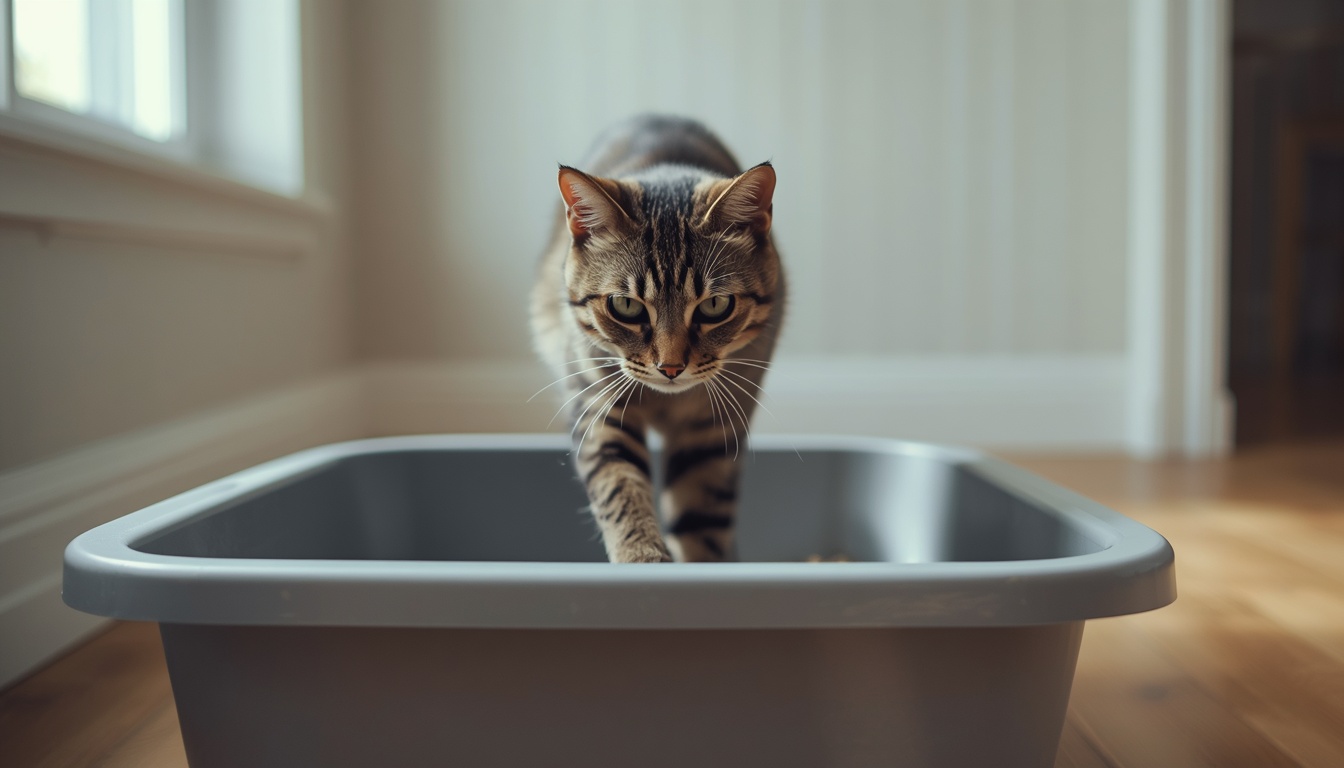
Vets describe a cat with an aversion this way: it perches on the edge, barely digs or covers, shakes its paws, or leaves in a hurry (Today’s Veterinary Practice, 2015; Veterinary Partner, VIN). Researchers also watch for paws raised on the box sides, scratching at the walls, and not digging at all (Iwabuchi-Inoue et al., 2025). In earlier work, cats with elimination problems spent less time digging (Sung & Crowell-Davis, 2006, as cited in Iwabuchi-Inoue et al., 2025).
Nobody has published a magic number, like “under 5 seconds of digging means trouble.” So if your smart litter box sets off an alarm based on a cutoff like that, the manufacturer chose it. It is not a scientifically backed finding.
Why texture matters
Cats follow a routine: dig a hollow, go, then cover it up. This instinct traces back to their pre-domestication era. Researchers in Japan link it to the wildcat ancestor of house cats, and suggest cats like fine, sandy material because it is easy to dig in and hides waste well (Iwabuchi-Inoue et al., 2025).
That ancestor is the Near Eastern wildcat (Felis silvestris lybica) (Driscoll et al., 2007). A genetic study of 979 cats found that house cats were domesticated in the Near East, probably alongside early farming villages in the Fertile Crescent (Driscoll et al., 2007, Science). The first domestic cats were mousers that settled near farmers about 10,000 years ago in the Middle East. Ancient DNA later showed that both Near Eastern and Egyptian populations of this wildcat contributed to modern cats (Ottoni et al., 2017, Nature Ecology & Evolution). From there, cats spread first by land and later by sea. International Cat Care says cats tend to prefer fine-grain litter, and that preferences develop early, so many cats stay with the material they used as kittens.

Large, pellet-like litters are reported to be disliked by cats. The Japanese team suspects the feel under the paw and the weight of the litter matter, but they did not test texture themselves.
What happened when cats got to choose
In a 2025 study in the Journal of Veterinary Medical Science, 46 cats in cafes were offered three clumping litters for three days each. They used clay the most (258 trips), then wood (152), then paper (66). Box size mattered too: large boxes of 50–60 cm drew about 36% of trips each, and a 40 cm box drew about 17%.
Three Caveats
- The preference tests used cats in cat cafes, not family homes. Only the final experiment, on cats with soiling problems, involved household cats.
- Silica gel and walnut shell litters were not tested.
- The study’s lead author works for Lion Pet Co., which also made the litters and the box used in the later experiments.
What aversion signs can’t tell you
A change in digging or posture suggests the cat is unhappy. It does not say whether the cause is the litter, the box, the room, or the cat’s health. Vets sort the causes into medical, social, and environmental groups (AAFP/ISFM, 2014).
A cat with a sore bladder may also start to link the box with pain, and then avoid it even after the pain is treated. In the 2025 study, vets ruled out disease with urine tests, X-rays, and ultrasound before blaming the setup.
⚠ Vet Warning
Call your vet promptly if you see:
- Straining or many trips with little urine
- Blood in the urine
- Crying in the box
- Suddenly going outside the box
- Lethargy, vomiting, or not eating
Not sure which box fits your home?
My Odor Fix Finder asks six questions about your cats, your space and how often you can scoop, then works out the minimum box length your largest cat needs.
Try the Odor Fix Finder →Fixing a litter box aversion
| Factor | What the guidance says |
|---|---|
| Litter | Fine-grain and unscented is what cats tend to prefer. My guide to the best cat litter for multiple cats lists unscented options that hold up with several cats. Keep to the material your cat is used to. |
| Box size | A rectangular box about 1.5 times the cat’s nose-to-tail-base length. AAFP/ISFM guidelines |
| Number of boxes | One per cat plus a spare. Two boxes in separate locations, even for a single cat. International Cat Care; AAFP/ISFM |
| Placement | Cats prefer privacy, so choose a quiet area. Some cats like a covered tray, so watch your own cat. RSPCA |
If you are wondering if integrating AI into smart litter boxes can revolutionize the pet health industry, you might be in the wrong. Besides, controlling litter box odor becomes a major challenge when your cat soils outside the box. In such cases, a litterbox that controls odor can come to your rescue.
Box count and location matter too. See how many litter boxes per cat you need and where to put litter boxes in a small apartment.

References
- Carney, H. C., Sadek, T. P., Curtis, T. M., Halls, V., Heath, S., Hutchison, P., Mundschenk, K., & Westropp, J. L. (2014). AAFP and ISFM guidelines for diagnosing and solving house-soiling behavior in cats. Journal of Feline Medicine and Surgery, 16(7), 579–598. https://doi.org/10.1177/1098612X14539092
- Curtis, T. M. (2015, August 14). Feline inappropriate urination. Today’s Veterinary Practice, September/October 2015. https://todaysveterinarypractice.com/behavior/practical-techniques-from-the-navc-institutefeline-inappropriate-urination/
- Driscoll, C. A., Menotti-Raymond, M., Roca, A. L., Hupe, K., Johnson, W. E., Geffen, E., Harley, E. H., Delibes, M., Pontier, D., Kitchener, A. C., Yamaguchi, N., O’Brien, S. J., & Macdonald, D. W. (2007). The Near Eastern origin of cat domestication. Science, 317(5837), 519–523. https://doi.org/10.1126/science.1139518
- International Cat Care. (2025a). Choosing a litter tray for your cat. https://icatcare.org/articles/choosing-a-litter-tray-for-your-cat
- International Cat Care. (2025b). Soiling indoors. https://icatcare.org/articles/soiling-indoors
- Iwabuchi-Inoue, Y., Hattori, Y., & Kikusui, T. (2025). Litter box size and litter type preference and their associated behavioral changes in cats. Journal of Veterinary Medical Science, 87(6), 614–620. https://doi.org/10.1292/jvms.24-0468
- Ottoni, C., Van Neer, W., De Cupere, B., Daligault, J., Guimaraes, S., Peters, J., Spassov, N., Prendergast, M. E., Boivin, N., Morales-Muñiz, A., Bălăşescu, A., Becker, C., Benecke, N., Boroneant, A., Buitenhuis, H., Chahoud, J., Crowther, A., Llorente, L., Manaseryan, N., . . . Geigl, E.-M. (2017). The palaeogenetics of cat dispersal in the ancient world. Nature Ecology & Evolution, 1, Article 0139. https://doi.org/10.1038/s41559-017-0139
- RSPCA. (n.d.). How to use a cat litter tray. https://www.rspca.org.uk/adviceandwelfare/pets/cats/environment/litter
Frequently Asked Questions
What causes litter box aversion in cats?
How do I know if my cat has a litter box aversion?
Do cats prefer clay litter?
Is silica gel litter bad?
Can a smart litter box diagnose illness?
Veterinary Disclaimer: This article is for general education and isn’t a substitute for veterinary advice.
