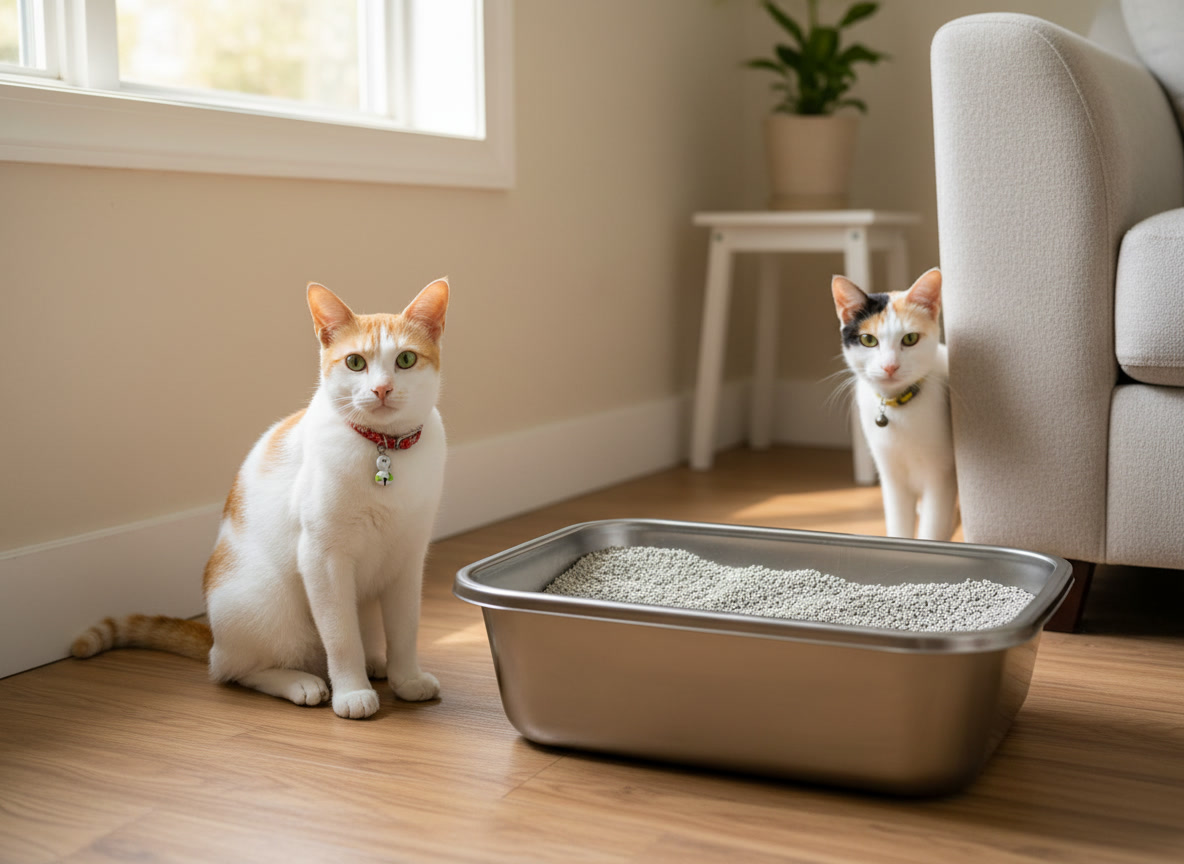
After we rescued Billu during covid, we didn’t know much about litter box and odor control. So, we began with a plastic bowl and some sand in it. Then she grew up and our need for a bigger litterbox emerged. Mornings became increasingly difficult inside our small apartment. We kept wondering what we might have done wrong that the smell doesn’t go away! And, how to get rid of litter box smell permanently! So, we switched to a stainless steel one. We added one more litterbox when Simba came to our household. We have since added a third one to meet the standard N+1 rule.
Why litter boxes smell
Let me simplify the science behind litterbox odor before we proceed any further. To get rid of litter box smell, start by removing urine clumps and feces, checking for contaminated litter left behind, and cleaning any urine outside the tray. Then maintain enough accessible boxes and a cleaning schedule that keeps pace with their use. Veterinary guidance recommends scooping at least daily and washing boxes regularly with soap and hot water. But, will washing and scooping alone solve the problem?
Let’s get to the root. The priority is source-control, meaning removing the material producing the smell rather than adding fragrance over it. In other words, prevention is better than cure.
In a multi-cat home, that also means checking whether every cat has a clean, comfortable place to go. A routine can look adequate on paper while one heavily used box needs more attention than the others. Veterinary guidelines therefore consider cleanliness, location, box size, and relationships between cats together.
Here is a practical way to tackle the smell without immediately replacing every product you own.

How to Get Rid of Litter Box Smell Effectively
Cat owners with 2 or mote cats often term this odor problem as the biggest challenge of parenting multiple pets. As a cat parent myself, I had to dig deeper into the problem that I myself can be benefitted from. So, the easy steps I have outlined below are tailored for your needs. Each one addresses a unique situation.
1. Start With a Full Check of the Litter Area
Before adding a deodorizer or a vacuum suction device, inspect the entire setup first.
Remove the obvious waste
Scoop out urine clumps and feces from every box, including deposits along the edges and corners. But how often? The answer is: as soon as you can. Whenever I see my cats using the litter box and if I am around, especially after they do number 2, I don’t waste any time.
Cleanliness matters even when a box does not smell particularly bad to you. A 2017 study found that cats preferred clean boxes over dirty ones. Physical waste-like obstructions affected their choices, while urine and fecal odor alone did not explain their preferences under the tested conditions.
So, you might be wondering, what’s the hurry if I don’t smell anything? You are in the wrong, sir/madam! Whether or not the box smells has nothing to do with whether your cats would feel comfortable going back to the litter box.
Check beyond the litter surface
Work through these inspection points:
- Waste stuck to the bottom or sides.
- Contamination on the rim.
- Urine beside or underneath the tray.
- Soiled litter mats or nearby flooring.
- Collected waste waiting for disposal.
The two cats at my household have different toilet habits. Therefore, how best to get rid of litter box smell varies depending on whether it’s Billu’s litter box or Simba’s. While Billu is a sitter, Simba stands upright while using the box. So, after his use, the litter box has to be cleaned thoroughly as residues remain around the corners after I scoop the waste out. However, if you are wondering why your cat soils the floor instead of its litter box, this explainer will answer your queries.
2. Understand Why Scooping Sometimes Is Not Enough
Cat-waste odor is not one chemical. On top of what is visible and what you can scoop out, there are microscopic elements contributing to the smell.
The Science Behind Litter Box Smell
Urine primarily contains urea. Microorganisms in contaminated litter can produce urease, an enzyme that breaks urea down and releases ammonia. Cats also excrete felinine, a precursor of sulfur-containing compounds associated with characteristic cat-urine odor.
Feces contribute another mixture, including p-cresol, indole, and volatile fatty acids. A study combining chemical analysis with human odor assessment found that some compounds remained perceptible at very low concentrations.
That explains two common frustrations:
- A box can develop a sharper smell as waste remains in it.
- A product that reduces ammonia may leave other unpleasant odors behind.
The practical response is to remove contaminated material and investigate remaining sources. It will be of no good to assume one “ammonia-control” additive will handle everything.
3. Scoop at Least Daily, plus Check Busy Boxes More Often

AAFP/ISFM veterinary guidelines recommend removing waste at least daily.
For a multi-cat household, morning and evening checks are a manageable starting routine. But, one rule doesn’t fit all. Your cats might drink more than normal. We have seen older cats with kidney disease and ones with diabetes have different drinking habits. So, their litter boxes might need to be cleaned more often than a healthy and younger pair of cats.
A simple morning-and-evening routine
| Morning | Evening |
|---|---|
| Inspect every box. | Recheck every box. |
| Remove urine clumps and feces. | Remove newly deposited waste. |
| Check the rim and surrounding floor. | Give extra attention to heavily used boxes. |
| Note unusual changes in use or waste. | Check whether collected waste needs emptying. |
Why this helps
Promptly removing the waste addresses urine-contaminated material before it remains in the box undergoing further microbial breakdown. It also removes the physical waste that can make a used box less appealing to cats.
Our routine is to clean the litterboxes once every evening, around 9ish PM. But if we notice them using the boxes any time of the day, we clean those up to avoid any bad odor from spreading. This also helps us keep the cats healthy and happy. However, on busier days, or if we have to go out of town for the whole day, we place the automatic litter box that controls odor next to the two stainless ones they regularly use.
4. Wash the Box When Residue Remains
Scooping removes individual deposits, and washing addresses contamination left on the tray. What else to do?
AAFP and ISFM guidelines suggest washing boxes every one to four weeks, while acknowledging variation in recommendations. They advise soap and hot water and recommend avoiding strong chemicals and ammonia-based cleaners.
A straightforward wash-day process
- Remove the used litter.
- Wash the tray with soap and hot water.
- Rinse away cleaning residue.
- Dry the tray before refilling.
- Clean contaminated surrounding surfaces.
- Refill with the cat’s accepted litter according to its instructions.
If scooping repeatedly leaves waste adhered to the bottom or sides, include that observation when deciding whether cleaning needs to happen sooner.
Depending on how busy I am, I clean the litter boxes every other weekend. But this is not a strictly followed schedule. If either Billu or Simba shows any signs of abnormality during the week, I prioritize cleaning the litter box so that the contaminants don’t spread up.
5. Clean Urine Outside the Box
Sometimes the tray is clean but the room still smells because the source is elsewhere.
In such cases, inspect nearby flooring, mats, walls, and locations where accidents have happened. Is your cats are standers, rather than squatters, this might happen more frequently than you could imagine. Veterinary guidelines recommend thorough cleaning of contaminated areas and discuss enzyme-based detergents for urine contamination. Avoid ammonia-containing cleaners. Use a product suitable for the affected surface and follow its instructions. For couches, carpet and floors, see my guide to getting cat pee smell out, and for clothes and blankets, my guide to getting cat pee smell out of clothes.
Do not treat repeated accidents as only a cleaning problem
New house-soiling or avoidance can have medical and behavioral causes. Urinary disease, pain, arthritis, gastrointestinal problems, and social factors cause the cats to soil the outer spaces more frequently. So, if a cat’s habits change, arrange veterinary assessment rather than repeatedly switching deodorizers or blaming the cat.
6. Give Every Cat a Usable Toilet: The N+1 rule
A clean box is not helpful if a cat cannot comfortably access it.
The usual starting recommendation is one box per cat, plus one additional box, which for Billu and Simba means three. Veterinary guidelines call it a rule of thumb rather than a requirement, and I go through where that number came from, and the four setups where it breaks down, in how many litter boxes per cat.
If you are not new to my blog, you already know how bossy Mr. Simba is. His bossiness doesn’t stop at stealing food, he guards the litter box area too. So, how to get rid of litter box smell without angering him? We did a simple trick; we have placed the two (now three) boxes in three different parts of the house.

7. Do Not Use Fragrance as a Substitute for Cleaning
This might come as a shocker for many new cat parents. Cats are hypersensitive to smell, and any new chemical fragrance can seriously confuse them. Strong fragrance can change what you notice without establishing that waste has been removed.
Cat research related guidelines warn that aromatic litter and deodorizers may be objectionable to cats. They generally recommend fine, unscented, sand-like clumping litter as a starting choice, while recognizing individual preferences. If several cats share your boxes, I compare specific unscented clumping litters in my guide to the best cat litter for multiple cats.
If your cats reliably use their current litter, first investigate cleaning, disposal, and contamination around the tray before changing the substrate.
What about baking soda, charcoal, and zeolite?
The evidence varies by formulation and by what was measured:
- Baking soda: Baking soda is not a reliable primary solution for household litter odor.
- Activated carbon: Some carbon-enhanced litters have behavioral or odorant-capture evidence, but ordinary carbon is not equally effective against all gases.
- Zeolite: A chemically modified formulation reduced urease activity and a sulfur-containing odorant in laboratory testing. That does not establish the same result for ordinary zeolite additives.
8. Include Waste Disposal in the Routine
Once waste leaves the box, it still needs somewhere to go.
Choose a disposal arrangement that is easy to use consistently. A lidded or sealed container may be convenient, but the research gathered for this article did not establish an independent household odor-reduction percentage for common consumer waste systems.
So, when smell persists, inspect the container, lid, scoop, and nearby surfaces as part of your troubleshooting. Once we scoop out the waste, we put the stuff inside a sealed plastic box. What we don’t do is to keep the waste-containing bag inside our apartment for long. That way, leakage or perforation of any sort doesn’t cause emission of bad odor.
9. Why Does the Litter Box Still Smell After Cleaning?
Use this troubleshooting order before buying another product:
| Check | What to investigate |
|---|---|
| Remaining waste | Clumps, fragments, or residue missed during scooping. |
| The tray | Contamination requiring washing rather than another scoop. |
| Surrounding surfaces | Urine on flooring, mats, walls, or beneath the box. |
| Collected waste | A disposal container or accessories needing attention. |
| Enclosure | A cover or cabinet making inspection difficult. |
| Cat behavior | New avoidance, accidents, or changes in use. |
Covered boxes can retain odors inside even when the room seems less smelly. If you are unsure about which kind of cat litter box would help your household, use our odor fix finder tool and check for yourself what would work.
Not sure which box fits your home?
My Odor Fix Finder asks six questions about your cats, your space and how often you can scoop, then works out the minimum box length your largest cat needs.
Try the Odor Fix Finder →Would an air purifier help?
Possibly as a supplement; but not every filter addresses litter gases. HEPA filters capture particles rather than gaseous ammonia. Gas removal requires suitable media, and ordinary activated carbon has important limitations. EPA also advises avoiding devices that intentionally produce ozone. However, there have been studies exploring whether smart litter boxes can predict your cats’ health conditions. The findings say that the results are promising.
Would a different box help?
Consider equipment when the current box creates a specific problem: inadequate size, difficult entry, awkward cleaning, or maintenance demands you cannot sustain.
For product comparisons, see our best cat litter boxes for odor control. This guide focuses on maintaining the setup rather than ranking replacements. If the location of the box is part of the problem, see where to put litter boxes in a small apartment.
A Fresher Home Starts With a Repeatable System
Getting rid of litter box smell starts with removing waste, cleaning contaminated surfaces, and keeping toileting options usable for every cat. What actually works includes – not relying on fragrance or assuming one product will solve every odor source.
Our logic is simple, we clean the litter boxes as soon as we see either Billu or Simba use them. On top of that, we clean the boxes every single day at around the dinner time. We never leave the waste inside our apartment past the following morning. We also look for waste residues inside the litter boxes each time we clean those. And more importantly, we deep clean the boxes every other weekend.
The goal is a system you can maintain through an ordinary week, and one Billu and Simba are comfortable using.
Research Sources and References (APA 7)
Research and veterinary guidance cited in this article. Select a DOI link to visit the original publication. External links open in a new tab or window.
- Banik, C., Koziel, J. A., & Li, J. Z. (2021). Simultaneous chemical and sensory analysis of domestic cat urine and feces with headspace solid-phase microextraction and GC-MS-olfactometry. Separations, 8(2), Article 15. https://doi.org/10.3390/separations8020015
- Carney, H. C., Sadek, T. P., Curtis, T. M., Halls, V., Heath, S., Hutchison, P., Mundschenk, K., & Westropp, J. L. (2014). AAFP and ISFM guidelines for diagnosing and solving house-soiling behavior in cats. Journal of Feline Medicine and Surgery, 16(7), 579–598. https://doi.org/10.1177/1098612X14539092
- Ellis, J. J., McGowan, R. T. S., & Martin, F. (2017). Does previous use affect litter box appeal in multi-cat households? Behavioural Processes, 141, 284–290. https://doi.org/10.1016/j.beproc.2017.02.008
- Robins, L. I., Napier, S., Seek, C. M., Gao, X., Flegler, C., & Mackenzie, C. D. (2022). Control of felinine-derived malodor in cat litter. Journal of Feline Medicine and Surgery, 24(2), 123–130. https://doi.org/10.1177/1098612X211009136
Frequently Asked Questions About Litter Box Smell
Does adding more litter help control litter box smell?
Adding extra litter does not replace removing waste. Cornell notes that most cats prefer about one to two inches of fine-textured litter. Use that as a starting point, check your litter’s instructions, and observe your cats’ preferences. Do not keep increasing the depth to bury waste or postpone cleaning.
Source: Cornell Feline Health Center: House-soiling guidance.
How do I switch to a different litter without upsetting my cats?
Avoid an abrupt switch. Cornell recommends gradually adding small amounts of the new litter to the old because some cats dislike sudden changes. In a multi-cat household, monitor each cat’s use rather than assuming that acceptance by one cat means acceptance by all. If avoidance or accidents develop, reassess the change and seek veterinary advice when needed.
Source: Cornell Feline Health Center: Litter preferences and changes.
Can I keep topping up the litter instead of replacing it?
Top up clean litter as needed after removing waste, but do not treat topping up as a permanent substitute for litter replacement and box washing. Cornell advises changing litter often enough that it looks and smells dry and clean. Replacement needs vary with the litter and how heavily the box is used.
Sources: Cornell Feline Health Center and ASPCA: General cat care.
Should I pour bleach into a smelly litter box?
No. Do not pour bleach into used litter or mix it with ammonia or other cleaners. CDC warns against mixing bleach with ammonia or any other cleaner, and contaminated litter can release ammonia as urine breaks down. For routine box washing, feline veterinary guidelines recommend soap and hot water rather than strong chemicals.
Sources: CDC: Bleach safety and AAFP/ISFM house-soiling guidelines.
Can I add essential oils to cat litter to improve the smell?
Do not add essential oils to the litter. ASPCA warns that concentrated oils can harm pets through exposure or ingestion, and cats may ingest residues while grooming. ASPCA also advises against using scents and deodorants when cleaning litter boxes. Use waste removal and appropriate cleaning rather than fragrancing the litter.
Sources: ASPCA: Essential oils around pets and ASPCA: Litter box care.
Can I flush used cat litter to keep waste out of the house?
Do not flush used cat litter. EPA-hosted disposal guidance warns against flushing cat litter because of plumbing problems and recommends placing used litter in a securely closed bag in the trash. Check your local waste authority’s instructions for disposal rules in your area.
